TLP:CLEAR · Disclosure is not limited.
South China Sea: Manila talks and maritime reporting gaps
Time window: Last 7 days · Audience: General analyst · Type: Situation report · DTG: 2026-11-16 11:21Z · Overall confidence: MEDIUM
BLUF
The latest reporting points to progress on an ASEAN-China Code of Conduct, but a Manila agreement was unlikely. Australia and the Philippines signed a defence agreement on 15 November; the supplied reporting does not establish its operational scope. Conflicting reports of Liaoning’s October route and thin reporting on China Coast Guard ramming require verification before they shape a near-term risk assessment.
Executive summary
Reported: Philippine Foreign Secretary Theresa Lazaro put ASEAN-China Code of Conduct negotiations at 80 per cent, while unnamed diplomats expected no agreement at the Manila summit. Australia and the Philippines signed a defence agreement on 15 November. Separate reports describe Liaoning movements in October through waters near Japan, the South China Sea and the Basilan Strait, but do not establish whether the reported routes were consecutive legs or a discrepancy. Assessment: diplomatic progress has not yet translated into a reported agreement, and the available reporting does not support a firm conclusion about recent China Coast Guard ramming of Philippine vessels.
Change from previous assessment
Compared with the prior brief, the Code of Conduct assessment is unchanged: Lazaro’s 80 per cent estimate is repeated, and the reporting still points to progress without a Manila agreement. This update adds the reported 15 November Australia-Philippines defence agreement and the unresolved October Liaoning route accounts. It also adds a low-confidence judgment on the China Coast Guard ramming allegation, which is supported only by summary-level and social-media reporting. The prior brief’s 10-11 November training notice is now past its stated window; the current claims provide no follow-up on its execution.
Key judgments
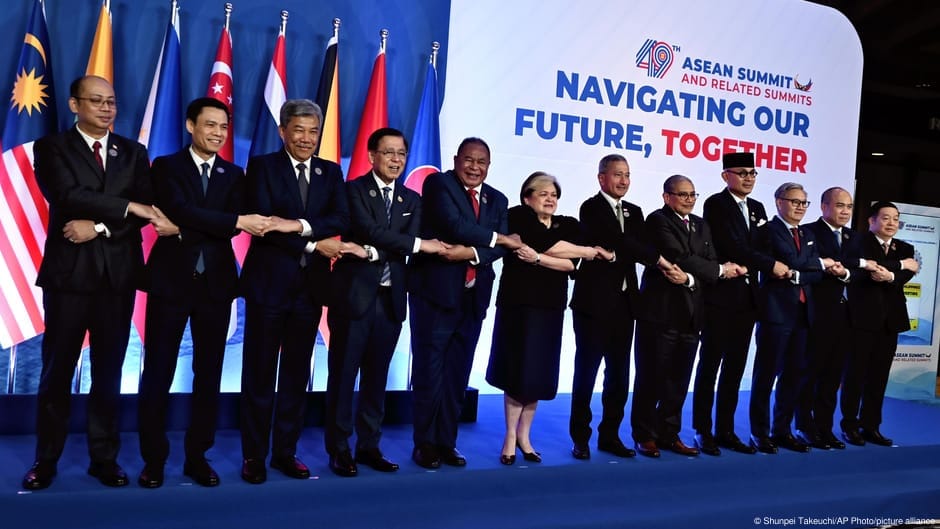
- A South China Sea Code of Conduct agreement at the Manila summit was unlikely, despite reported progress. On 16 November, Philippine Foreign Secretary Theresa Lazaro said ASEAN-China negotiations had reached 80 per cent; unnamed diplomats told AFP they expected no agreement at the summit. This indicates progress short of a concluded agreement, rather than a process that can confidently be described as simply stalled. (Confidence: medium · REPORTED)
- I&W: Confirm: an ASEAN or China official readout says negotiations continue without a signed Code of Conduct. (0-14 days)
- I&W: Break: ASEAN and China announce that a Code of Conduct was adopted at the Manila summit. (0-14 days)
- Australia and the Philippines signed a defence agreement in Manila on 15 November. The claim that maritime surveillance and deterrence are central to the pact rests on a social-media account, so the reported signature is better supported than the agreement’s specific operational scope. (Confidence: medium · REPORTED)
- I&W: Confirm the reported scope: Australia or the Philippines publishes agreement text or an official summary naming maritime surveillance or deterrence provisions. (0-30 days)
- I&W: Break the reported scope: the published text or an official clarification shows that maritime surveillance and deterrence are not covered. (0-30 days)
- The supplied reporting does not resolve Liaoning’s October route. Japan’s Joint Staff Office reported the carrier group sailing south past waters between Okinawa and Miyako Island on 14 October and heading towards the South China Sea on 15 October; another report says the group transited the Basilan Strait into the Western Pacific between 23 and 26 October. These accounts are consistent with separate legs of one deployment, but do not establish that interpretation or rule out a reporting discrepancy. (Confidence: low · ASSESSED)
- I&W: Confirm a single deployment: official, dated route information links the October movements past Japan, towards the South China Sea and through the Basilan Strait. (1-3 months)
- I&W: Confirm a reporting discrepancy or separate movements: Japan’s Joint Staff Office or Philippine authorities correct a reported date or route, or identify separate passages. (1-3 months)
- The supplied evidence is insufficient to treat China Coast Guard ramming of Philippine vessels in the South China Sea as a verified, specific recent incident. The ramming claim comes from a site whose full text was unavailable, so it was read only in summary; the other supporting accounts are social-media posts without incident dates or locations. Confidence is low because the reporting is thin and lacks independently corroborated incident details. (Confidence: low · ASSESSED)
- I&W: Break the assessment of insufficient evidence: the Philippine Coast Guard publishes an incident record naming the date, location, vessels and damage, with independent reporting that corroborates it. (0-14 days)
- I&W: Confirm the reporting remains weak: the original publisher provides no incident-specific details or corrects its ramming claim. (0-14 days)
Outlook & scenarios
Talks continue without a completed Code of Conduct (60%)
Over the next 1-3 months, ASEAN and China continue negotiations but do not announce a completed Code of Conduct. The 80 per cent progress estimate and diplomats’ expectation of no Manila agreement fit this path.
Diplomatic progress accelerates (30%)
Over the next 1-3 months, ASEAN and China announce a further negotiating milestone or a completed agreement. Lazaro’s progress estimate supports this as a credible outcome, although the supplied reporting does not identify a completion timetable.
A maritime encounter raises bilateral tensions (10%)
A verified encounter between China Coast Guard vessels and Philippine vessels prompts a public diplomatic response from Manila and Beijing. This is a low-probability, high-impact wildcard: the current ramming reporting is too thin to establish that such an incident has occurred.
Recommendations
- Track ASEAN and Chinese official readouts for whether the Code of Conduct has been signed, what negotiating milestone follows the 80 per cent estimate, and whether a further round is scheduled.
- Obtain the Australia-Philippines defence agreement text or an official summary before assessing changes to maritime surveillance or deterrence arrangements.
- Reconcile the Liaoning route against dated reporting from Japan’s Joint Staff Office and Philippine authorities. Treat the October movements as historical reporting, not evidence of a current deployment.
- Require incident-specific Philippine or Chinese official information, or independently corroborated reporting, before treating the China Coast Guard ramming allegation as established.
Confidence & uncertainty
Overall confidence is medium. Major-media reporting supports Lazaro’s statement on Code of Conduct progress and the reported Australia-Philippines agreement, but the summit account includes unnamed diplomatic sources and does not provide an agreed text. The Liaoning reports give different October route details that the supplied material does not reconcile. The ramming allegation is particularly weak: one source was available only as a lede, and the other accounts are social-media posts without dates or locations.
Intelligence gaps
- [EEI 1.1 · PARTIAL] Number, class, and position (time-stamped) of Chinese Coast Guard (CCG), People’s Armed Forces Maritime Militia (PAFMM), and other PRC paramilitary/auxiliary vessels inside Philippine-claimed EEZ or within 12 nautical miles of Philippine-occupied features (e.g., Scarborough Shoal, Second Thomas/Ayungin Shoal, and other named features). Recommended collection: maritime/AIS
- [EEI 1.2 · PARTIAL] Observed maneuvers or posture indicating hostile action: vessel-to-vessel blocking/contact, use of water cannons, boarding attempts, formation maneuvers to interdict Philippine vessels, or sustained stationing near Philippine resupply/relief routes. Recommended collection: imagery/satellite
- [EEI 1.3 · PARTIAL] Incidents of Philippine vessels (coast guard, navy, supply boats, civilian fishing vessels) being ordered to alter course, detained, chased, or physically impeded, with time, location, involved units, and damage/injuries if any. Recommended collection: open-source/official statements
- [EEI 1.4 · UNCOVERED] Abrupt changes to vessel identification behavior: AIS transponder deactivations, spoofing, or mismatches between flagged identity and observed equipment/markings among PRC maritime law-enforcement or militia vessels operating near Philippine claims. Recommended collection: maritime/AIS
- [EEI 2.1 · PARTIAL] Issued directives, patrol orders, or internal guidance from PRC Central Military Commission, PLAN, CCG, or provincial maritime authorities that specify objectives, geographic limits, patrol tempos, or escalation thresholds for operations near Philippine-claimed features. Recommended collection: signals/communications
- [EEI 2.2 · UNCOVERED] Public declarations, maritime notices, or newly published 'maritime safety' or exclusion zones, with effective dates and coordinates, issued by Chinese authorities that could be used to justify interdiction or exclusion of Philippine activity. Recommended collection: open-source/official statements
- [EEI 2.3 · UNCOVERED] Evidence of mobilization orders, tasking lists, or logistics planning for Maritime Militia units (vessel requisitions, local fisheries bureau instructions, fuel/resupply manifests) indicating intent to employ militia alongside CCG/PLAN assets. Recommended collection: HUMINT/defense
- [EEI 3.1 · PARTIAL] Deployment and movement of Philippine Coast Guard and Navy vessels (class, location, on-station times) and scheduled or unscheduled escort/resupply missions to occupied features. Recommended collection: military/AIS
- [EEI 3.2 · UNCOVERED] Air component activity: number and frequency of Philippine air patrol sorties, maritime domain awareness flights, and air-to-surface or maritime strike assets placed on alert or redeployed toward contested areas. Recommended collection: imagery/satellite
- [EEI 3.3 · PARTIAL] Requests for diplomatic, intelligence, or military assistance from allies (e.g., US, Australia, Japan) including notifications of planned joint patrols, port calls, or freedom of navigation operations with dates and participating units. Recommended collection: open-source/official statements
- [EEI 3.4 · UNCOVERED] Changes to Philippine rules of engagement, emergency law measures, mobilization orders, or civil advisories (evacuations, fishing bans) that alter civilian or military behavior in contested maritime zones. Recommended collection: open-source/official statements
Red cell review: CONCUR
TLP:CLEAR