TLP:CLEAR · Disclosure is not limited.
South China Sea: Maritime Encounters and Diplomatic Signals
Time window: Last 7 days · Audience: General analyst · Type: Situation report · DTG: 2026-10-26 14:21Z · Overall confidence: MEDIUM
BLUF
The immediate risk is continued close encounters involving Chinese and Philippine vessels, not a confirmed shift to broader armed conflict. The 20 October USS Charleston episode and Taiwan’s report of a Chinese Coast Guard vessel near the Pratas Islands show competing maritime claims being enforced; the reported Philippines-China roadmap has not yet shown an operational effect.
Executive summary
China’s Southern Theatre Command said it tracked the USS Charleston near Sabina Shoal on 20 October. The US Navy 7th Fleet said the ship conducted routine operations in international waters, while a Philippine military spokesperson rejected China’s claim that prior permission was required. Separately, Taiwan’s Coast Guard reported that a Chinese Coast Guard ship entered restricted waters near the Pratas Islands and said it sent the Taichung to warn the vessel away. Reporting also describes September confrontations involving Philippine resupply vessels near Second Thomas Shoal. Manila reportedly summoned Chinese Ambassador Jing Quan, while President Ferdinand Marcos Jr. was reported not inclined to expel him. Exact vessel tracks, the accounts of resupply operations and the implementation of the reported roadmap remain unsettled.
Change from previous assessment
Since the prior brief, a US Navy 7th Fleet statement and a Philippine military comment add corroboration that the USS Charleston conducted operations in the South China Sea, but they do not establish its precise track near Sabina Shoal or independently confirm Chinese tracking. The reported Chinese Coast Guard encounter with Taiwan’s Coast Guard near the Pratas Islands is a newly captured development. The outlook for further close encounters and the assessment that the reported roadmap has not yet demonstrated operational effect remain unchanged. The baton-strike allegation remains unverified.
Key judgments
- The USS Charleston likely conducted operations in the South China Sea on 20 October, but its exact track near Sabina Shoal and the claimed Chinese tracking operation are not independently established. China’s Southern Theatre Command described the ship as entering waters near the shoal without approval; the US Navy 7th Fleet said it was operating in international waters, and a Philippine military spokesperson supported the US position. The legal status of the waters remains disputed. (Confidence: medium · ASSESSED)
- I&W: A US Navy 7th Fleet statement or other verifiable position record places USS Charleston near Sabina Shoal on 20 October, confirming the reported location. (0-14 days)
- I&W: A US Navy clarification or verifiable position record places USS Charleston outside the waters near Sabina Shoal, breaking the reported location claim. (0-14 days)
- Taiwan’s Coast Guard likely experienced a close encounter with a Chinese Coast Guard ship near the Pratas Islands on 20 October: it reported entry into restricted waters, said it sent the Taichung to warn the vessel away, and described broadcasts between the ships. The restricted-water entry rests on Taiwan’s account as carried in major-media reporting, so confidence in that detail is low. (Confidence: low · ASSESSED)
- I&W: Taiwan’s Coast Guard releases a dated log or footage identifying the Chinese vessel and showing its position relative to the Pratas restricted waters. (0-14 days)
- I&W: Taiwan’s Coast Guard corrects or withdraws its report of entry into restricted waters near the Pratas Islands. (0-14 days)
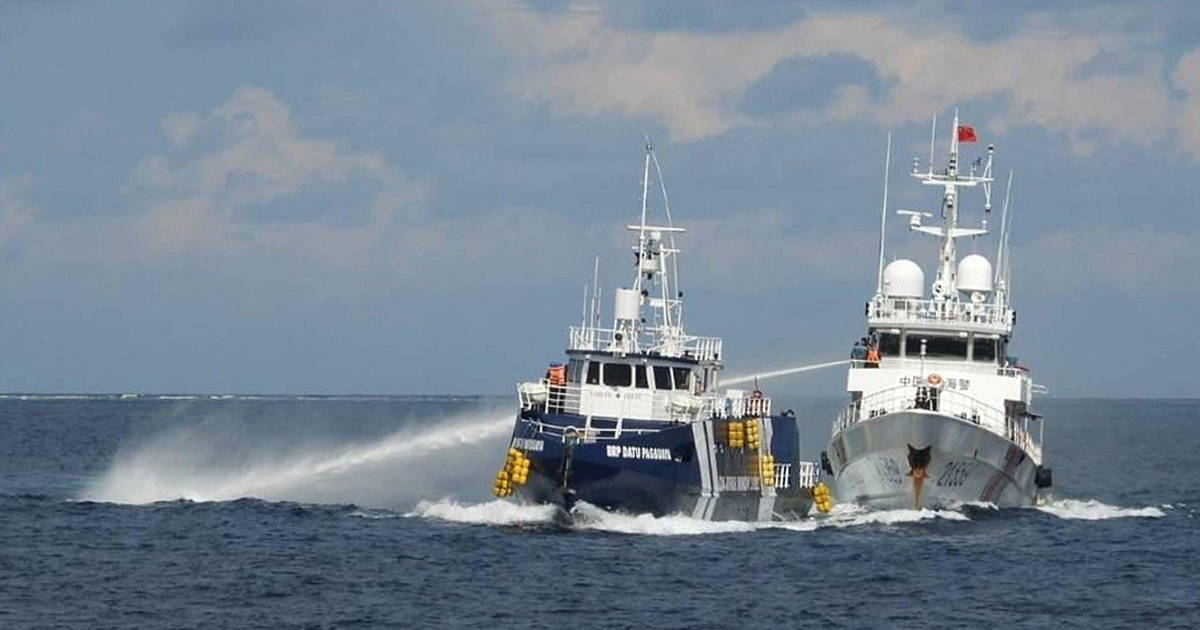
- There is a roughly even chance of another close-range encounter involving Chinese and Philippine vessels near Sabina Shoal or Second Thomas Shoal within 1-3 months. Philippine Coast Guard reporting says a China Coast Guard vessel rammed a Philippine boat near Sabina Shoal, while think-tank reporting describes an interception of Philippine resupply vessels on 24 September and China Coast Guard, maritime militia and warship activity near Second Thomas Shoal. China blamed the Philippine side for the Sabina collision, and the accounts of a Wednesday resupply delivery at Ren’ai Jiao conflict over whether China approved it. The underlying incident details are not independently corroborated here. (Confidence: low · ASSESSED)
- I&W: A Philippine resupply mission to Second Thomas Shoal or Sabina Shoal is intercepted by China Coast Guard vessels, or either coast guard reports a new collision. (1-3 months)
- I&W: Two consecutive Philippine resupply missions reach BRP Sierra Madre without a reported China Coast Guard interception or collision. (1-3 months)
- Manila is likely to keep Jing Quan in post in the near term, while the reported Philippines-China roadmap remains preliminary rather than evidence that direct military-to-military channels have resumed. Local-media reporting says Malacañang summoned Jing Quan and Marcos Jr. was not inclined to expel him, despite Senator Kiko Pangilinan urging his return. The same reporting describes a preliminary roadmap and says Gilberto Teodoro Jr. suspended direct military-to-military channels nearly three years earlier. These details are not independently corroborated in the supplied reporting. (Confidence: low · ASSESSED)
- I&W: Manila announces Jing Quan’s expulsion or declares him persona non grata, breaking the assessment that he will remain in post. (0-3 months)
- I&W: Manila and Beijing publish dated roadmap steps and announce a meeting through restored direct military-to-military channels. (1-3 months)
- The allegation that Chinese personnel struck a Filipino sailor with a baton remains unverified. The supplied think-tank account gives no incident date or identified Chinese unit and has no corroborating account in the reporting provided. (Confidence: low · REPORTED)
- I&W: A dated account identifies the location and Chinese unit, with a separate Philippine official or eyewitness account corroborating the alleged baton strike. (0-30 days)
- I&W: The original reporting is corrected or withdrawn, or Philippine authorities state that the alleged strike did not occur. (0-30 days)
Outlook & scenarios
Managed maritime friction continues (55%)
Close encounters and competing public claims are likely to continue around Sabina Shoal, Second Thomas Shoal and the Pratas Islands. Philippine resupply activity and Chinese Coast Guard operations remain the main settings for incidents; the reported roadmap remains preliminary.
A limited diplomatic track reduces operational risk (30%)
This is unlikely but plausible if Manila and Beijing publish roadmap steps and resume direct military-to-military contacts. Such steps would provide observable evidence that the reported preliminary consensus has become an operating channel.
A collision worsens the Philippines-China dispute (10%)
An encounter during a Philippine resupply mission is unlikely to cause a collision that injures personnel, but it would probably intensify public accusations and increase pressure on Manila and Beijing to respond.
High-impact confrontation involving US and Chinese forces (5%)
A collision or dangerous close approach involving a Philippine vessel is very unlikely to develop into a sustained face-off between US and Chinese forces near Sabina Shoal. The 20 October USS Charleston episode shows that US naval operations and Chinese claims are already part of the local dispute, but the supplied reporting does not establish an escalation beyond competing statements and monitoring claims.
Recommendations
- Seek a more precise US Navy 7th Fleet account of USS Charleston’s position and activity on 20 October, then compare it with the Southern Theatre Command account. Keep the competing legal claims separate from the vessel-track question.
- Track Taiwan Coast Guard reporting on the Pratas encounter, including any dated vessel log, identification of the Chinese ship or clarification of the restricted-water claim.
- For the next Philippine resupply missions, record vessel identities, timing, China Coast Guard presence, any maritime militia or warship support, and reports of interception or contact. Compare Philippine accounts with Chinese Coast Guard statements and any released video.
- Test the reported roadmap against observable steps: a published document, dates for implementation meetings, and an announced resumption of direct military-to-military channels.
- Do not use the baton-strike allegation as an established incident unless a dated account identifies the location and unit and receives independent corroboration.
Confidence & uncertainty
Major-media reporting carries statements from the US Navy, China’s Southern Theatre Command and Philippine officials, giving moderate support to the general account of the USS Charleston episode but not independently establishing its exact track. The Pratas encounter, September resupply incidents and roadmap details rely on attributed official statements, local-media or think-tank reporting, and in some cases social-media material. Responsibility for the Sabina collision and the permission status of a reported resupply delivery remain contested.
Alternative analysis (red cell)
The supplied evidence indicates persistent China-Philippines maritime friction, but it does not support assigning an approximately even chance to a new close-range encounter within the next 1-3 months. The cited reports are retrospective, contested, and partly sourced to official or state-linked accounts, while the contradictions among claims, and 3ce55f6b-cf2f-42de-8c75-0250b45f40d8 undermine confidence in the operational picture. A recurrence risk is defensible, but its magnitude and timing remain indeterminate.
Intelligence gaps
- [EEI 1.4 · UNCOVERED] Abrupt changes to vessel identification behavior: AIS transponder deactivations, spoofing, or mismatches between flagged identity and observed equipment/markings among PRC maritime law-enforcement or militia vessels operating near Philippine claims. Recommended collection: maritime/AIS
- [EEI 2.1 · UNCOVERED] Issued directives, patrol orders, or internal guidance from PRC Central Military Commission, PLAN, CCG, or provincial maritime authorities that specify objectives, geographic limits, patrol tempos, or escalation thresholds for operations near Philippine-claimed features. Recommended collection: signals/communications
- [EEI 2.2 · PARTIAL] Public declarations, maritime notices, or newly published 'maritime safety' or exclusion zones, with effective dates and coordinates, issued by Chinese authorities that could be used to justify interdiction or exclusion of Philippine activity. Recommended collection: open-source/official statements
- [EEI 2.3 · PARTIAL] Evidence of mobilization orders, tasking lists, or logistics planning for Maritime Militia units (vessel requisitions, local fisheries bureau instructions, fuel/resupply manifests) indicating intent to employ militia alongside CCG/PLAN assets. Recommended collection: HUMINT/defense
- [EEI 3.1 · PARTIAL] Deployment and movement of Philippine Coast Guard and Navy vessels (class, location, on-station times) and scheduled or unscheduled escort/resupply missions to occupied features. Recommended collection: military/AIS
- [EEI 3.2 · UNCOVERED] Air component activity: number and frequency of Philippine air patrol sorties, maritime domain awareness flights, and air-to-surface or maritime strike assets placed on alert or redeployed toward contested areas. Recommended collection: imagery/satellite
- [EEI 3.3 · UNCOVERED] Requests for diplomatic, intelligence, or military assistance from allies (e.g., US, Australia, Japan) including notifications of planned joint patrols, port calls, or freedom of navigation operations with dates and participating units. Recommended collection: open-source/official statements
- [EEI 3.4 · UNCOVERED] Changes to Philippine rules of engagement, emergency law measures, mobilization orders, or civil advisories (evacuations, fishing bans) that alter civilian or military behavior in contested maritime zones. Recommended collection: open-source/official statements
Red cell review: PARTIAL DISSENT
TLP:CLEAR