TLP:CLEAR · Disclosure is not limited.
South China Sea: No New Operational Reporting, Persistent Maritime Risk
Time window: Last 7 days · Audience: General analyst · Type: Situation report · DTG: 2026-11-09 11:21Z · Overall confidence: LOW
BLUF
The supplied reporting for 2-9 November adds diplomatic messaging, not a new documented China-Philippines maritime encounter. Coercive contact is likely to remain a risk, while a deliberate armed clash is unlikely over the next 14 days; confidence is low because recent operational reporting is absent and the incident accounts available here are thin.
Executive summary
The seventh Symposium on Global Maritime Cooperation and Ocean Governance took place in Sanya from 6 to 8 November, drawing around 400 representatives from more than 30 countries and regions. The Huayang Center released its Global Maritime Security Report 2025-2026 at the symposium. CGTN reported that Huayang Center chairman Wu Shicun described China-ASEAN consultations on a South China Sea Code of Conduct as continuing, while characterising the sea as generally stable and manageable and acknowledging persistent security risks. Other supplied reporting concerns a Chinese cutter reportedly ramming a Philippine fisheries vessel on 18 September, a China Coast Guard interception of a Philippine resupply mission on 24 September, and competing Chinese and Philippine positions on a Philippine maritime map. The current reporting window contains no new dated account of a maritime encounter. This does not establish that patrol activity has stopped or changed.
Change from previous assessment
Since the prior brief, this update adds no new patrol count or documented maritime encounter. It adds reporting on the 6-8 November Sanya symposium and on competing positions over the Philippine maritime map. The prior assessment of continued patrol activity is not confirmed or overturned by this material, and the identity and function of the orange sensor-equipped object remain unresolved.
Key judgments
- The Sanya symposium presented China's view that South China Sea tensions remain manageable while dialogue and Code of Conduct consultations continue. Wu Shicun also acknowledged persistent maritime risks. These are reported statements, not independent evidence that tensions are easing. Confidence is medium: CGTN reports the event and remarks, but the material comes from one outlet and includes a perspective associated with the Huayang Center. (Confidence: medium · REPORTED)
- I&W: China and ASEAN publish a dated Code of Conduct consultation milestone, confirming that consultations continue. (1-3 months)
- I&W: Wu Shicun or a Chinese Foreign Ministry spokesperson publicly states that Code of Conduct consultations have halted, breaking the reported account of continuing dialogue. (1-3 months)
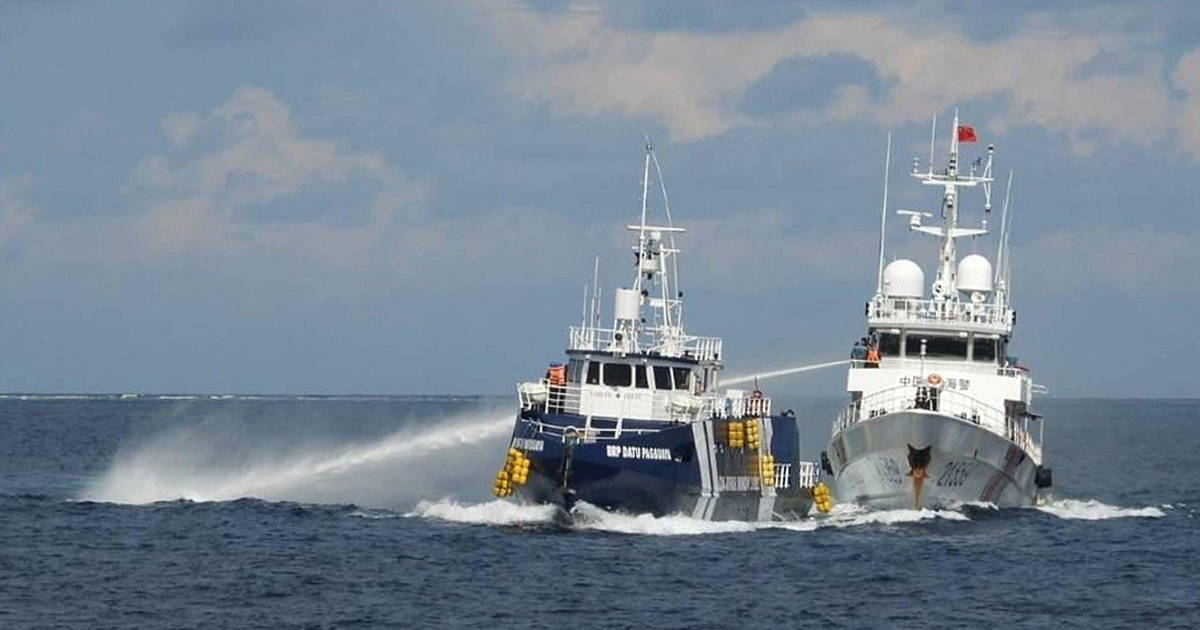
- Coercive maritime contact is likely to remain a risk, but a deliberate armed clash between Chinese and Philippine forces over the next 14 days is unlikely. The supplied accounts describe a Chinese cutter ramming a Philippine fisheries vessel on 18 September and China Coast Guard patrol ships intercepting a Philippine resupply mission bound for Second Thomas Shoal on 24 September. This is an assessment based on older, thin reporting from a think tank, with no new encounter reported in the current window; confidence is low. (Confidence: low · ASSESSED)
- I&W: A Philippine Coast Guard or China Coast Guard release, supported by dated imagery, reports a collision, water-cannon use or interception involving a Philippine vessel near Scarborough Shoal or Second Thomas Shoal. (0-14 days)
- I&W: A Philippine resupply run to Second Thomas Shoal is publicly reported to complete without China Coast Guard interception, weakening the assessment of near-term coercive contact. (0-14 days)
- The legal status of the Philippine maritime map remains contested in the supplied reporting: the Philippine National Maritime Council included Huangyan Island, Zhongye Island and Mahuan Island within Philippine maritime areas, while Chinese Foreign Ministry spokesperson Guo Jiakun called the map unlawful and invalid. The opposing statements establish a dispute over the map, not its legal status. Confidence is low because the account comes from a single low-reliability blog and does not independently verify either government's position. (Confidence: low · REPORTED)
- I&W: The Philippine National Maritime Council issues a revised map that removes or changes the treatment of Huangyan Island, Zhongye Island or Mahuan Island, weakening the reported dispute over the current map. (1-3 months)
- I&W: Guo Jiakun or another named Chinese Foreign Ministry spokesperson issues a further public rejection of the Philippine map, confirming that the dispute remains active. (1-3 months)
Outlook & scenarios
Managed competition continues (65%)
Over the next 14 days, China and the Philippines maintain competing maritime positions without a new reported encounter. Continued official emphasis on dialogue and stability is likely, while the available reporting does not establish a change in patrol activity.
Localised maritime coercion (30%)
Over the next 14 days, a China Coast Guard vessel again intercepts or obstructs a Philippine vessel near Scarborough Shoal or Second Thomas Shoal. Such an incident is likely to generate competing official accounts, as in the supplied reporting on the September resupply mission.
Armed clash following a dangerous encounter (5%)
A collision or other dangerous encounter leads to an exchange of fire between Chinese and Philippine forces. This outcome is unlikely, but it is a high-impact wildcard; the supplied reporting provides no evidence of attack preparations.
Recommendations
- Maintain a dated incident log for Scarborough Shoal and Second Thomas Shoal. Record the reporting source, named vessels, actions, location and time, and distinguish official statements from independently corroborated imagery.
- Do not assess a change in patrol tempo from this update alone. Seek fresh Philippine Coast Guard, China Coast Guard and PLA Southern Theater Command reporting before revising the operational picture.
- Treat statements from the Sanya symposium as attributed Chinese framing. Track dated China-ASEAN Code of Conduct milestones separately from evidence of maritime activity.
- Record Philippine and Chinese statements on the maritime map as opposing positions. Do not treat either government's legal characterisation as independently established by this reporting.
Confidence & uncertainty
Overall confidence is low because the current update contains no new dated operational encounter and the September incident accounts rely on thin think-tank reporting. The latest symposium material is reported by one outlet and includes statements from a China-focused institution; the map dispute is reported by a low-reliability blog. Some other potentially relevant items were available only as article ledes and do not support the key judgments.
Alternative analysis (red cell)
The supplied evidence supports a judgment that coercive maritime contact remains plausible, but it does not support the stronger estimate that a deliberate armed clash is unlikely over the next 14 days. Claims, and cc4362dc-8848-47ca-8571-2f3959937c56 show repeated hazardous interaction and concentrated forces. In the absence of current-window collection, the likelihood of escalation is indeterminate rather than demonstrably low.
Intelligence gaps
- [EEI 1.3 · PARTIAL] Incidents of Philippine vessels (coast guard, navy, supply boats, civilian fishing vessels) being ordered to alter course, detained, chased, or physically impeded, with time, location, involved units, and damage/injuries if any. Recommended collection: open-source/official statements
- [EEI 1.4 · UNCOVERED] Abrupt changes to vessel identification behavior: AIS transponder deactivations, spoofing, or mismatches between flagged identity and observed equipment/markings among PRC maritime law-enforcement or militia vessels operating near Philippine claims. Recommended collection: maritime/AIS
- [EEI 2.1 · UNCOVERED] Issued directives, patrol orders, or internal guidance from PRC Central Military Commission, PLAN, CCG, or provincial maritime authorities that specify objectives, geographic limits, patrol tempos, or escalation thresholds for operations near Philippine-claimed features. Recommended collection: signals/communications
- [EEI 2.2 · PARTIAL] Public declarations, maritime notices, or newly published 'maritime safety' or exclusion zones, with effective dates and coordinates, issued by Chinese authorities that could be used to justify interdiction or exclusion of Philippine activity. Recommended collection: open-source/official statements
- [EEI 2.3 · PARTIAL] Evidence of mobilization orders, tasking lists, or logistics planning for Maritime Militia units (vessel requisitions, local fisheries bureau instructions, fuel/resupply manifests) indicating intent to employ militia alongside CCG/PLAN assets. Recommended collection: HUMINT/defense
- [EEI 3.1 · PARTIAL] Deployment and movement of Philippine Coast Guard and Navy vessels (class, location, on-station times) and scheduled or unscheduled escort/resupply missions to occupied features. Recommended collection: military/AIS
- [EEI 3.2 · UNCOVERED] Air component activity: number and frequency of Philippine air patrol sorties, maritime domain awareness flights, and air-to-surface or maritime strike assets placed on alert or redeployed toward contested areas. Recommended collection: imagery/satellite
- [EEI 3.3 · PARTIAL] Requests for diplomatic, intelligence, or military assistance from allies (e.g., US, Australia, Japan) including notifications of planned joint patrols, port calls, or freedom of navigation operations with dates and participating units. Recommended collection: open-source/official statements
- [EEI 3.4 · UNCOVERED] Changes to Philippine rules of engagement, emergency law measures, mobilization orders, or civil advisories (evacuations, fishing bans) that alter civilian or military behavior in contested maritime zones. Recommended collection: open-source/official statements
Red cell review: PARTIAL DISSENT
TLP:CLEAR