TLP:CLEAR · Disclosure is not limited.
South China Sea: Second Thomas Shoal and US Marine Rotation
Time window: Last 7 days · Audience: General analyst · Type: Situation report · DTG: 2026-10-29 10:06Z · Overall confidence: MEDIUM
BLUF
China Coast Guard monitoring of a reported Philippine delivery to Second Thomas Shoal does not establish a durable easing of enforcement. There is a roughly even chance of another close encounter there within 1-3 months, while the second consecutive Philippines-focused US Marine rotation points to a continued US presence through spring 2027; the supplied reporting does not support predicting an armed exchange.
Executive summary
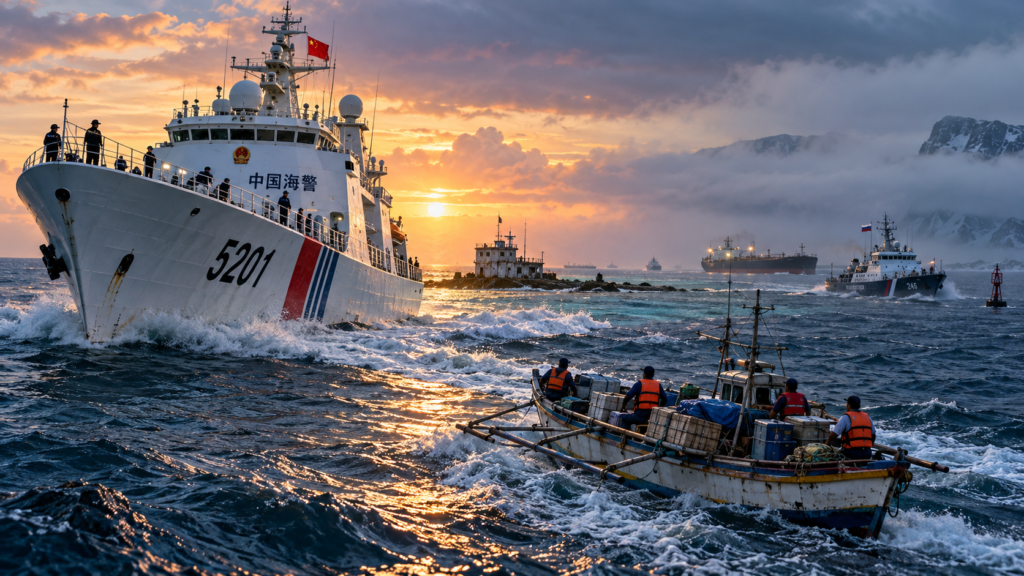
China's coast guard said it monitored a Philippine delivery of necessities to a vessel at Second Thomas Shoal. Manila had accused Beijing of obstructing a resupply mission about a month earlier, and a think-tank account says China Coast Guard cutters blocked resupply ships to the BRP Sierra Madre in September. The same account reports that Chinese personnel struck a Filipino sailor with a baton, but provides no date or more precise location for that incident. It also describes China Coast Guard Regulation No. 3 as permitting detention of foreign nationals suspected of border violations and ships in Chinese territorial waters; the supplied reporting does not establish that the regulation has been used against Philippine personnel or vessels in the South China Sea. Separately, a 29 October Stars and Stripes report described a second consecutive Marine Rotational Force-Southeast Asia rotation focused on the Philippines. Col. Coby Moran took over from Col. Robert Bunn at Clark Air Base on 26 October; the incoming force is slated to participate in spring 2027 Balikatan activities. The resupply and coercion reporting is less well corroborated than the Marine rotation reporting.
Change from previous assessment
Since the 28 October brief, the assessment on Second Thomas Shoal is unchanged: the reported monitored delivery does not establish durable easing. This brief adds the 29 October account of a second Philippines-focused Marine Rotational Force-Southeast Asia rotation and its planned spring Balikatan role, along with reporting on Regulation No. 3 and a baton strike on a Filipino sailor. These additions widen the range of reported enforcement risks but are not independently corroborated; no armed-exchange judgment has been added.
Key judgments
- There is a roughly even chance that China Coast Guard monitoring of a reported Philippine delivery of necessities to Second Thomas Shoal reflects episode-specific tolerance rather than durable easing of enforcement. The earlier Manila accusation and September blockade reporting weigh against treating the monitored delivery as a policy shift. The monitoring account is social-media sourced, and the claim that the provisional arrangement is fragile is uncorroborated. (Confidence: low · ASSESSED)
- I&W: China Coast Guard and Philippine authorities both report a subsequent delivery to the BRP Sierra Madre completed without obstruction. (0-30 days)
- I&W: A subsequent China Coast Guard or Philippine report describes blocking, boarding, detention, or physical contact during a resupply mission to the BRP Sierra Madre. (0-30 days)
- The US Marine Corps is likely to sustain a Philippines-focused rotational presence through spring 2027. The incoming Marine Rotational Force-Southeast Asia contingent from I Marine Expeditionary Force at Camp Pendleton replaced Marines already in the Philippines, and the incoming force is scheduled for spring Balikatan training. (Confidence: medium · ASSESSED)
- I&W: The Marine Corps confirms the incoming force's participation in spring 2027 Balikatan, including command-and-control or maritime-surveillance training. (1-6 months)
- I&W: The Marine Corps announces cancellation or deferral of the Philippines-focused rotation, or confirms the force will leave before spring Balikatan. (0-6 months)
- There is a roughly even chance of another close encounter involving Chinese and Philippine vessels near Second Thomas Shoal within 1-3 months, but the supplied reporting does not support forecasting an armed exchange. September blockade reporting, the more recent monitored delivery, and a reported baton strike point to recurring contact; the coercion accounts are thinly corroborated and partly social-media sourced. (Confidence: low · ASSESSED)
- I&W: Philippine or Chinese authorities report, or release imagery showing, a China Coast Guard vessel blocking or making physical contact with a Philippine resupply vessel near Second Thomas Shoal. (0-3 months)
- I&W: Two successive resupply missions to the BRP Sierra Madre are publicly reported by both sides as completed without interception, contact, or obstruction. (0-3 months)
- China Coast Guard Regulation No. 3 reportedly permits detention of foreign nationals suspected of border violations and ships in Chinese territorial waters. The supplied reporting does not establish that the regulation has been invoked against Philippine personnel or vessels in the South China Sea. (Confidence: low · REPORTED)
- I&W: Chinese authorities publish a detention notice citing Regulation No. 3 for a Filipino crew member or Philippine vessel in the South China Sea. (0-6 months)
- I&W: The China Coast Guard publicly states that Regulation No. 3 is not being applied to Philippine resupply activity at Second Thomas Shoal. (0-6 months)
Outlook & scenarios
Monitored resupply continues without durable easing (55%)
China Coast Guard monitoring remains the pattern around Philippine deliveries to Second Thomas Shoal, with no clear evidence of a lasting change in enforcement. The Marine Corps rotation proceeds towards spring Balikatan, while close contact remains possible.
Renewed obstruction at Second Thomas Shoal (30%)
China Coast Guard vessels again obstruct a Philippine resupply mission or engage in physical coercion near the BRP Sierra Madre. The reported September blockade and baton strike make this a credible alternative, but the available accounts do not indicate that an encounter would lead to an armed exchange.
Detention under Regulation No. 3, low-probability wildcard (5%)
Chinese authorities detain a Filipino crew member or Philippine vessel during a South China Sea encounter and cite Regulation No. 3. The reporting does not show prior use of the regulation against Philippine resupply activity, but such an action would sharply raise pressure around Second Thomas Shoal.
Recommendations
- Treat the monitored delivery as an episode, not evidence of a policy change. Reassess only after multiple subsequent resupply missions have independently corroborated outcomes.
- For reports of obstruction or physical violence, seek confirmation from Philippine and Chinese official statements and independently sourced imagery before treating the incident details as established.
- Track any Chinese detention notice that names a Filipino crew member or Philippine vessel and cites Regulation No. 3; distinguish an announced legal authority from evidence of its use in the South China Sea.
- Track Marine Corps announcements on the incoming I Marine Expeditionary Force contingent and its spring 2027 Balikatan participation. Describe the deployment as rotational, not as permanent basing.
Confidence & uncertainty
Overall confidence is medium. The Marine rotation, Clark Air Base turnover, and planned Balikatan participation are supported by a major-media report drawing on Marine Corps information. The Second Thomas Shoal monitoring account is social-media sourced, while the blockade, baton-strike, and Regulation No. 3 details rely on a think-tank account without independent corroboration in the supplied claims. The reporting does not establish whether enforcement policy has changed or whether detention powers have been used against Philippine personnel or vessels.
Intelligence gaps
- [EEI 1.1 · PARTIAL] Number, class, and position (time-stamped) of Chinese Coast Guard (CCG), People’s Armed Forces Maritime Militia (PAFMM), and other PRC paramilitary/auxiliary vessels inside Philippine-claimed EEZ or within 12 nautical miles of Philippine-occupied features (e.g., Scarborough Shoal, Second Thomas/Ayungin Shoal, and other named features). Recommended collection: maritime/AIS
- [EEI 1.4 · UNCOVERED] Abrupt changes to vessel identification behavior: AIS transponder deactivations, spoofing, or mismatches between flagged identity and observed equipment/markings among PRC maritime law-enforcement or militia vessels operating near Philippine claims. Recommended collection: maritime/AIS
- [EEI 2.1 · PARTIAL] Issued directives, patrol orders, or internal guidance from PRC Central Military Commission, PLAN, CCG, or provincial maritime authorities that specify objectives, geographic limits, patrol tempos, or escalation thresholds for operations near Philippine-claimed features. Recommended collection: signals/communications
- [EEI 2.2 · UNCOVERED] Public declarations, maritime notices, or newly published 'maritime safety' or exclusion zones, with effective dates and coordinates, issued by Chinese authorities that could be used to justify interdiction or exclusion of Philippine activity. Recommended collection: open-source/official statements
- [EEI 2.3 · UNCOVERED] Evidence of mobilization orders, tasking lists, or logistics planning for Maritime Militia units (vessel requisitions, local fisheries bureau instructions, fuel/resupply manifests) indicating intent to employ militia alongside CCG/PLAN assets. Recommended collection: HUMINT/defense
- [EEI 3.1 · PARTIAL] Deployment and movement of Philippine Coast Guard and Navy vessels (class, location, on-station times) and scheduled or unscheduled escort/resupply missions to occupied features. Recommended collection: military/AIS
- [EEI 3.2 · UNCOVERED] Air component activity: number and frequency of Philippine air patrol sorties, maritime domain awareness flights, and air-to-surface or maritime strike assets placed on alert or redeployed toward contested areas. Recommended collection: imagery/satellite
- [EEI 3.3 · PARTIAL] Requests for diplomatic, intelligence, or military assistance from allies (e.g., US, Australia, Japan) including notifications of planned joint patrols, port calls, or freedom of navigation operations with dates and participating units. Recommended collection: open-source/official statements
- [EEI 3.4 · UNCOVERED] Changes to Philippine rules of engagement, emergency law measures, mobilization orders, or civil advisories (evacuations, fishing bans) that alter civilian or military behavior in contested maritime zones. Recommended collection: open-source/official statements
Red cell review: CONCUR
TLP:CLEAR