TLP:CLEAR · Disclosure is not limited.
South China Sea Situation Report: 25 October to 1 November 2026
Time window: Last 7 days · Audience: General analyst · Type: Situation report · DTG: 2026-11-01 10:07Z · Overall confidence: HIGH
BLUF
Chinese reporting says a Philippine C-208 was warned away from Scarborough Shoal on 30 October, alongside announced PLA and China Coast Guard patrols. China Coast Guard drills near Second Thomas and Sabina Shoals, and a Philippines-US-Australia-New Zealand patrol, add to the risk of coercive contact; the reporting does not establish preparations for an armed attack.
Executive summary
The latest reporting describes Chinese patrol activity around Scarborough Shoal and China Coast Guard drills practising interceptions, boarding and water cannon use near Second Thomas and Sabina Shoals. Chinese reporting also says a Philippine C-208 was warned away from Scarborough Shoal. The Philippines, US, Australia and New Zealand reportedly conducted a joint patrol in the South China Sea around 30 October. These developments point to continued pressure and close-contact risk, but details of the Scarborough activity remain unverified and accounts differ on whether the patrol took place on 30 or 31 October. China's account of approval and supervision for a 21 October resupply mission also does not resolve the dispute over authority at Second Thomas Shoal.
Change from previous assessment
The prior brief already recorded the announced Scarborough patrol and China Coast Guard drills. This update adds the Chinese account of a 30 October warning to a Philippine C-208, a reported Philippines-US-Australia-New Zealand patrol around the same date, and the China Coast Guard's account of approval and supervision for the 21 October resupply. The assessment remains that close contact is the more immediate concern than a deliberate attack; confidence remains low because the Scarborough reporting is Chinese-led and the patrol date is inconsistent.
Key judgments
- Chinese reporting says the PLA Southern Theater Command and China Coast Guard conducted patrols around Scarborough Shoal, and that Chinese military aircraft warned a Philippine C-208 to leave on 30 October. The reporting presents the patrol as a response to Philippine actions, but does not independently verify the movements or the warning. Claims date the patrol to 30 and 31 October, leaving the exact date unresolved. (Confidence: low · REPORTED)
- I&W: A Philippine military statement or independently corroborated flight record confirms the C-208 route and the radio warning over Scarborough Shoal. (0-14 days)
- I&W: A Philippine statement or released flight information disputes the reported route or warning, or places the aircraft elsewhere. (0-14 days)
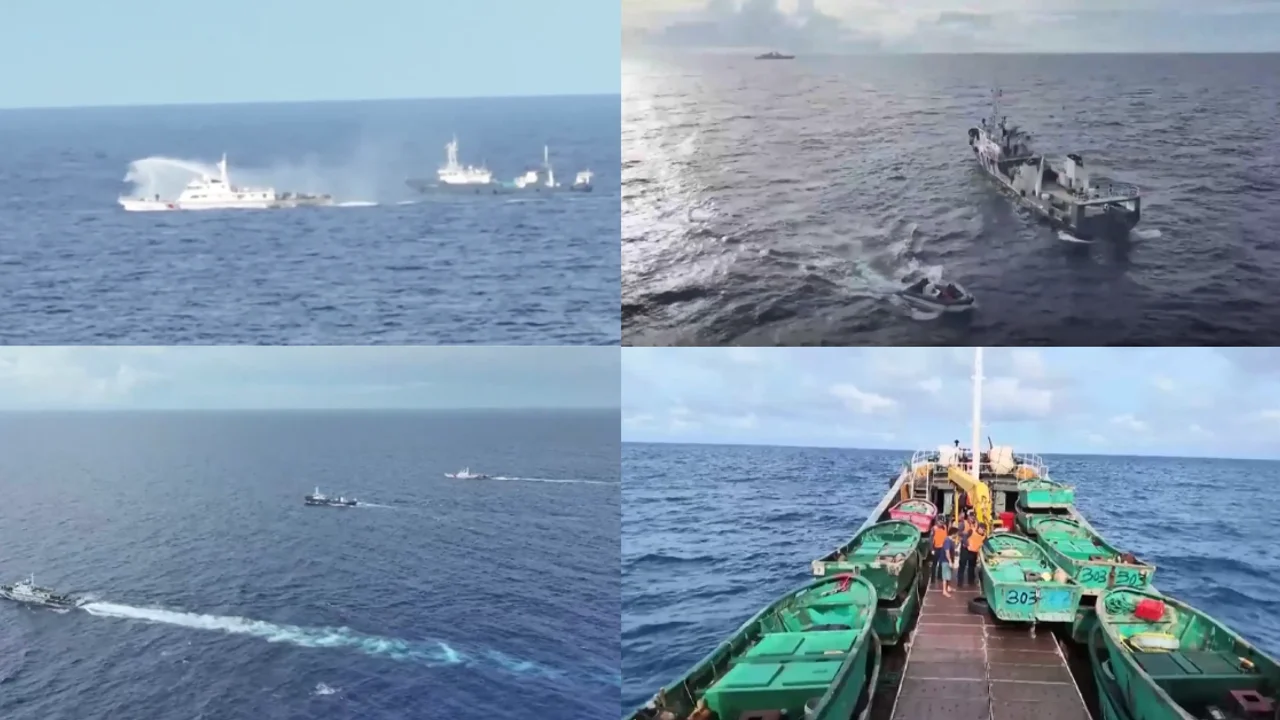
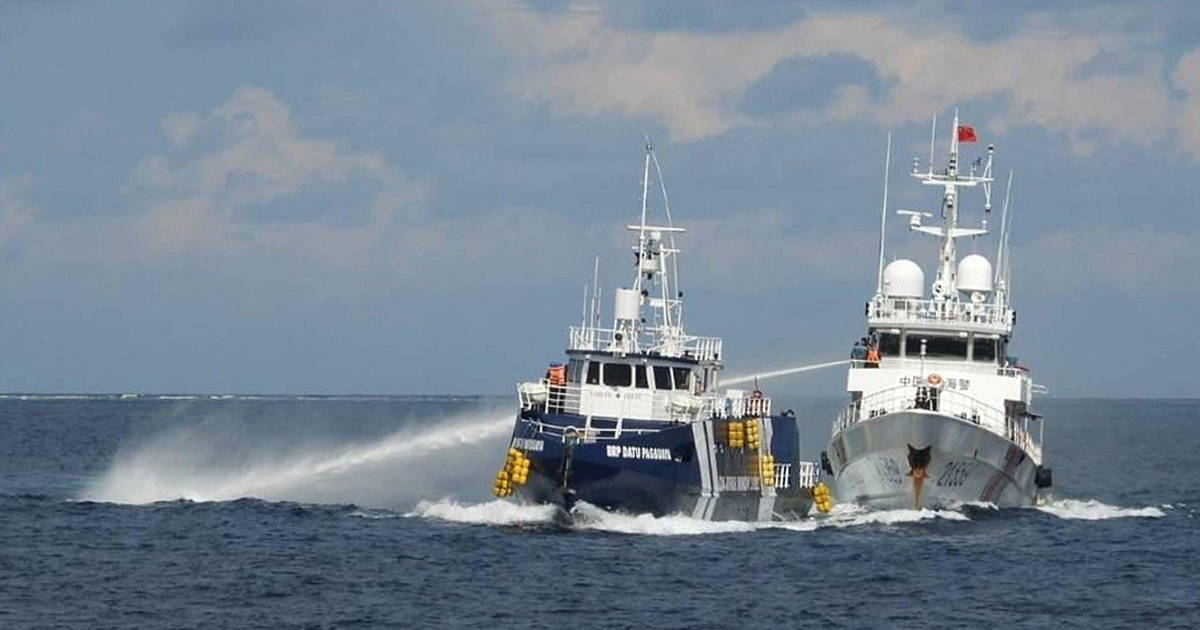
- The China Coast Guard likely has rehearsed interception, boarding and water cannon procedures near Second Thomas and Sabina Shoals. Reporting describes drills and footage of ships in formation, patrol boats and drone monitoring, but does not show those tactics being used against a Philippine vessel. Confidence is low because the operational detail rests mainly on media accounts of Chinese-released footage, without independent verification. (Confidence: low · ASSESSED)
- I&W: A Philippine or China Coast Guard account, supported by released imagery, describes an interception, boarding or water cannon use near Second Thomas or Sabina Shoal. (0-14 days)
- I&W: Over the next three months, public accounts of China Coast Guard operations near either shoal report neither repeat drills nor use of the practised tactics. (1-3 months)
- An unsafe close-contact encounter is likely to remain the more immediate concern than a deliberate armed attack in the next 14 days; a deliberate armed attack is unlikely on the reporting available. The assessment rests on reported patrols, a warning to a Philippine aircraft, China Coast Guard drills and a multilateral patrol, not evidence of an order to attack. Confidence is low because much of the Scarborough account comes from Chinese reporting and the current record does not establish intent. (Confidence: low · ASSESSED)
- I&W: A Philippine or Chinese report, corroborated by imagery or another account, records a collision, injury, boarding, water cannon use or close manoeuvre involving Chinese and Philippine forces near the named shoals. (0-14 days)
- I&W: No further aircraft warnings or close vessel encounters are reported, and public accounts show patrol activity around Scarborough, Second Thomas and Sabina Shoals subsiding. (0-14 days)
- The reporting does not resolve Beijing and Manila's competing positions on authority over resupply at Second Thomas Shoal. The China Coast Guard said Philippine supply ships passed after Chinese approval and were subject to inquiries and supervision; a separate Global Times account said a Philippine mission was illegal because it lacked prior approval. The available reporting does not establish whether both accounts concern the same mission. Confidence is low because the accounts are attributed and the second relies on an unnamed source. (Confidence: low · REPORTED)
- I&W: The Philippine Armed Forces or Philippine Coast Guard publicly addresses whether it accepted Chinese approval or supervision for the 21 October resupply. (0-14 days)
- I&W: China Coast Guard and Philippine authorities publish accounts that identify the same resupply mission and agree on its approval and handling. (0-14 days)
Outlook & scenarios
Continued managed pressure (60%)
The PLA Southern Theater Command and China Coast Guard continue patrols around Scarborough Shoal, while China Coast Guard activity near Second Thomas and Sabina Shoals remains at the level of drills, monitoring and controlled encounters. The Philippines and its partners continue joint patrol activity. No collision or armed exchange occurs.
Close-contact incident (35%)
A Chinese interception near Second Thomas or Sabina Shoal, or another warning to a Philippine aircraft near Scarborough Shoal, results in a collision, injury, boarding or water cannon use. China and the Philippines issue competing accounts, increasing pressure on both governments without an immediate armed exchange.
Attempted removal of the Sierra Madre (5%)
A Chinese attempt to tow the BRP Sierra Madre from Second Thomas Shoal creates an acute escalation crisis. Philippine Defence Secretary Teodoro has described towing the ship as an act of war, while clarifying that this would not automatically trigger war and that the President decides whether to invoke the US-Philippines Mutual Defense Treaty.
Recommendations
- Separate reported announcements from verified activity in the daily event record. Track the 30 versus 31 October date discrepancy and seek corroboration of the reported C-208 warning before treating the aircraft encounter as independently confirmed.
- Monitor China Coast Guard and Philippine reports for specific activity at Second Thomas and Sabina Shoals, recording any interception, boarding, water cannon use, collision or injury separately from exercise footage.
- Treat the China Coast Guard's account of approval and supervision for the 21 October resupply as Beijing's position. Check for a Philippine Armed Forces or Coast Guard response and establish whether the Global Times account concerns the same mission before drawing conclusions about a direct contradiction.
- Maintain a 14-day watch for close encounters around Scarborough Shoal, Second Thomas Shoal and Sabina Shoal. Flag any reported attempt to tow the BRP Sierra Madre for immediate reassessment of escalation risk.
Confidence & uncertainty
Overall confidence is high for the broad picture that Chinese authorities publicly announced patrol and training activity, and that Philippine and partner patrol activity was reported during the period. Multiple reports support the existence of the announcements and drill coverage, although some repeat official Chinese accounts rather than independently verifying events. Confidence is lower in the precise conduct and intent: reporting differs by one day on the Scarborough patrol date, the C-208 account is Chinese-led, and the resupply accounts do not establish whether they concern the same mission. The high headline confidence applies to the broad activity picture, not to every operational detail.
Alternative analysis (red cell)
The evidence more securely supports continued coercive signaling and elevated encounter risk than a specific forecast that an unsafe close-contact incident will be the most immediate concern. Claims 01e3c0d3-b4de-4300-8af1-60b1904da04b and 63a60a48-b0a7-4f39-918a-9e42b446c9ad indicate prior warnings and expulsions, but the record does not establish a near-term operational pattern sufficient to rank unsafe contact over other possible outcomes.
Intelligence gaps
- [EEI 1.1 · PARTIAL] Number, class, and position (time-stamped) of Chinese Coast Guard (CCG), People’s Armed Forces Maritime Militia (PAFMM), and other PRC paramilitary/auxiliary vessels inside Philippine-claimed EEZ or within 12 nautical miles of Philippine-occupied features (e.g., Scarborough Shoal, Second Thomas/Ayungin Shoal, and other named features). Recommended collection: maritime/AIS
- [EEI 1.4 · UNCOVERED] Abrupt changes to vessel identification behavior: AIS transponder deactivations, spoofing, or mismatches between flagged identity and observed equipment/markings among PRC maritime law-enforcement or militia vessels operating near Philippine claims. Recommended collection: maritime/AIS
- [EEI 2.1 · PARTIAL] Issued directives, patrol orders, or internal guidance from PRC Central Military Commission, PLAN, CCG, or provincial maritime authorities that specify objectives, geographic limits, patrol tempos, or escalation thresholds for operations near Philippine-claimed features. Recommended collection: signals/communications
- [EEI 2.2 · PARTIAL] Public declarations, maritime notices, or newly published 'maritime safety' or exclusion zones, with effective dates and coordinates, issued by Chinese authorities that could be used to justify interdiction or exclusion of Philippine activity. Recommended collection: open-source/official statements
- [EEI 2.3 · UNCOVERED] Evidence of mobilization orders, tasking lists, or logistics planning for Maritime Militia units (vessel requisitions, local fisheries bureau instructions, fuel/resupply manifests) indicating intent to employ militia alongside CCG/PLAN assets. Recommended collection: HUMINT/defense
- [EEI 3.1 · PARTIAL] Deployment and movement of Philippine Coast Guard and Navy vessels (class, location, on-station times) and scheduled or unscheduled escort/resupply missions to occupied features. Recommended collection: military/AIS
- [EEI 3.2 · PARTIAL] Air component activity: number and frequency of Philippine air patrol sorties, maritime domain awareness flights, and air-to-surface or maritime strike assets placed on alert or redeployed toward contested areas. Recommended collection: imagery/satellite
- [EEI 3.3 · PARTIAL] Requests for diplomatic, intelligence, or military assistance from allies (e.g., US, Australia, Japan) including notifications of planned joint patrols, port calls, or freedom of navigation operations with dates and participating units. Recommended collection: open-source/official statements
- [EEI 3.4 · UNCOVERED] Changes to Philippine rules of engagement, emergency law measures, mobilization orders, or civil advisories (evacuations, fishing bans) that alter civilian or military behavior in contested maritime zones. Recommended collection: open-source/official statements
Red cell review: PARTIAL DISSENT
TLP:CLEAR