TLP:CLEAR · Disclosure is not limited.
South China Sea Situation Report: Ren’ai Shoal Risk and Unverified Maritime Claims
Time window: Last 7 days · Audience: General analyst · Type: Situation report · DTG: 2026-11-24 10:07Z · Overall confidence: MEDIUM
BLUF
Ren’ai Shoal remains the clearest near-term flashpoint, but the latest claims of maritime activity are not sufficiently verified to support a warning of imminent escalation. The strongest new reporting concerns China’s Type 004 carrier under construction at Dalian, a long-term capability issue rather than evidence of an immediate change in South China Sea posture.
Executive summary
Reporting this week focuses on the risk of friction between China Coast Guard vessels and Philippine resupply activity around Ren’ai Shoal, and on uncertainty over how the US-Philippines Mutual Defense Treaty would apply to a non-lethal confrontation. The details of recurring incidents and a reported understanding between Manila and Beijing come from low-reliability social-media posts or a single media account. A separate report describes the Type 004 hull at Dalian and cites estimates that deployment would follow launch by five to 10 years. A social-media allegation that the Liaoning and three destroyers approached Talulu Point in October remains unverified.
Change from previous assessment
Since the 23 November brief, the assessment now includes reporting on the Type 004 carrier at Dalian, an allegation that the Liaoning and three destroyers approached Talulu Point, and renewed attention to treaty thresholds and Ren’ai Shoal. The Liaoning claim remains low confidence and does not establish a change in operations. The prior allegation of a 22 November joint patrol by PLA anti-submarine ships and the Vietnamese navy is not corroborated in the new material, so its status remains unverified. No settled prior forecast outcomes were provided.
Key judgments
- China Coast Guard and Philippine resupply activity around Ren’ai Shoal is likely to remain the most immediate South China Sea escalation risk. The reporting describes recurring water-cannon use, interceptions and collisions, and says the Philippines reinforced the BRP Sierra Madre, but these details rely on low-confidence social-media reporting; confidence is low. (Confidence: low · ASSESSED)
- I&W: A Philippine or Chinese public incident report, supported by dated imagery, records China Coast Guard water-cannon use, interception or a collision involving Philippine resupply vessels near the BRP Sierra Madre. (0-14 days)
- I&W: A documented Philippine resupply run reaches the BRP Sierra Madre without interception, water-cannon use or collision, and both sides report no encounter. (0-30 days)
- The US-Philippines Mutual Defense Treaty is likely to remain an ambiguous deterrent in a non-lethal incident at Ren’ai Shoal. The reporting describes an obligation to respond to an armed attack on Philippine territory, forces or vessels, subject to constitutional processes, but also presents water-cannon use or interception as actions that might not trigger explicit treaty provisions. Those conflicting framings come from a single media account, so confidence is low. (Confidence: low · ASSESSED)
- I&W: Manila and Washington issue materially different public descriptions of whether a specific China Coast Guard action against a Philippine vessel falls within the treaty’s scope. (0-3 months)
- I&W: The US and the Philippines jointly clarify whether a named water-cannon or interception incident involving a Philippine vessel falls within the treaty’s response framework. (0-3 months)
- The allegation that the Liaoning and three accompanying destroyers sailed within 15.2 nautical miles of Talulu Point in Siocon, Zamboanga del Norte, in October 2026 remains unverified and should not drive an operational warning. The claim rests on a low-confidence social-media post and has no independent corroboration in the material reviewed; confidence is low. (Confidence: low · REPORTED)
- I&W: A Philippine Navy monitoring report or independently sourced, dated imagery corroborates the Liaoning group’s position and track near Talulu Point. (0-30 days)
- I&W: A Philippine Navy statement or independently sourced track data places the Liaoning group elsewhere during the reported period. (0-30 days)
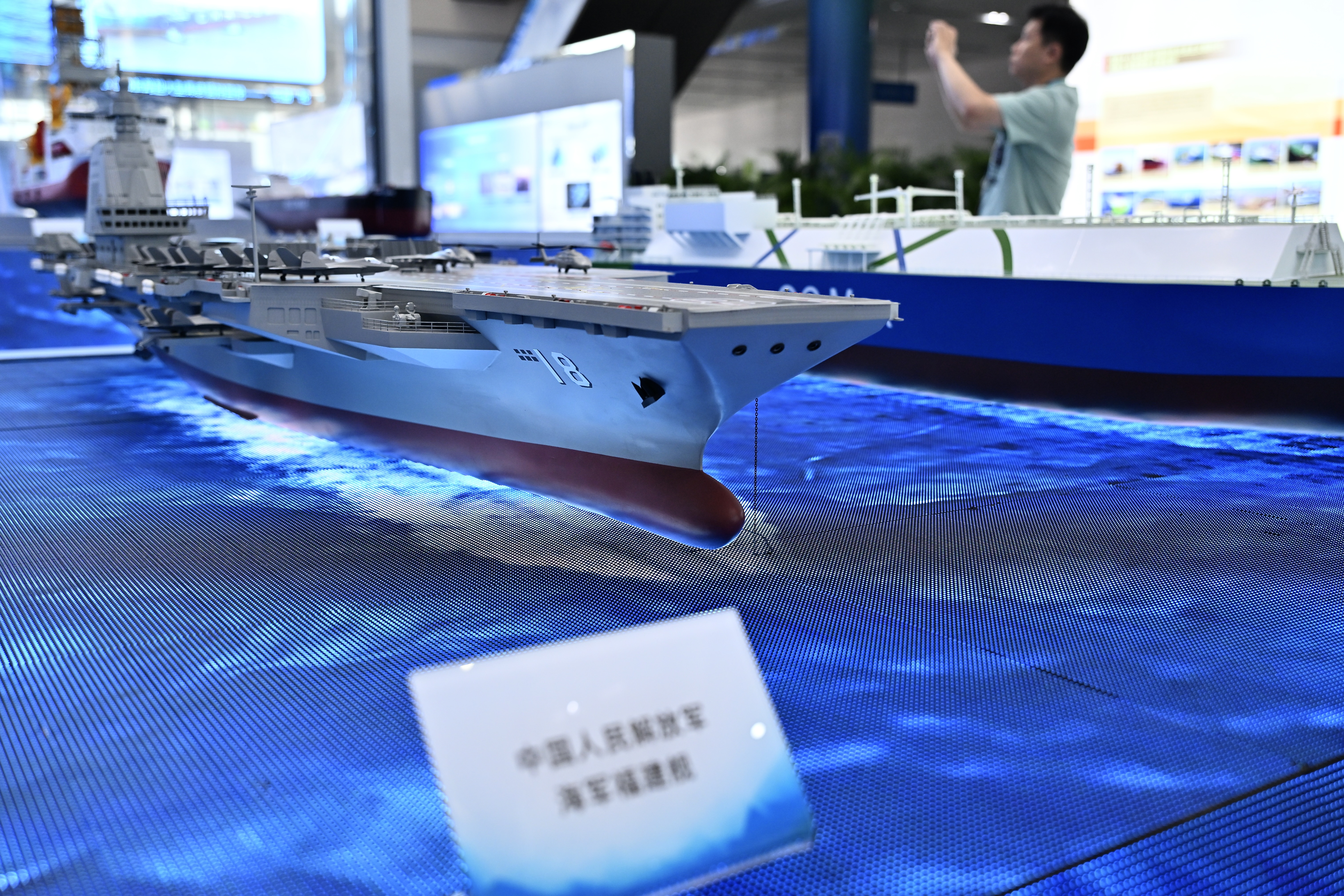
- China’s Type 004 carrier under construction at Dalian is likely to expand China’s long-term naval capacity, but is unlikely to change its South China Sea posture in the next 12 months. The report gives an approximate hull length of 322 metres and width of 46 metres, while an analyst estimates deployment five to 10 years after launch. The account cites CSIS and named analysts but provides no independent confirmation of the deployment timeline; confidence is medium. (Confidence: medium · ASSESSED)
- I&W: Dated imagery or reporting confirms a Type 004 launch at Dalian by the end of 2027, without evidence of operational deployment. (6-18 months)
- I&W: Reliable reporting documents the Type 004 entering operational deployment within 18 months of launch. (6-18 months)
Outlook & scenarios
Contested resupply continues without a major incident (55%)
This is the most likely near-term course. China Coast Guard and Philippine vessels continue to contest resupply activity around the BRP Sierra Madre, while communication between Manila and Beijing remains available. The reporting on both the incidents and the communications is weak, so this scenario is a working outlook rather than a confirmed trajectory.
A Ren’ai Shoal encounter causes a short escalation (25%)
A water-cannon incident, interception or collision involving China Coast Guard and Philippine resupply vessels is unlikely but plausible. Public disagreement over whether such an incident engages the US-Philippines treaty could intensify the diplomatic response even without a wider military confrontation.
Manila and Beijing maintain a practical resupply understanding (15%)
A renewed or clarified arrangement is unlikely on the evidence provided. The reporting describes an alleged understanding over the BRP Sierra Madre and says President Ferdinand Marcos Jr. would maintain communication with China, but the account is weakly sourced and does not establish agreement on current resupply terms.
A lethal attack triggers a treaty crisis (5%)
A lethal attack on a Philippine vessel or forces is very unlikely in this outlook, but would be a high-impact wildcard. It would force Manila and Washington to address the treaty’s application under acute pressure; the material reviewed does not establish how either government would respond.
Recommendations
- Treat social-media claims about the Liaoning group and recurring Ren’ai Shoal incidents as unconfirmed until checked against Philippine Navy statements, dated imagery or independent vessel tracking.
- Maintain a focused watch on China Coast Guard and Philippine resupply activity near the BRP Sierra Madre. Record any water-cannon use, interception, collision, injury or change to resupply access, with time and location where available.
- Prepare a short treaty reference that distinguishes an armed attack on Philippine territory, forces or vessels from water-cannon use and interception. Seek official US and Philippine statements on the specific threshold for each type of incident.
- Track Type 004 construction and launch milestones separately from the near-term South China Sea incident watch. Do not use the carrier’s construction as evidence of an imminent change in Chinese operations.
Confidence & uncertainty
Overall confidence is medium because the material combines a detailed Type 004 report citing CSIS and named analysts with substantially weaker reporting on current South China Sea activity. The Ren’ai Shoal and Liaoning claims rely on social-media posts or a single account, and the treaty discussion presents unresolved differences over the scope and timing of a US response. No independent corroboration in the material settles those uncertainties.
Alternative analysis (red cell)
Ren’ai Shoal activity is credibly a recurring friction point, but the ledger does not demonstrate that it is the leading near-term escalation risk in the wider South China Sea. The Type 004 evidence supports ongoing construction and possible long-term capacity growth, but it does not reliably exclude near-term signaling or posture effects because the deployment estimate is a single, unindependently confirmed assessment. Both judgments should therefore be treated as narrower and less settled than their principal conclusions imply.
Intelligence gaps
- [EEI 1.1 · UNCOVERED] Number, class, and position (time-stamped) of Chinese Coast Guard (CCG), People’s Armed Forces Maritime Militia (PAFMM), and other PRC paramilitary/auxiliary vessels inside Philippine-claimed EEZ or within 12 nautical miles of Philippine-occupied features (e.g., Scarborough Shoal, Second Thomas/Ayungin Shoal, and other named features). Recommended collection: maritime/AIS
- [EEI 1.2 · PARTIAL] Observed maneuvers or posture indicating hostile action: vessel-to-vessel blocking/contact, use of water cannons, boarding attempts, formation maneuvers to interdict Philippine vessels, or sustained stationing near Philippine resupply/relief routes. Recommended collection: imagery/satellite
- [EEI 1.3 · PARTIAL] Incidents of Philippine vessels (coast guard, navy, supply boats, civilian fishing vessels) being ordered to alter course, detained, chased, or physically impeded, with time, location, involved units, and damage/injuries if any. Recommended collection: open-source/official statements
- [EEI 1.4 · UNCOVERED] Abrupt changes to vessel identification behavior: AIS transponder deactivations, spoofing, or mismatches between flagged identity and observed equipment/markings among PRC maritime law-enforcement or militia vessels operating near Philippine claims. Recommended collection: maritime/AIS
- [EEI 2.1 · UNCOVERED] Issued directives, patrol orders, or internal guidance from PRC Central Military Commission, PLAN, CCG, or provincial maritime authorities that specify objectives, geographic limits, patrol tempos, or escalation thresholds for operations near Philippine-claimed features. Recommended collection: signals/communications
- [EEI 2.2 · UNCOVERED] Public declarations, maritime notices, or newly published 'maritime safety' or exclusion zones, with effective dates and coordinates, issued by Chinese authorities that could be used to justify interdiction or exclusion of Philippine activity. Recommended collection: open-source/official statements
- [EEI 2.3 · UNCOVERED] Evidence of mobilization orders, tasking lists, or logistics planning for Maritime Militia units (vessel requisitions, local fisheries bureau instructions, fuel/resupply manifests) indicating intent to employ militia alongside CCG/PLAN assets. Recommended collection: HUMINT/defense
- [EEI 3.1 · PARTIAL] Deployment and movement of Philippine Coast Guard and Navy vessels (class, location, on-station times) and scheduled or unscheduled escort/resupply missions to occupied features. Recommended collection: military/AIS
- [EEI 3.2 · UNCOVERED] Air component activity: number and frequency of Philippine air patrol sorties, maritime domain awareness flights, and air-to-surface or maritime strike assets placed on alert or redeployed toward contested areas. Recommended collection: imagery/satellite
- [EEI 3.3 · PARTIAL] Requests for diplomatic, intelligence, or military assistance from allies (e.g., US, Australia, Japan) including notifications of planned joint patrols, port calls, or freedom of navigation operations with dates and participating units. Recommended collection: open-source/official statements
- [EEI 3.4 · UNCOVERED] Changes to Philippine rules of engagement, emergency law measures, mobilization orders, or civil advisories (evacuations, fishing bans) that alter civilian or military behavior in contested maritime zones. Recommended collection: open-source/official statements
Red cell review: PARTIAL DISSENT
TLP:CLEAR