TLP:CLEAR · Disclosure is not limited.
Sudan conflict: RSF-led atrocities, humanitarian collapse, obstructed accountability
Time window: Last 7 days · Audience: General analyst · Type: Situation report · DTG: 2026-07-13 14:26Z · Overall confidence: LOW
BLUF
Sudan’s war is grinding into a fourth year marked by RSF-linked atrocities in Darfur and North Kordofan and a catastrophic humanitarian emergency, while international accountability efforts proceed but face obstruction from Khartoum. Casualty and displacement reporting remains divergent, and control in Khartoum is contested.
Executive summary
Fighting between the Sudanese Armed Forces (SAF) and the Rapid Support Forces (RSF) has continued since 15 April 2023, with the RSF mounting early assaults in Khartoum and rapid gains across Darfur, including Geneina, Nyala and key infrastructure. Reporting documents ethnically targeted attacks by the RSF and allied militias against the Masalit in West Darfur, the abduction and killing of West Darfur governor Khamis Abakar after he accused the RSF of genocide, and international findings consistent with crimes against humanity, ethnic cleansing and the hallmarks of genocide. The humanitarian situation is catastrophic: over 11 million people are internally displaced, more than 918,000 have fled to Chad, essential services have collapsed and over 33 million Sudanese face the world’s largest hunger crisis. The UN Human Rights Council has condemned RSF violence in Al-Obeid and tasked a fact-finding mission, which Khartoum rejects, while the International Criminal Court has opened a war crimes investigation into both SAF and RSF. Conflicting claims persist about who controls Khartoum in 2025, reinforcing uncertainty around the military balance.
Change from previous assessment
Initial assessment of this topic. Compared with the prior brief, this run adds specific reporting on UN Human Rights Council condemnation of RSF violence and a tasked fact‑finding mission in Al‑Obeid, alongside Khartoum’s rejection of that mandate; expands displacement and refugee figures, including more than 11 million internally displaced and over 918,000 refugees in Chad; and details RSF operations in Darfur through late 2023 and the tightening of the El Fasher siege in May 2024. Conflicting accounts over control of Khartoum in early 2025 and divergent casualty estimates lower confidence on the current balance of power and death tolls. No claims in this run address cholera, so that line of effort cannot be updated.
Key judgments
- The RSF very likely seized and held the initiative across much of Darfur through late 2023, degrading SAF presence via the capture of key urban centres and infrastructure and by tightening the siege of El Fasher in May 2024. (Confidence: high · ASSESSED)
- I&W: Confirm: independent field reporting or verifiable imagery of RSF checkpoints and administrative control in Nyala and Geneina persisting without SAF presence. (1-3 months)
- I&W: Break: credible reports of SAF re-establishing permanent garrisons and civil administration in Darfur state capitals. (1-3 months)
- The RSF and allied militias almost certainly perpetrated atrocities amounting to crimes against humanity and ethnic cleansing in Darfur, with multiple determinations pointing to genocide indicators and ethnically targeted violence against the Masalit. (Confidence: high · REPORTED)
- I&W: Confirm: ICC or UN fact-finding publications naming RSF commanders and units for crimes in West Darfur towns such as El Geneina, Misterei and Ardamata. (1-3 months)
- I&W: Break: authoritative investigations attributing the cited atrocities to actors other than RSF and allied militias. (1-3 months)
- Sudan very likely faces a catastrophic humanitarian emergency, with internal displacement exceeding 11 million, more than 918,000 refugees in Chad, widespread hospital closures and school shutdowns, and over 33 million affected by acute hunger. (Confidence: medium · ASSESSED)
- I&W: Confirm: updated displacement dashboards showing sustained totals above 12 million and refugee outflows to Chad continuing to rise from 918,000. (1-3 months)
- I&W: Break: verified reopening and sustained operation of a significant share of main hospitals and schools in conflict-affected states. (1-3 months)
- International accountability mechanisms are active but likely to have limited near‑term impact due to Sudan’s rejection of UN fact‑finding mandates and adversarial diplomacy, despite ICC investigations and external legal actions. (Confidence: medium · ASSESSED)
- I&W: Confirm: continued public refusals by Sudan to grant access to UN fact‑finders for Al‑Obeid and related sites. (0-14 days)
- I&W: Break: Sudanese authorities announce cooperation with UN investigations and facilitate site visits and witness access. (1-3 months)
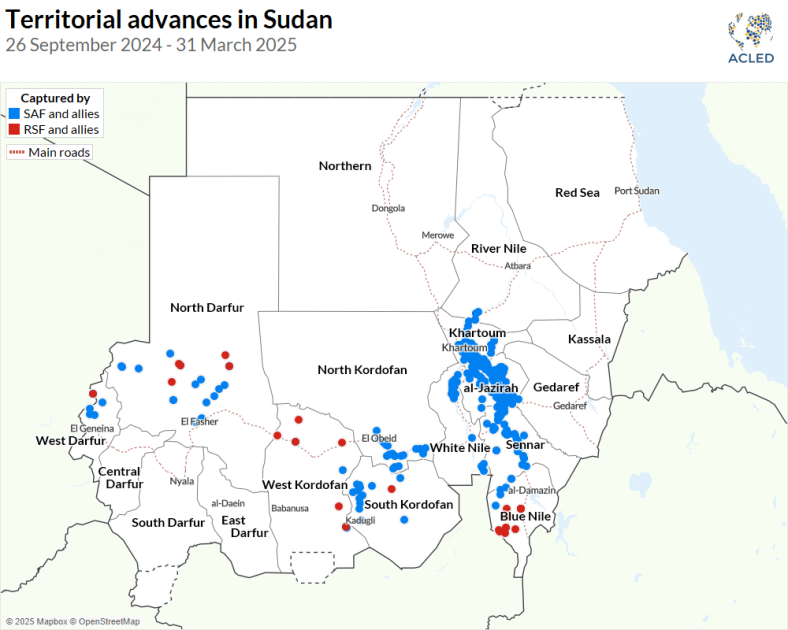
- Control in Khartoum remains uncertain, with contradictory reporting on SAF regaining the presidential palace and full control in early 2025 despite RSF’s 15 April 2023 seizure of key sites; the balance is roughly even chance pending corroboration. (Confidence: low · ASSESSED)
- I&W: Confirm: sustained, multi‑source evidence of SAF civil administration and security forces operating continuously from central Khartoum ministries. (0-14 days)
- I&W: Break: verifiable RSF media or independent journalist access showing RSF command posts functioning in core Khartoum government precincts. (0-14 days)
Outlook & scenarios
War of attrition persists through Q3 2026 (60%)
SAF and RSF remain locked in a protracted fight. RSF keeps pressure on Darfur fronts, including around El Fasher, while SAF holds in parts of Khartoum and the east. Civilian suffering intensifies as displacement grows and food insecurity deepens, with limited aid access and service collapse.
RSF consolidates de facto control across Darfur (50%)
RSF sustains its territorial gains in Geneina, Nyala and surrounding corridors, draws on Darfur’s Arab tribes to bolster manpower and tightens siege tactics. Ethnically targeted violence increases, driving further outflows into Chad and worsening access constraints.
SAF secures core Khartoum and shifts the negotiation calculus (30%)
SAF consolidates presence in central Khartoum and nearby districts, enabling limited administrative recovery. RSF adapts, intensifying attacks in periphery states. Intermittent talks re‑emerge but stall over maximalist demands and mutual distrust.
Accountability advances but with minimal immediate battlefield effect (40%)
ICC and UN fact‑finding outputs escalate scrutiny of RSF and, to a lesser extent, SAF. Khartoum maintains rejection of external mandates, limiting cooperation. Naming of alleged perpetrators raises diplomatic costs yet does not curb violence in the near term.
Recommendations
- Prioritise geolocation and longitudinal mapping of control in Geneina, Nyala, Kabkabiya, Ed Daein and El Fasher to validate RSF presence and lines of communication using commercially available imagery and consistent source logging.
- Establish a standing watch on Al‑Obeid: catalogue air and drone strike reports, siege indicators, and aid access denials; cross‑reference with casualty reporting on children and any starvation‑as‑warfare indicators.
- Reconcile displacement datasets: track weekly IDP and refugee totals against baselines for Sudan and the Chad frontier, flagging variance bands and source provenance for figures above 11 million IDPs and 918,000 refugees.
- Build an actor‑level atrocities ledger for Darfur with event, location, unit and victim group fields, ingesting verified reports of attacks against Masalit communities and leadership targeting such as the killing of Khamis Abakar.
- Monitor legal and diplomatic dockets: queue alerts for ICC filings, UN fact‑finding outputs and Sudanese government statements rejecting or accepting mandates; assess implications for evidence access and witness protection.
- Track RSF recruitment patterns and tribal alignments in Darfur to anticipate manpower surges, and correlate with shifts in front lines and civilian flight routes.
- Maintain a Khartoum control checklist: ministry operations, police presence, checkpoints and public services, requiring two independent sources per indicator before updating assessments.
Confidence & uncertainty
Overall confidence is low because key elements rely on mixed‑quality sources, including think tanks and blogs alongside major media and NGO reporting. Several critical data points conflict, notably displacement and fatality estimates, and there is contradictory reporting on control of Khartoum. While multiple high‑credibility claims corroborate RSF atrocities and the scale of humanitarian needs, gaps in recent, independently verified ground truth and Sudanese government obstruction of UN mechanisms limit confident, granular assessment.
Alternative analysis (red cell)
An alternative, defensible reading is that the RSF achieved significant local and tactical gains but the evidence does not conclusively demonstrate uncontested, sustained RSF hegemony ‘across much of Darfur’ through late 2023; episodic offensives and sieges may represent contested influence rather than consolidated governance. Similarly, while the humanitarian situation is clearly catastrophic in many areas, displacement and hunger estimates in the claims diverge sufficiently that precise national‑level totals remain estimative and require further reconciliation.
Intelligence gaps
- [EEI 1.2 · UNCOVERED] Changes in employment of heavy weapons and systems: documented use or emplacement of artillery, multiple-launch rocket systems, tanks, combat helicopters, and airstrikes at specific coordinates and times. Recommended collection: open-source/media
- [EEI 1.4 · PARTIAL] Status of critical infrastructure and lines of communication: control or denial of named bridges, main highways (identify route numbers), airfields, fuel depots and telecommunication hubs and any reported sabotage/blockage incidents. Recommended collection: human intelligence/field reporting
- [EEI 2.3 · PARTIAL] Functional status of medical infrastructure in named locations: number of operational hospitals/clinics, reported shortages of key medicines/blood, and hospital casualty/occupancy figures for the last 72 hours. Recommended collection: medical/health cluster reporting
- [EEI 3.1 · PARTIAL] Detection of flights, ships or overland convoys delivering military materiel or foreign personnel to named airfields, ports or border crossings (flight/IMO numbers, manifests if available, timestamps, route origin/destination). Recommended collection: air-traffic / maritime / border customs
- [EEI 3.2 · UNCOVERED] Imagery or on-the-ground confirmation of foreign military personnel or private military contractor bases/forward operating elements at specified coordinates or compounds, including vehicle/weapon types observed. Recommended collection: imagery/satellite
- [EEI 3.3 · UNCOVERED] Financial and sanctions-relevant indicators: atypical large transfers, use of designated front companies, or shipments routed through third states linked to procurement of weapons or fuel for RSF or SAF (transaction dates, parties, amounts where obtainable). Recommended collection: financial intelligence
Cited sources
[1] Amnesty International · Destruction and violence in Sudan (B) · sha256:eb7fd8154b66 [2] Wikipedia · Darfur campaign (2023–present) (B) · sha256:44ecb992ee6e [3] Wikipedia · Darfur genocide (2023–present) (B) · sha256:3107b6dc93e9 [4] Council on Foreign Relations · Civil War in Sudan (B) · sha256:ca030c02ffe2 [5] arabic.sudanspost.com · السودان يعترض. مجلس حقوق الإنسان يكلف بعثة تقصي الحقائق بالتحقيق في انتهاكات الأبيض (B) · sha256:e1778d2d4d0e [6] afsc.org · What you need to know about the war in Sudan (C) · sha256:76ba871d6689 [7] Council on Foreign Relations · Sudan's Humanitarian Crisis, Explained (B) · sha256:8c995224d78d [8] Operation Broken Silence · Sudan Crisis Guide — Operation Broken Silence (D) · sha256:f6184027d7e9 [9] acleddata.com · Two years of war in Sudan: How the SAF is gaining the upper hand (C) · sha256:46cedbda98e4
Source content hashes were computed at collection time; the cited text is preserved unmodified for the life of this product.
Red cell review: PARTIAL DISSENT
TLP:CLEAR