TLP:CLEAR · Disclosure is not limited.
Taiwan Strait: Broad Chinese Activity, Unclear Exercise Purpose
Time window: Last 7 days · Audience: General analyst · Type: Situation report · DTG: 2026-11-11 15:29Z · Overall confidence: MEDIUM
BLUF
Taiwanese officials report broad Chinese naval and air activity across the Western Pacific, the South China Sea and waters around Taiwan. The reporting supports concern about area-denial training, but does not establish that the activity is a single coordinated operation to isolate Taiwan or that an attack is imminent.
Executive summary
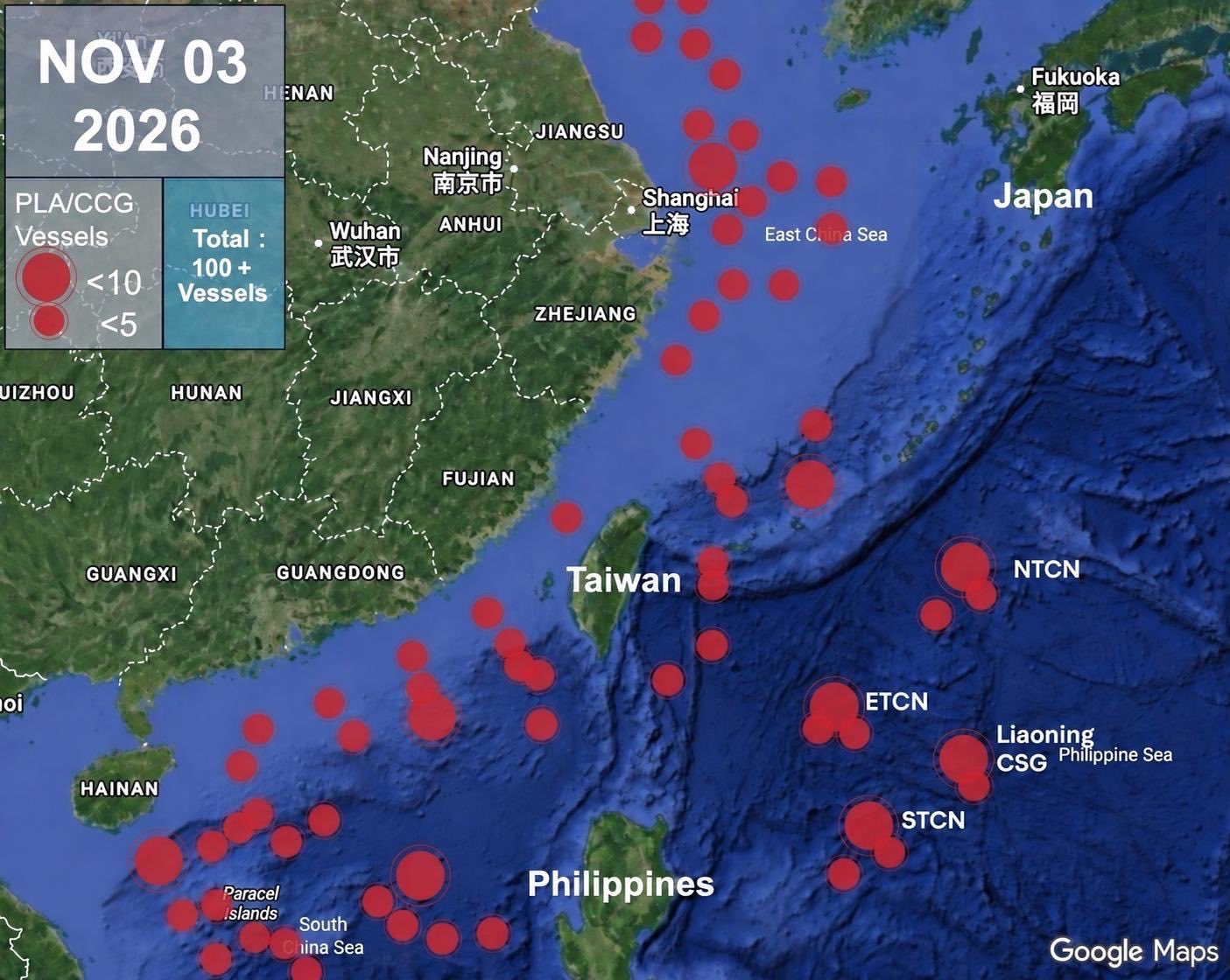
Taiwan National Security Council Secretary-General Joseph Wu reported more than 100 Chinese Navy and China Coast Guard vessels operating across the Western Pacific, the South China Sea and around Taiwan in early November. Defence Minister Wellington Koo said the Liaoning carrier group and other formations conducted area-denial drills in the Western Pacific. Taiwan also reported 49 Chinese aircraft movements in a 24-hour period by 3 November, including 36 south of Taiwan, and four PLA aircraft sorties, seven PLA Navy vessels and three official ships in the 24 hours to 11 November. ISW assessed that the deployments could represent a major exercise simulating Taiwan's isolation. That interpretation remains uncertain: the supplied reporting includes no corresponding Chinese exercise announcement, and ship tracking and aircraft transponder data do not establish command relationships or mission. Beijing described the Liaoning deployment as routine annual training. We assess that broad activity is reported with medium confidence, while confidence in a coordinated isolation exercise or near-term attack is lower.
Change from previous assessment
Since the 10 November brief, this update adds Joseph Wu's account of more than 100 Chinese Navy and China Coast Guard vessels across the Western Pacific, the South China Sea and around Taiwan, and Wellington Koo's specific description of Liaoning-led area-denial drills. It also adds Taiwan's 11 November report of four PLA aircraft sorties, seven PLA Navy vessels and three official ships in the preceding 24 hours, a lower count from a narrower and later reporting window than the broader early-November totals. The isolation-exercise assessment remains at roughly even chance with low confidence, and the near-term attack assessment remains unlikely with low confidence. The prior GJ-11 capability judgement is not carried forward because this reporting window provides no new evidence on that system.
Key judgments
- Taiwanese reporting indicates Chinese maritime and air activity was geographically broad in early November. Joseph Wu reported more than 100 Chinese Navy and China Coast Guard vessels across the Western Pacific, the South China Sea and around Taiwan. Wellington Koo said the Liaoning carrier group and other naval formations conducted area-denial drills in the Western Pacific. Taiwan reported 49 Chinese aircraft movements in 24 hours by 3 November, including 36 south of Taiwan; its 11 November report recorded four PLA aircraft sorties, seven PLA Navy vessels and three official ships in the preceding 24 hours, with two sorties crossing the median line. These figures cover different dates and geographic scopes. The accounts largely rely on Taiwanese official reporting and do not independently verify every vessel or formation. (Confidence: medium · REPORTED)
- I&W: Taiwan's Ministry of National Defense reports at least 20 aircraft movements or more than seven PLA Navy vessels in each of two consecutive 24-hour reporting windows around Taiwan, with dates and areas specified. (0-14 days)
- I&W: Taiwan's Ministry of National Defense reports no more than 10 aircraft movements and seven PLA Navy vessels per 24-hour window for seven consecutive days, with no new report of a region-wide deployment exceeding 100 vessels. (0-14 days)
- There is a roughly even chance that the early-November deployments formed a coordinated PLA exercise rehearsing Taiwan's isolation rather than overlapping or separate training. ISW interpreted the reported scope and locations as consistent with an isolation exercise, but ship tracking and transponder data do not identify unit command or mission. The supplied reporting records no corresponding Chinese exercise announcement, while Beijing described the Liaoning's Western Pacific deployment as routine annual training. The isolation interpretation therefore rests on limited reporting and remains low confidence. (Confidence: low · ASSESSED)
- I&W: The PLA Eastern Theater Command issues an exercise notice identifying areas around Taiwan and naming blockade, port-control or live-fire activity, which would strengthen the case for an organised isolation rehearsal. (0-14 days)
- I&W: Taiwan's reported vessel and aircraft activity declines across consecutive daily windows while no Chinese exercise notice appears and the Liaoning deployment is described as routine training. (0-30 days)
- A PLA attack on Taiwan in the next 1-3 months is unlikely on the supplied reporting. The claims describe naval deployments, aircraft activity and an assessed exercise purpose, but report neither an attack order nor an invasion-force assembly. This judgement depends partly on the absence of such reporting in a limited source set, not on evidence that Beijing has ruled out an attack; confidence is low. (Confidence: low · ASSESSED)
- I&W: Chinese authorities announce live-fire or navigation exclusion zones around Taiwan and reporting identifies PLA amphibious formations moving into the Taiwan Strait. (0-30 days)
- I&W: Taiwan's Ministry of National Defense reports no more than 10 aircraft movements and seven PLA Navy vessels per 24-hour window for seven consecutive days, with no announced exercise zones or reported amphibious movements. (0-30 days)
Outlook & scenarios
Dispersed training continues or tapers (55%)
Likely, Chinese naval and air activity continues as dispersed deployments or gradually declines, without a formal announcement of a coordinated exercise around Taiwan. Beijing's routine-training explanation for the Liaoning deployment remains consistent with this scenario. Taiwan continues to report activity, but the available evidence does not establish a unified isolation operation.
A coordinated isolation rehearsal becomes clearer (35%)
Unlikely, activity develops into a coordinated PLA exercise focused on limiting access to Taiwan. An announcement identifying multiple exercise areas, blockade or port-control objectives, or live-fire activity would strengthen this scenario. Without such evidence, the interpretation remains uncertain.
A sustained cordon raises the risk of crisis (10%)
Very unlikely, deployments shift into a sustained cordon around Taiwan, with activity that restricts access or disrupts maritime movement. This is a low-probability, high-impact wildcard. The current reporting does not establish that such a shift is under way.
Recommendations
- In the next update, distinguish region-wide vessel totals from counts around Taiwan and state the exact 24-hour reporting window for every Taiwan Ministry of National Defense figure.
- Treat the isolation-exercise interpretation as a hypothesis. Do not describe the three PLA coastal commands as operating under unified control without evidence beyond ship tracking and aircraft transponder data.
- Monitor for PLA or Chinese government exercise notices that specify areas around Taiwan, live-fire activity, port-control objectives or navigation restrictions. Record whether the notices are absent, issued or amended.
- Compare Taiwan's daily reports with independently reported vessel positions and Japanese official reporting, while noting when multiple accounts rely on the same Taiwanese statement.
- Keep near-term attack likelihood separate from the risk of coercive deployments. Raise the attack assessment only if reporting identifies concrete mobilisation, amphibious-force movement or sustained exclusion measures around Taiwan.
Confidence & uncertainty
Overall confidence is medium. Several media and trade accounts report Taiwanese official statements about vessel and aircraft activity, which corroborates the reported account but does not independently verify every formation or count. The figures refer to different dates and geographic scopes. The main uncertainty is whether the activity is centrally coordinated and intended to rehearse Taiwan's isolation; the available ship-tracking data cannot establish command relationships or mission, and Beijing has described the Liaoning deployment as routine training.
Alternative analysis (red cell)
The supplied reporting does not establish that an attack is likely, but it also does not support the stronger inference that an attack in the next one to three months is unlikely. The broad deployments in claims 1eaf673a-ab67-4311-9965-fddc97ae25d8 and 1295be06-c02f-41f5-a966-8c4d0178b810, together with the isolation interpretation in claim 095633d8-1861-4f5d-833e-06dfd15d1b45, are compatible with preparation, coercive signaling, or routine activity. The most defensible reading is that the supplied reporting cannot discriminate among these possibilities.
Intelligence gaps
- [EEI 1.1 · UNCOVERED] Concentration of PLA amphibious warfare vessels exceeding 15 ships in Fujian Province naval ports. Recommended collection: imagery/satellite
- [EEI 1.2 · UNCOVERED] Unplanned surge in encrypted communications traffic from PLA Eastern Theater Command headquarters. Recommended collection: SIGINT
- [EEI 1.3 · UNCOVERED] Movement of PLA airborne unit heavy equipment to airbases within 200km of Taiwan Strait. Recommended collection: imagery/satellite
- [EEI 2.1 · PARTIAL] Daily aggregate count of PLA Air Force sorties within 30km of the median line. Recommended collection: radar
- [EEI 2.2 · PARTIAL] Number of active PLA naval live-fire exercise zones in Taiwan Strait international waters. Recommended collection: SIGINT
- [EEI 2.3 · UNCOVERED] Positioning of PLA Type 055 destroyers west of 122°E longitude. Recommended collection: maritime/AIS
- [EEI 3.1 · UNCOVERED] Operational activation of Taiwan's Hsiung Feng III coastal defense missile systems. Recommended collection: SIGINT
- [EEI 3.2 · UNCOVERED] Increased cargo aircraft movements to Penghu Islands military installations. Recommended collection: air/ADS-B
Red cell review: PARTIAL DISSENT
TLP:CLEAR