TLP:CLEAR · Disclosure is not limited.
Taiwan Strait: Broad Chinese Naval Activity, Coordination Unconfirmed
Time window: Last 7 days · Audience: General analyst · Type: Situation report · DTG: 2026-11-11 19:11Z · Overall confidence: MEDIUM
BLUF
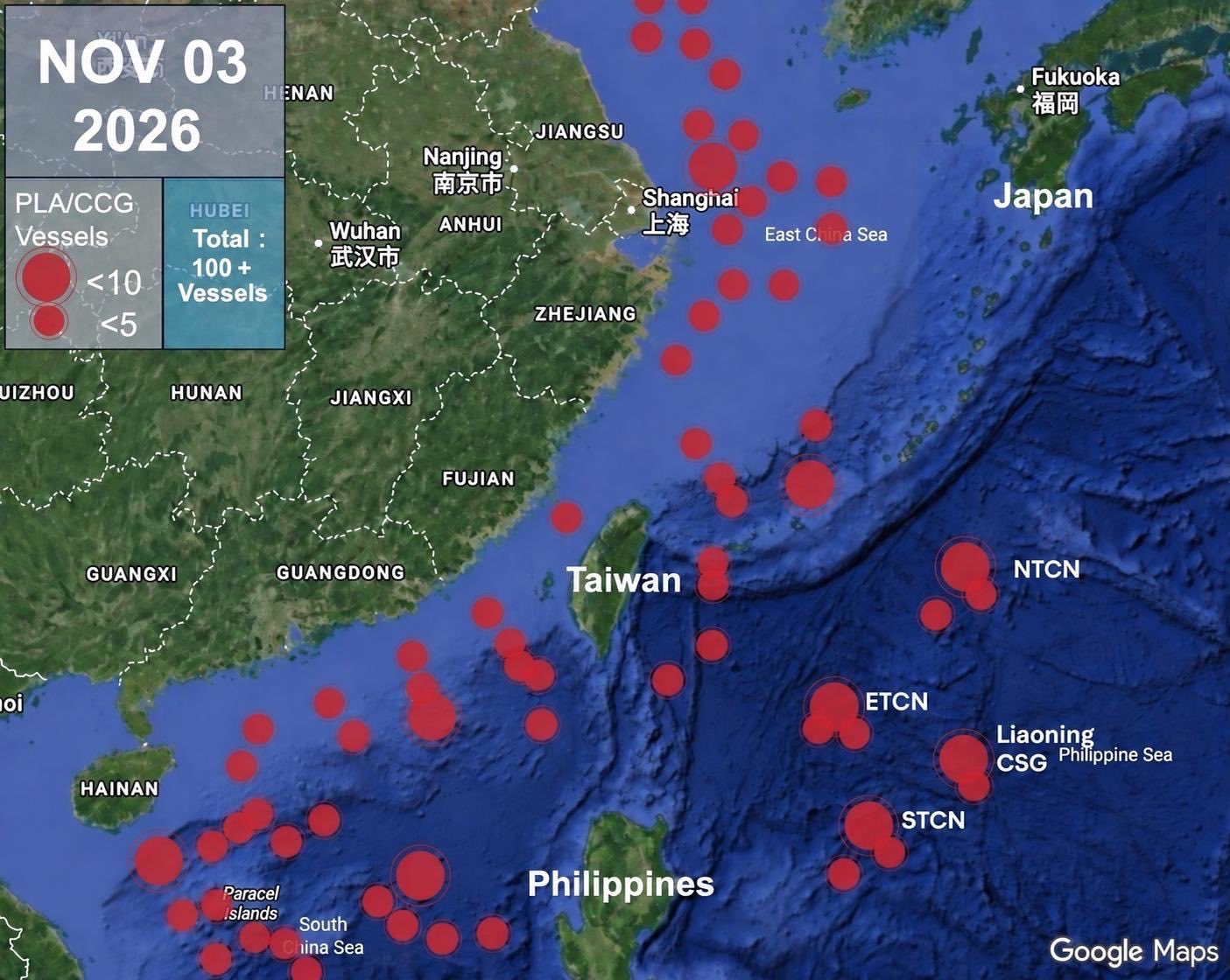
Taiwanese officials report Chinese naval activity spanning the Western Pacific, South China Sea, East China Sea and Philippine Sea, including more than 100 PLA Navy and China Coast Guard vessels at sea on 3 November. A coordinated exercise rehearsing Taiwan's isolation remains plausible but unproven; the available reporting does not establish an imminent attack.
Executive summary
Taiwanese officials described large, unannounced Chinese naval activity in early November. Defence Minister Wellington Koo said China conducted area-denial drills in the Western Pacific, while a Taiwanese security official described exercises across the South China Sea, East China Sea and Philippine Sea. Separate reporting described a Liaoning-led group heading into the Pacific and another force around Taiwan. A social-media account relaying an ISW assessment reported four surface battle groups from the Eastern, Northern and Southern Theater Commands between Guam and Taiwan, but that deployment detail is not independently corroborated here. ISW also noted that the exercise was unannounced, unlike a coastwide drill in October. The reporting supports concern about the scale and possible purpose of the activity, but does not establish that all deployments were centrally coordinated or that an attack is imminent.
Change from previous assessment
The central judgements are unchanged: activity is broad, the isolation-exercise interpretation remains unresolved, and an attack in the next 1-3 months remains unlikely on the available reporting. This brief adds detail on reported movements by the Eastern, Northern and Southern Theater Commands beyond the first island chain, but the detail comes from a low-reliability social-media relay and does not justify raising confidence in coordination.
Key judgments
- Chinese naval activity in early November was geographically broad, according to Taiwanese officials. Joseph Wu reported more than 100 PLA Navy and China Coast Guard vessels at sea on 3 November; Wellington Koo said China conducted area-denial drills in the Western Pacific on 10 November. A separate account described the Liaoning carrier group heading into the Pacific and another force encircling Taiwan. These reports cover different dates and areas and do not establish that every deployment was part of one operation. (Confidence: medium · REPORTED)
- I&W: Confirm: independent vessel tracking reconstructs more than 100 PLA Navy and China Coast Guard vessels operating across the reported maritime areas during the same period. (0-14 days)
- I&W: Break: independent tracking shows the reported vessel total combined separate dates or areas, with no simultaneous broad deployment. (0-14 days)
- There is a roughly even chance that the early-November deployments formed one coordinated exercise with a Taiwan-isolation component, rather than overlapping deployments for area-denial training and signalling against potential US or Japanese intervention. ISW assessed that the scope and location suggested an exercise simulating isolation of Taiwan; Koo described Western Pacific area-denial drills, and Chinese commentator Song Zhongping framed the drills as a signal about possible intervention. A social-media relay attributed to ISW reported four surface battle groups from the Eastern, Northern and Southern Theater Commands between Guam and Taiwan, but the supplied reporting does not independently establish their command relationship or mission. (Confidence: low · ASSESSED)
- I&W: Confirm: independent tracking corroborates Eastern, Northern and Southern Theater Command warships converging beyond the first island chain through the Miyako Strait and Bashi Channel, with evidence of coordinated timing. (0-14 days)
- I&W: Break: independent tracking or official exercise notices show the formations operating separately in time or area, without evidence of a shared exercise plan. (0-14 days)
- A PLA attack on Taiwan within the next 1-3 months is unlikely on the supplied reporting. The reporting describes naval deployments and competing assessments of exercise purpose, but contains no report of an attack order or invasion-force assembly. This judgement rests partly on the limits of the supplied reporting, not on evidence that Beijing has ruled out an attack. (Confidence: low · ASSESSED)
- I&W: Break: credible official reporting identifies PLA orders for Taiwan operations or a sustained concentration of amphibious forces and transport vessels for those operations. (0-14 days)
- I&W: Confirm: Taiwanese official reporting records the current deployments subsiding without reporting attack orders or a sustained amphibious-force mobilisation. (1-3 months)
Outlook & scenarios
Overlapping training and strategic signalling (55%)
This is the most likely near-term course. Chinese naval formations operate across several maritime areas for overlapping training and signalling, without evidence that all units are executing one Taiwan-isolation plan. Taiwan continues to report military activity, while the mission and command links between formations remain unclear.
Coordinated area-denial exercise with an isolation component (35%)
PLA naval formations from multiple theater commands act as parts of a coordinated exercise. The activity rehearses pressure around Taiwan while positioning forces in the Western Pacific for area denial. ISW's isolation assessment and the reports of cross-theater deployments support this scenario, but the command and mission details remain unverified.
High-impact incident during naval operations (10%)
If the reported cordon around Taiwan and Western Pacific deployments are accurate, an encounter during those operations could trigger a rapid political and military response. This is a low-probability, high-impact scenario; the supplied reporting does not describe an incident already occurring.
Recommendations
- Keep vessel counts, dates and geographic areas separate in reporting. Do not combine the 3 November figure of more than 100 vessels with later activity counts as though they describe one simultaneous deployment.
- Seek independent confirmation of the reported four battle groups, including their positions, routes through the Miyako Strait and Bashi Channel, and timing. Distinguish verified movements from assessments of command relationships or mission.
- Track Taiwan's daily defence ministry and coast guard reporting alongside Chinese exercise announcements and navigational notices. Record whether activity clusters around Taiwan, converges in the Western Pacific, or separates into distinct operating areas.
- Maintain the competing isolation-rehearsal and overlapping-training explanations in updates. Raise confidence in a coordinated exercise only if independent tracking or official notices establish linked movements or a shared exercise plan.
- Treat the absence of reported attack orders or invasion-force assembly as a limitation of the available reporting, not as evidence that Beijing has ruled out military action.
Confidence & uncertainty
Taiwanese official statements carried by established news outlets support the broad description of naval activity and the reported area-denial drills. Confidence is lower on the number, routes and coordination of the Western Pacific battle groups: those details rely in part on a low-reliability social-media relay, and the supplied reporting does not independently establish command links or mission. The assessment of near-term attack risk also rests partly on the absence of such reporting in a limited source set.
Alternative analysis (red cell)
The reporting does not justify assigning roughly even odds to a single coordinated Taiwan-isolation exercise. Claim c064f523-34ae-4742-a291-ebf12eddba15 is an assessment, while claims bf638c3f-373d-4952-8889-d4eeea5fc4b4 and fa4bc52c-7f45-4905-a861-abe5307d5a8d are E1 reporting that do not independently establish common command or mission. The evidence therefore supports a possible coordinated exercise, but overlapping deployments for training and signalling remain the more defensible alternative reading.
Intelligence gaps
- [EEI 1.1 · UNCOVERED] Concentration of PLA amphibious warfare vessels exceeding 15 ships in Fujian Province naval ports. Recommended collection: imagery/satellite
- [EEI 1.2 · UNCOVERED] Unplanned surge in encrypted communications traffic from PLA Eastern Theater Command headquarters. Recommended collection: SIGINT
- [EEI 1.3 · UNCOVERED] Movement of PLA airborne unit heavy equipment to airbases within 200km of Taiwan Strait. Recommended collection: imagery/satellite
- [EEI 2.1 · PARTIAL] Daily aggregate count of PLA Air Force sorties within 30km of the median line. Recommended collection: radar
- [EEI 2.2 · PARTIAL] Number of active PLA naval live-fire exercise zones in Taiwan Strait international waters. Recommended collection: SIGINT
- [EEI 2.3 · PARTIAL] Positioning of PLA Type 055 destroyers west of 122°E longitude. Recommended collection: maritime/AIS
- [EEI 3.1 · UNCOVERED] Operational activation of Taiwan's Hsiung Feng III coastal defense missile systems. Recommended collection: SIGINT
- [EEI 3.2 · UNCOVERED] Increased cargo aircraft movements to Penghu Islands military installations. Recommended collection: air/ADS-B
Red cell review: PARTIAL DISSENT
TLP:CLEAR