TLP:CLEAR · Disclosure is not limited.
Taiwan Strait: Fujian carrier transit and Taiwan’s immediate-readiness drills intensify signalling
Time window: Last 7 days · Audience: General analyst · Type: Situation report · DTG: 2026-06-24 19:10Z · Overall confidence: MEDIUM
BLUF
China’s carrier Fujian transited the Taiwan Strait on 22 June as Taiwan ran five days of immediate-readiness drills built around a sudden-attack scenario. There is almost certainly no evidence of kinetic strikes on Taiwan during 22-24 June based on satellite thermal data.
Executive summary
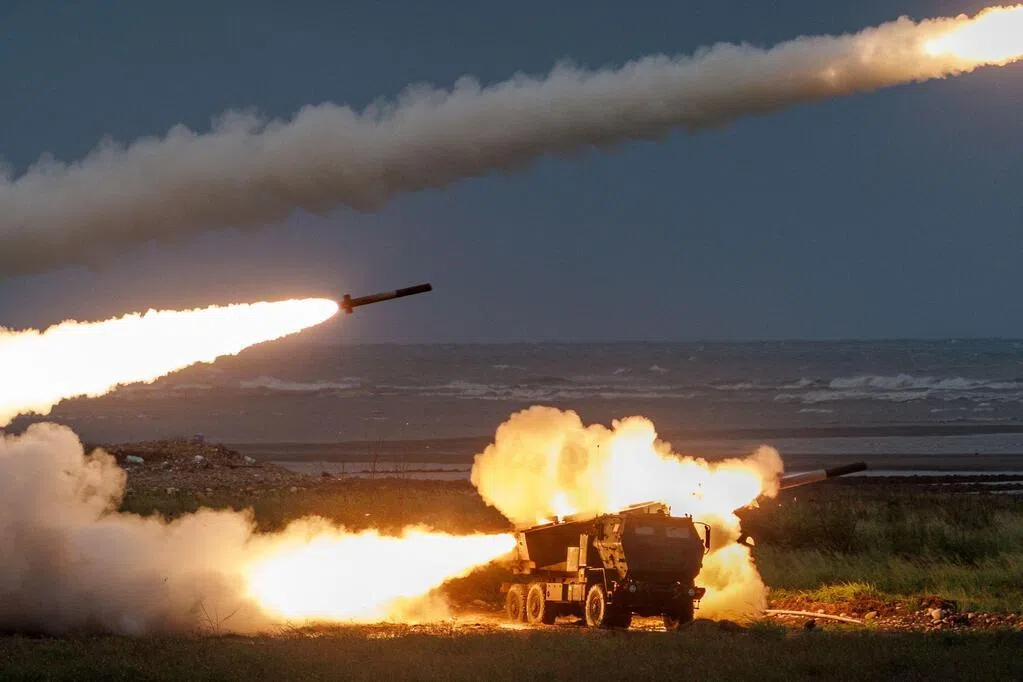
Beijing sent its newest aircraft carrier, Fujian, through the Taiwan Strait on 22 June, which Taiwan’s defence ministry tracked with joint ISR. The British, French and German offices in Taipei voiced concern over recent Chinese activity off Taiwan’s east coast. Taipei ran a five-day Immediate Combat Readiness exercise from 22 June, integrating a scenario in which a routine PLA drill flips to an attack and following early-June HIMARS firings, while Defence Minister Chiu warned warning times are shortening and President Lai pressed modernisation with U.S. backing. Taiwan schedules joint-defence drills in July and the Han Guang exercise in August. NASA recorded five low-confidence thermal anomalies over Taiwan in the past two days, which almost certainly do not indicate strikes.
Change from previous assessment
Since the prior brief on 23 June, China’s Fujian carrier transited the Taiwan Strait and Taiwan’s defence ministry reported it was tracked with joint ISR; the British, French and German offices in Taipei issued a joint statement of concern over recent Chinese activity off Taiwan’s east coast; Taiwan’s Immediate Combat Readiness drills continued with added emphasis on an exercise-turns-attack scenario; Defence Minister Chiu highlighted shortening warning times and President Lai’s modernisation push featured alongside U.S. support. Our confidence remains medium, with added corroboration on the Fujian transit and expanded diplomatic signalling.
Key judgments
- China very likely sent the carrier Fujian through the Taiwan Strait on Tuesday 22 June, and Taiwan’s defence ministry monitored the transit with joint ISR; European partners in Taipei publicly signalled concern about recent Chinese activity off Taiwan’s east coast. (Confidence: high · REPORTED)
- I&W: Additional PLA carrier or major surface combatant transits through the Taiwan Strait reported by Taiwan’s defence ministry and corroborated by open-source imagery or shipping trackers (0-14 days)
- I&W: PRC statements or state media announcing Fujian’s return to port with no near-term strait activity (0-14 days)
- Taiwan very likely conducted a five-day Immediate Combat Readiness exercise from 22 June that focused on rapid mobilisation and a scenario in which a routine PLA drill turns into an attack, following early-June HIMARS firings including shots toward the Taiwan Strait. (Confidence: high · REPORTED)
- I&W: Ministry of National Defense after-action releases detailing mobilisation timings or road-movement drills (0-14 days)
- I&W: New NOTAM or maritime exclusion notices for additional live-fire events linked to the Immediate Combat Readiness cycle (0-14 days)
- Taiwan is likely to sustain an elevated training tempo into August, aligned with leadership assessments that warning times are shortening and with a modernisation push toward 5 percent of GDP backed by the United States, including joint-defence drills in July and Han Guang in August. (Confidence: high · REPORTED)
- I&W: Publication of July joint-defence exercise schedules and August Han Guang traffic-control or mobilisation directives (0-14 days)
- I&W: Executive or legislative action advancing defence-spending targets toward 5 percent of GDP (1-3 months)
- Routine PLA coercive pressure is likely to persist around Taiwan, including near-daily air and maritime activity and renewed maritime-lawfare signalling, amid continued dispute over the strait’s status and periodic U.S. Navy transits. (Confidence: medium · ASSESSED)
- I&W: Taiwan’s daily ADIZ reports continue to log frequent PLA aircraft and vessel activity, alongside repeated PRC coast guard appearances off Taiwan’s east coast (0-14 days)
- I&W: A sustained two-week drop in PLA sorties and sailings reported by Taiwan’s defence ministry (0-14 days)
- There is almost certainly no evidence of kinetic strikes on Taiwan during 22-24 June, with five satellite thermal detections over two days assessed at low confidence and thermal sensors recording heat sources rather than causation. (Confidence: high · REPORTED)
- I&W: Absence of high-confidence thermal anomalies co-located with military facilities and lack of corroborated imagery of strike damage (0-14 days)
- I&W: Emergence of high-confidence thermal detections at sensitive sites paired with verified ground or satellite imagery of blast effects (0-14 days)
- PLA command-and-control resilience is likely improving, as the 71st Group Army trains to increase data throughput, integrate joint communications and enable real-time ISR-to-fire sharing, which would raise PLA operational effectiveness around the Strait over the next quarter. (Confidence: medium · ASSESSED)
- I&W: PLA releases or observable drills demonstrating cross-service comms integration supporting long-range fires in coastal brigades (1-3 months)
- I&W: Training pauses or lack of joint-integration content in PLA official channels (1-3 months)
- There is a likely risk of sharp, short-notice PLA demonstrations, including missile firings around Taiwan, if triggered by high-profile political events, as demonstrated in August 2022 when at least 11 missiles were fired, five reportedly landing in Japan’s EEZ, alongside large-scale joint drills. (Confidence: medium · ASSESSED)
- I&W: PRC announcement of exclusion zones and live-fire areas around Taiwan, with accompanying NOTAM or maritime exclusion notices (0-14 days)
- I&W: Public PRC messaging deferring or scaling back drills during high-profile visits (0-14 days)
Outlook & scenarios
Managed coercion persists without direct clashes (60%)
PLA sustains near-daily air and maritime pressure, intermittent carrier transits and east-coast patrol signalling. Taiwan continues intensive training through July, August. Diplomatic protests continue, but no live-fire envelopes are declared and no kinetic incidents occur.
Snap blockade-style drills with live fire (35%)
Beijing launches short-notice joint drills around Taiwan in July or August, declaring temporary exclusion zones and conducting missile firings to signal resolve, drawing on the August 2022 template. Taiwan elevates readiness and runs counter-blockade injects, while partners issue coordinated diplomatic responses.
Carrier signalling cycle intensifies, remains non-kinetic (40%)
PLA surface action groups, including Fujian, conduct additional Taiwan Strait transits and operations east and south of Taiwan, paired with heightened ISR activity, but avoid live-fire events near the island. Taiwan’s ISR tracks movements and publicises daily tallies.
Miscalculation incident at sea or in air (15%)
An unsafe intercept or median-line challenge results in collision or weapons employment in warning, prompting rapid force surges and emergency crisis communications. Both sides then work to contain escalation, but military postures harden for weeks.
Recommendations
- Maintain a daily log of Taiwan Ministry of National Defense ADIZ and maritime reports to track trends in sortie and vessel counts, and flag deviations from recent baselines for rapid alerting.
- Set collection tripwires for PRC exercise activity: monitor for maritime exclusion notices, NOTAM issuance and official announcements of drills around Taiwan, especially 0-14 days before and during Taiwan’s July joint-defence and August Han Guang exercises.
- Task open-source maritime and aerial tracking to watch for additional PLA carrier or major surface combatant movements through the Taiwan Strait, and correlate with Taiwan ISR reporting for confirmation.
- Exploit satellite thermal and optical feeds to vet any claims of strikes on Taiwan, applying a standing analytic note that thermal detections indicate heat sources, not causation, and require independent corroboration.
- Track official statements by PRC’s Taiwan Affairs Office, Taiwan’s Mainland Affairs Council and partner embassies in Taipei to map diplomatic signalling cycles against PLA operations.
- Prepare decision memos outlining response options to a snap blockade-style drill, using the August 2022 playbook as a reference for missile, air and maritime activity patterns and likely closure areas.
- Coordinate with maritime trade-risk colleagues to assess potential shipping-route adjustments during elevated drills, including contingency planning for rerouting around declared exclusion zones.
Confidence & uncertainty
Multiple judgments rest on corroborated reporting from reliable major media and official sources, including Taiwan’s defence ministry statements on the Fujian transit, European diplomatic messaging from Taipei, and NASA’s satellite data. Taiwan’s exercise schedule and early-June HIMARS activity are consistently reported across outlets. Assessments about continued PLA pressure and improving command-and-control draw on credible but state-affiliated PLA reporting that is subject to messaging bias, and the outlook for snap drills extrapolates from 2022 precedent. These single-source or inference elements, and the inherent uncertainty in intent and timing, justify a medium overall confidence rating.
Alternative analysis (red cell)
Several judgments rely heavily on official statements (B1) without independent sensor corroboration or documentary budgetary evidence. For the Fujian transit and thermal anomaly interpretation, the available claims permit plausible alternative readings — routine movement or ambiguous thermal events rather than a confirmed carrier transit or kinetic strikes. Similarly, unit-level training and communications tests (71st Group Army) indicate intent but do not yet demonstrate validated, operational ISR-to-fire capability or guaranteed near-term force-multiplying effects.
Intelligence gaps
- [EEI 1.1 · UNCOVERED] Concentration of PLA amphibious warfare vessels exceeding 15 ships in Fujian Province naval ports. Recommended collection: imagery/satellite
- [EEI 1.2 · UNCOVERED] Unplanned surge in encrypted communications traffic from PLA Eastern Theater Command headquarters. Recommended collection: SIGINT
- [EEI 1.3 · UNCOVERED] Movement of PLA airborne unit heavy equipment to airbases within 200km of Taiwan Strait. Recommended collection: imagery/satellite
- [EEI 2.1 · UNCOVERED] Daily aggregate count of PLA Air Force sorties within 30km of the median line. Recommended collection: radar
- [EEI 2.2 · UNCOVERED] Number of active PLA naval live-fire exercise zones in Taiwan Strait international waters. Recommended collection: SIGINT
- [EEI 2.3 · UNCOVERED] Positioning of PLA Type 055 destroyers west of 122°E longitude. Recommended collection: maritime/AIS
- [EEI 3.1 · UNCOVERED] Operational activation of Taiwan's Hsiung Feng III coastal defense missile systems. Recommended collection: SIGINT
- [EEI 3.2 · UNCOVERED] Increased cargo aircraft movements to Penghu Islands military installations. Recommended collection: air/ADS-B
Cited sources
[1] jpost.com · UK, France, Germany issue joint statement of concern about Chinese activities off coast of Taiwan (B) · sha256:91319c5b954d [2] marinelink.com · Chinese Advanced Aircraft Carrier Passes Through Sensitive Taiwan Strait (B) · sha256:13de1e93bf1e [3] zaobao.com.sg · 台防长称大陆攻台预警时间缩短 即时备战演练聚焦快速应战 (B) · sha256:09584c789f6c [4] NASA · NASA FIRMS thermal detections — Taiwan (2d) (A) · sha256:0a1aedce65ea [5] military.cctv.com · 在习近平强军思想指引下·树立和践行正确政绩观丨潜心耕耘密织“战场神经” (A) · sha256:8523ecc20d83 [6] Wikipedia · 2022 Chinese military exercises around Taiwan (B) · sha256:fbc32469e7f2 [7] Wikipedia · Fourth Taiwan Strait Crisis (B) · sha256:36ef98bf8e33
Source content hashes were computed at collection time; the cited text is preserved unmodified for the life of this product.
Red cell review: PARTIAL DISSENT
TLP:CLEAR