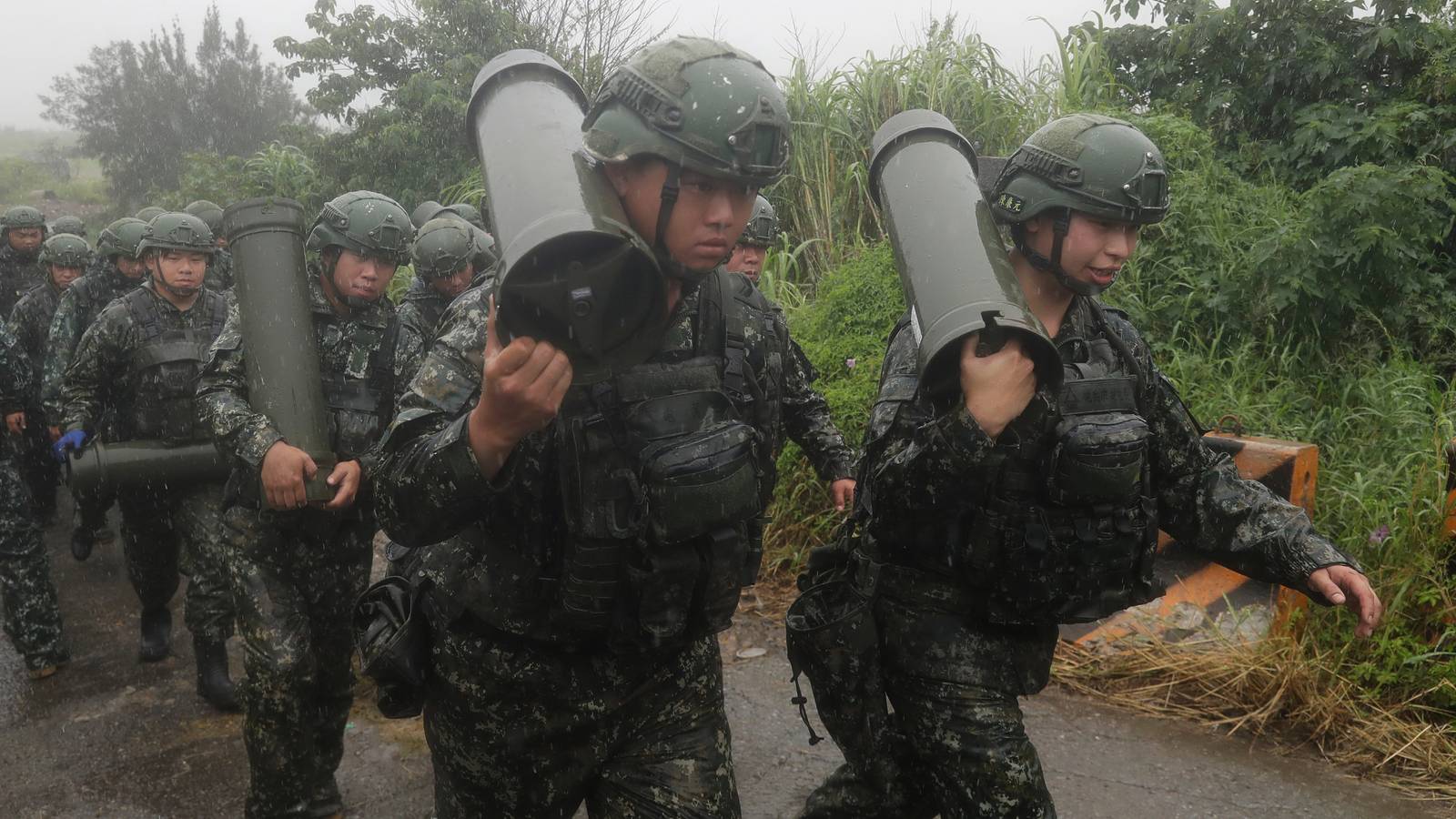
Taiwan Strait: Taiwan Fires HIMARS in First Strait Live-Fire; PLA Tracks Dutch Frigate; Rhetoric Firm, Escalation Contained
Time window: Last 7 days · Audience: General analyst · Type: Situation report · DTG: 2026-06-10 19:10Z · Overall confidence: MEDIUM
BLUF
Taiwan very likely conducted the first-ever HIMARS live-fire into the Taiwan Strait on 10 June 2026, signaling an asymmetric defense focus. Beijing is likely to sustain close monitoring and firm messaging around foreign transits, while near-term escalation to 2022 missile-launch levels appears unlikely; the planned sale of 82 additional HIMARS to Taiwan remains uncertain.
Executive summary
On 10 June, Taiwan’s military fired U.S.-supplied HIMARS rockets into the Taiwan Strait in live-fire drills that also used 155 mm howitzers and practiced “shoot-and-scoot” tactics, marking the first firing of HIMARS rockets into these waters. Days earlier, China’s military publicly tracked the Dutch frigate HNLMS De Ruyter as it transited the Taiwan Strait and tied the passage to the ship’s late-May activity near the Paracels, while the PLA Eastern Theater Command declared continued vigilance. Around the Shangri-La Dialogue, Beijing lowered its level of representation and Washington’s defense chief avoided forceful Taiwan rhetoric, pointing to calibrated messaging. Taiwan’s move aligns with a U.S.-encouraged asymmetric strategy centered on mobile precision fires, but the December plan for 82 more HIMARS systems faces conflicting reporting about being on hold following a Trump, Xi meeting.
Key judgments
- Taiwan very likely conducted the first-ever firing of U.S.-supplied HIMARS rockets into the waters of the Taiwan Strait on 10 June 2026 during live-fire drills that also used 155 mm howitzers and emphasized shoot-and-scoot tactics. (Confidence: high · REPORTED)
- I&W: Taiwan’s Ministry of National Defense issues an official after-action report explicitly describing HIMARS rockets fired into the Taiwan Strait during the 10 June drill. (0-14 days)
- I&W: Taiwanese authorities correct the record to state the rockets were not HIMARS or were not fired into the Strait. (0-14 days)
- Taipei’s emphasis on mobile precision fires is very likely consistent with a U.S.-encouraged shift toward an asymmetric defense concept, in which HIMARS features prominently. (Confidence: medium · ASSESSED)
- I&W: Announcement of additional Taiwan training events or procurements highlighting dispersed coastal rocket batteries and HIMARS battalions. (1-3 months)
- I&W: Taipei elevates large conventional platforms as centerpiece acquisitions that eclipse mobile rocket forces. (1-3 months)
- There is a roughly even chance that the announced December plan to sell 82 additional HIMARS to Taiwan proceeds on its original terms, given competing reports that the package is on hold after a Trump, Xi meeting. (Confidence: low · ASSESSED)
- I&W: U.S. DSCA/DoD announcement of contract awards, Letters of Offer and Acceptance, or delivery schedules for the 82 HIMARS to Taiwan. (0-3 months)
- I&W: Official U.S. or Taiwan statement confirms deferral or cancellation of the 82-system sale. (0-3 months)
- Beijing likely will continue to publicly track and rhetorically challenge allied naval transits near Taiwan, linking them to South China Sea activities while asserting PLA Eastern Theater Command vigilance and framing Taiwan as a core interest. (Confidence: medium · ASSESSED)
- I&W: PLA Eastern Theater Command issues public tracking statements or imagery during the next Western/allied warship transit of the Taiwan Strait. (0-2 months)
- I&W: An allied transit occurs with no accompanying PLA public tracking or criticism. (0-2 months)
- Despite sharper military signaling, it is likely the near-term cross-Strait temperature stays below 2022 missile-launch levels as both sides calibrate messaging around high-profile forums. (Confidence: medium · ASSESSED)
- I&W: PRC public communications emphasize monitoring/transits and ADIZ messaging without declaring live-fire missile exclusion zones around Taiwan. (0-1 month)
- I&W: PLA announces or conducts ballistic missile launches into waters around Taiwan, akin to August 2022. (0-1 month)
- Available open-source signals this week suggest limited immediate impacts on maritime traffic and infrastructure during Taiwan’s drills, but this assessment is uncertain due to narrow samples and sensor limitations. (Confidence: low · ASSESSED)
- I&W: Commercial AIS tracks show sustained vessel traffic through the Strait with no widespread diversions; no official reports of on-island damage. (0-14 days)
- I&W: New maritime safety notices or diversions reduce Strait traffic density; high-confidence thermal signatures spike near Taiwan’s west coast. (0-14 days)
Outlook & scenarios
Signaling cycle without major escalation, 60%
Taiwan repeats asymmetric-focused live-fires and mobility drills over coming weeks, while Beijing sustains public tracking of allied transits and firm rhetoric but refrains from new missile launches around Taiwan. Diplomatic messaging stays calibrated around major forums, keeping the military tempo elevated but sub-threshold.
PLA counter-drills with missile firings (2022-pattern return), 30%
Following allied transits or additional Taiwan HIMARS events, the PLA announces maritime/air exclusion zones and conducts ballistic missile launches into waters around Taiwan, referencing precedent. Air and naval activity intensifies, flight routes are adjusted, and risk of miscalculation rises despite efforts to manage communications.
HIMARS sale stalls and creates a near-term capability gap, 40%
Conflicting signals culminate in a formal deferral of the 82-system HIMARS package. Taiwan continues training with existing batteries but faces a delayed scaling of rocket artillery capacity, prompting stopgaps such as enhanced training cycles, munitions stockpiling, or interim domestic alternatives.
Recommendations
- Establish a near-term collection plan keyed to the indicators above: monitor Taiwan MND and PLA Eastern Theater Command channels for drill notices, tracking statements, and any missile-exclusion announcements; set alerts on DSCA/DoD portals for contract or delivery updates tied to the 82-system HIMARS package.
- Task maritime monitoring to watch AIS density and routing through the Taiwan Strait, including recurring tracks of named sample vessels as reference points; pair with periodic NASA FIRMS checks to detect anomalous thermal activity along Taiwan’s west coast training areas.
- Catalog Taiwan’s firing ranges and likely HIMARS deployment zones on the west coast and in Taichung-area facilities; prioritize fresh commercial imagery after announced events to validate launcher dispersal patterns and logistics nodes.
- Prepare an escalation decision matrix anchored in 2022 benchmarks (missile launches, exclusion zones) to rapidly brief when activity crosses key thresholds; pre-draft risk messaging for civil aviation and shipping stakeholders if live-fire zones are declared.
- Maintain an alternatives log for the HIMARS sale status and pre-identify mitigating lines of effort (training tempo, munitions procurement, allied exercises) to brief if a formal deferral is announced.
Confidence & uncertainty
Overall confidence is medium. The HIMARS live-fire into the Strait is well-corroborated by multiple major outlets. Judgments on Beijing’s tracking and rhetoric use credible but fewer sources and official statements, yielding medium confidence. The status of the 82-system HIMARS sale is uncertain due to directly conflicting reports, lowering confidence. Assessments of maritime and on-island impacts rely on narrow AIS and thermal samples and are thus low confidence.
Cited sources
[1] wyso.org, Taiwan drills with U.S. rocket system, firing in China's direction (A) [2] Los Angeles Times, Taiwan fires rockets in China's direction from a U.S.-supplied mobile launching system in drill - Los Angeles Times (A) [3] ualrpublicradio.org, Taiwan drills with U.S. rocket system, firing in China's direction (A) [4] military.com, Taiwan Fires Rockets in China's Direction from a US-Supplied Mobile Launching System in Drill (B) [5] npr.org, Taiwan drills with U.S. rocket system, firing in China's direction (A) [6] marinelink.com, China's military claims to have tracked a Dutch frigate in the Taiwan Strait (D) [7] 中国驻比利时大使馆, 中国驻比利时大使费胜潮接受比利时荷语国家广播电视台《墙外的中国》节目专访实录 (A) · Wed May 31 2023 00:00:00 GMT+0000 (Coordinated Universal Time) [8] foreignpolicy.com, China Is Too Big for Shangri-La (B) [9] Wikipedia, 2022 Chinese military exercises around Taiwan (B) [10] Wikipedia, Fourth Taiwan Strait Crisis (B) [11] aisstream.io, AISStream vessel traffic, Taiwan (5 vessels) (F) [12] NASA, NASA FIRMS thermal detections, Taiwan (5d) (A)