TLP:CLEAR · Disclosure is not limited.
Taiwan Strait Tensions: Military Activity and Attribution, 17 to 24 October 2026
Time window: Last 7 days · Audience: General analyst · Type: Situation report · DTG: 2026-10-24 19:08Z · Overall confidence: LOW
BLUF
The PLA Navy announced that the Liaoning led a formation into the Western Pacific for training, while Keen Sword 27 is reported under way in Japan and PLA live-fire activity is scheduled in the southern Yellow Sea through 30 November. These activities do not establish a Taiwan-directed attack sequence; the reported US deployments to Ishigaki and Yonaguni remain unverified, and a PLA attack in the next 1 to 3 months remains unlikely on the supplied evidence.
Executive summary
Reporting says the PLA Navy announced on 14 October that the Liaoning led a formation into the Western Pacific for training. A separate account describes Keen Sword 27 running from 19 to 29 October across Japan, with about 45,000 Japanese Self-Defense Forces personnel and 12,000 US troops. The same reporting claims the US will deploy HIMARS to Ishigaki and NMESIS and the Marine Air Defense Integrated System to Yonaguni, but the supplied material does not independently verify those deployments. PLA live-fire activity is reported in the southern Yellow Sea from 15 October to 30 November, alongside footage of four named Type 071 amphibious transport docks conducting live-fire training. Separately, a trade publication describes an average of about 75 ships lingering off Tainan and Kaohsiung, while reporting that inspections found no regular PLA personnel or military surveillance equipment aboard inspected vessels. NASA FIRMS recorded six thermal detections in the Taiwan Strait on 23 and 24 October, none rated high-confidence; those detections record heat, not its cause.
Change from previous assessment
Since the 23 October brief, the Liaoning training report is now tied to a major-media account of a PLA Navy announcement, rather than relying only on the earlier low-reliability social-media account. This brief also adds reported Keen Sword 27 force totals and first-time participants, HIMARS on Ishigaki, footage of four Type 071 ships conducting live-fire training, and six FIRMS detections in the Taiwan Strait. The Yonaguni deployment claim has a further media account but remains unverified. The ship-cluster assessment is unchanged, and the judgement that a PLA attack in the next 1 to 3 months is unlikely remains at low confidence.
Key judgments
- The Liaoning formation was likely conducting Western Pacific training after the PLA Navy announced on 14 October that the carrier led a formation there. This establishes a reported carrier training deployment, not a Taiwan-directed operation. Confidence is medium because the supplied account relays the PLA Navy announcement but provides no independent tracking corroboration. (Confidence: medium · REPORTED)
- I&W: Confirm: a PLA Navy update or independent vessel tracking places the Liaoning formation in the Western Pacific during the next two weeks. (0-14 days)
- I&W: Break: a correction from the PLA Navy or the reporting outlet states that the 14 October deployment was misidentified or did not occur. (0-14 days)
- Keen Sword 27 was likely under way on 24 October, following its reported start on 19 October and planned end on 29 October. Reporting gives force totals of about 45,000 Japanese Self-Defense Forces personnel and 12,000 US troops, and names France, Germany, the Netherlands, New Zealand and the Philippines as first-time participants. Confidence is medium: the reported dates and force details come through a single major-media account. (Confidence: medium · REPORTED)
- I&W: Confirm: a Japanese or US exercise release records activity through 29 October and identifies the participating forces or countries. (0-14 days)
- I&W: Break: an official Japanese or US statement says Keen Sword 27 was cancelled or ended before its reported 29 October finish. (0-14 days)
- The reported US deployment of HIMARS to Ishigaki and NMESIS and the Marine Air Defense Integrated System to Yonaguni remains unverified. The claims are specific, including Yonaguni's reported distance of about 110 km from Taiwan, but the supplied material offers no independent confirmation. Confidence is low because the deployment details rest on a single account. (Confidence: low · REPORTED)
- I&W: Confirm: dated imagery or a US or Japanese defence release identifies HIMARS on Ishigaki or NMESIS and the Marine Air Defense Integrated System on Yonaguni. (0-14 days)
- I&W: Break: a US or Japanese defence statement explicitly denies that either island deployment took place. (0-14 days)
- PLA training activity is likely continuing beyond the Taiwan Strait: reporting describes a 47-day, around-the-clock live-fire window in the southern Yellow Sea from 15 October to 30 November, and footage released by the PLA Navy on 16 October showing the Type 071 ships Kunlunshan, Changbaishan, Wuzhishan and Qilianshan conducting live-fire training. These reports indicate military activity, but do not establish preparation for an attack on Taiwan. Confidence is medium because the details are reported through one major-media account, albeit with reference to official notices and released footage. (Confidence: medium · REPORTED)
- I&W: Confirm: Yancheng Maritime Safety Administration notices or observed live-fire activity show the southern Yellow Sea window continuing after 24 October. (0-14 days)
- I&W: Break: the relevant maritime authority cancels or materially shortens the reported live-fire window before 30 November. (0-14 days)
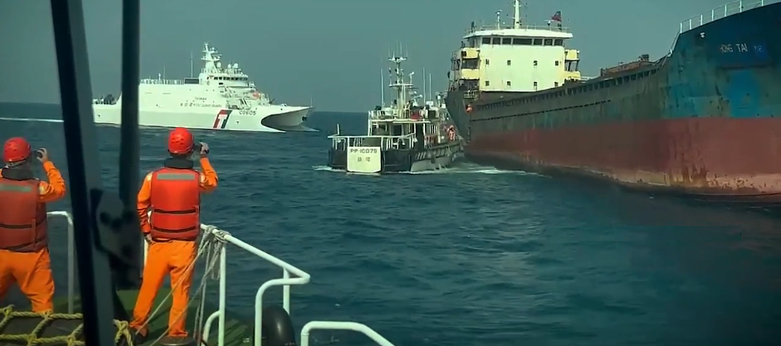
- The ship cluster off Tainan and Kaohsiung is likely a persistent maritime-security concern, but current reporting does not establish PLA direction. The Maritime Executive describes an average of about 75 ships, 65 classified as high risk, and reports that Taiwanese Coast Guard inspections found no regular PLA personnel or military surveillance equipment aboard inspected vessels. It also reports that the Coast Guard has driven off 240 ships and that a consultancy suspects some vessels of links to organised crime and smuggling. Confidence is low because these details and competing explanations rely on thin, single-publication reporting. (Confidence: low · ASSESSED)
- I&W: Confirm: Taiwanese Coast Guard inspection reporting identifies regular PLA personnel or military surveillance equipment aboard a vessel in the cluster. (1-3 months)
- I&W: Break: Coast Guard records or repeated vessel observations show the cluster dispersing and the recurring ship count falling well below the reported average of about 75. (1-3 months)
- The six NASA FIRMS thermal detections in the Taiwan Strait on 23 and 24 October are unlikely to indicate military activity: none was rated high-confidence, and the data record heat rather than cause. Confidence is medium because the detection count and confidence ratings come from an official system, while attribution remains undetermined. (Confidence: medium · ASSESSED)
- I&W: Break: geolocated imagery or an official incident report matches one of the six detections to a strike, shelling or other military event. (0-14 days)
- I&W: Confirm: no geolocated imagery or official incident report links the detections to military activity during the next two weeks. (0-14 days)
- A PLA attack on Taiwan in the next 1 to 3 months remains unlikely on the supplied evidence. The Liaoning training report, Keen Sword 27, the southern Yellow Sea live-fire window and the reported ship cluster do not establish a Taiwan-directed invasion sequence. Confidence is low because the reporting is unevenly corroborated and key deployment and vessel-attribution claims remain unverified. (Confidence: low · ASSESSED)
- I&W: Confirm: the PLA announces Taiwan-adjacent live-fire or exclusion zones alongside sustained naval or amphibious force movements directed towards Taiwan. (0-14 days)
- I&W: Break: no new Taiwan-adjacent exercise or exclusion notices, and no reported sustained naval or amphibious concentration directed towards Taiwan, appear by 30 November. (1-3 months)
Outlook & scenarios
Scheduled exercises continue without a Taiwan-directed operation (60%)
This is the most likely outlook. Keen Sword 27 ends on its reported schedule on 29 October, while the southern Yellow Sea live-fire window continues towards 30 November. The Liaoning's reported Western Pacific training remains separate from any demonstrated attack sequence against Taiwan.
Regional force signalling increases (25%)
PLA training and US-Japan exercise activity generate additional public signalling, but no Taiwan-directed operation is established. Confirmation of the reported HIMARS deployment on Ishigaki or NMESIS and air-defence deployment on Yonaguni would sharpen this scenario; those deployments remain unverified in the supplied material.
A Taiwan Strait crisis develops (10%)
New Taiwan-adjacent live-fire or exclusion zones coincide with sustained PLA naval or amphibious movements directed towards Taiwan. Such a change would be materially different from the geographically dispersed training and exercise reporting available in this brief.
A maritime incident involving the southwest Taiwan ship cluster (5%)
A collision, cable-related incident or confrontation involving one of the reported vessels off Tainan and Kaohsiung triggers a wider security response. The cluster's reported proximity to Taiwanese airbases and Tsoying Naval Base raises the potential impact, while its composition and purpose remain uncertain.
Recommendations
- Verify the reported Keen Sword 27 personnel totals, participating countries and 29 October end date against Japanese and US official exercise releases before using them as confirmed force figures.
- Seek dated visual or official confirmation of the reported HIMARS deployment on Ishigaki and NMESIS and Marine Air Defense Integrated System deployments on Yonaguni. Keep these claims labelled unverified until corroborated.
- Track Yancheng Maritime Safety Administration notices and reporting on activity in the southern Yellow Sea. Distinguish continuation of the announced live-fire window from new Taiwan-adjacent restrictions.
- Request or monitor Taiwanese Coast Guard inspection and incident reporting on the vessels off Tainan and Kaohsiung. Compare repeat vessel identities, inspection findings and any cable-related incidents before assigning military or criminal attribution.
- Use NASA FIRMS detections as an alert for further checking, not as evidence of military activity. Require location-matched imagery or an official incident report before attributing a detection to a strike or exercise.
- Keep the near-term Taiwan attack assessment at unlikely with low confidence. Reassess promptly if Taiwan-adjacent exercise notices coincide with sustained naval or amphibious force movements directed towards Taiwan.
Confidence & uncertainty
Overall confidence is low because the reporting is unevenly corroborated. The Liaoning, Keen Sword 27 and PLA training details are carried through a single major-media account, while the claimed US island deployments are not independently confirmed in the supplied material. The southwest Taiwan ship-cluster account comes from one trade publication and offers competing explanations without establishing vessel direction. NASA FIRMS provides reliable detection data, but not attribution.
Alternative analysis (red cell)
The FIRMS observations are best treated as indeterminate rather than unlikely to be military, because low sensor confidence and the absence of causal attribution do not exclude military heat sources. More broadly, the supplied reporting does not demonstrate an invasion sequence, but it also does not establish that an attack in the next one to three months is unlikely; the defensible conclusion is that the evidence is insufficient for a reliable near-term probability estimate.
Intelligence gaps
- [EEI 1.1 · PARTIAL] Concentration of PLA amphibious warfare vessels exceeding 15 ships in Fujian Province naval ports. Recommended collection: imagery/satellite
- [EEI 1.2 · UNCOVERED] Unplanned surge in encrypted communications traffic from PLA Eastern Theater Command headquarters. Recommended collection: SIGINT
- [EEI 1.3 · UNCOVERED] Movement of PLA airborne unit heavy equipment to airbases within 200km of Taiwan Strait. Recommended collection: imagery/satellite
- [EEI 2.1 · UNCOVERED] Daily aggregate count of PLA Air Force sorties within 30km of the median line. Recommended collection: radar
- [EEI 2.2 · UNCOVERED] Number of active PLA naval live-fire exercise zones in Taiwan Strait international waters. Recommended collection: SIGINT
- [EEI 2.3 · UNCOVERED] Positioning of PLA Type 055 destroyers west of 122°E longitude. Recommended collection: maritime/AIS
- [EEI 3.1 · UNCOVERED] Operational activation of Taiwan's Hsiung Feng III coastal defense missile systems. Recommended collection: SIGINT
- [EEI 3.2 · UNCOVERED] Increased cargo aircraft movements to Penghu Islands military installations. Recommended collection: air/ADS-B
Red cell review: PARTIAL DISSENT
TLP:CLEAR