TLP:CLEAR · Disclosure is not limited.
Ukraine: Sustained Air Campaign Expands Pressure on Infrastructure
Time window: Last 1 day · Audience: General analyst · Type: Situation report · DTG: 2026-09-23 01:46Z · Overall confidence: HIGH
BLUF
Russia very likely sustained a broader, more persistent air campaign against Ukraine on 22 September 2026, using daytime barrages and striking energy, logistics, industrial and transport sites across multiple oblasts. Ukraine likely continued deep strikes against Russian oil infrastructure, while discussions of an energy ceasefire have not produced a verified reduction in attacks.
Executive summary
Russian forces reportedly conducted strikes across 11 Ukrainian regions on 22 September, including attacks on a Poltava energy facility, Fire Point missile production sites, logistics hubs in Odesa, electrical substations and railway facilities. Ukrainian authorities reported power outages in seven oblasts. Ukraine also struck or attempted to strike Russian refineries in Samara, Ufa and Moscow, although damage to the Kuybyshev facility remains disputed. The pattern indicates a reciprocal long-range strike cycle with rising risks to civilian services, industrial output and Black Sea shipping. Diplomatic contacts between Donald Trump and Volodymyr Zelenskyy produced discussion of a proposed energy ceasefire, but Russian and Ukrainian strikes continued.
Change from previous assessment
Since the prior brief on 22 September 2026, the assessment has added a confirmed 22 September Russian strike pattern involving daytime barrages, 11 Ukrainian regions, electrical substations, rail facilities, Fire Point sites and Odesa logistics hubs. Confidence has increased in the assessment that the reciprocal long-range strike cycle is already active rather than only forecast. The brief also adds the proposed energy ceasefire as an explicit judgment, with confidence lowered because the reported agreement status conflicts with continued strikes. No prior judgment has been retired.
Key judgments
- Russia very likely sustained and intensified a distributed air campaign against Ukraine on 22 September 2026, shifting from concentrated overnight attacks towards barrages throughout the day. Reporting describes strikes in 11 Ukrainian regions, including Kyiv, Dnipropetrovsk, Poltava, Vinnytsia and Odesa, using ballistic missiles, jet-powered Shahed drones and other strike systems. The core pattern is supported by wire-service, major-media and local reporting, although the precise number of weapons intercepted and the effect of individual strikes remain less certain. (Confidence: high · REPORTED)
- I&W: Confirm: Ukrainian authorities or multiple independent media outlets record daytime Russian drone or missile barrages on at least three days and impacts in at least five oblasts. (0-14 days)
- I&W: Break: Ukraine records 48 consecutive hours without reported Russian impacts on energy, logistics, industrial or railway facilities, with attacks confined to isolated incidents. (0-7 days)
- Russian forces very likely prioritised Ukrainian military sustainment, energy and transport infrastructure during the 22 September campaign. Reported targets included Fire Point production facilities in Pavlohrad and Kyiv Oblast, a Poltava energy facility owned by Naftogaz, the Kremenchuk refinery, the JTI Ukraine facility reportedly converted to ammunition production, a Vinnytsia railway junction, electrical substations and logistics hubs at Odesa and Reni. The targeting assessment is medium confidence because several target descriptions come from Russian reporting and operational damage at some sites is not independently established. (Confidence: medium · ASSESSED)
- I&W: Confirm: Ukrainian authorities or independent imagery report additional damage, production stoppages or prolonged outages at named energy, missile-production, logistics or railway facilities. (0-14 days)
- I&W: Break: Ukrainian and independent reporting shows the named facilities operating normally and attributes the reported effects only to unrelated civilian damage. (0-14 days)
- Ukraine likely continued a deep-strike campaign against Russian energy infrastructure on 22 September 2026, following the 20 September attack on Moscow and Moscow Oblast. Reports identified Ukrainian strikes on the Samara and Ufa refineries, and the Ukrainian General Staff confirmed a strike on the Kuybyshev Oil Refinery in Samara. Russian air defences separately reported intercepting 297 Ukrainian drones over 15 Russian regions. The extent of refinery damage remains disputed because Samara authorities did not confirm damage to the oil facility. (Confidence: medium · ASSESSED)
- I&W: Confirm: Ukraine's General Staff, Russian regional authorities or independent imagery confirms additional Ukrainian strikes on Russian refineries or oil-storage facilities. (0-14 days)
- I&W: Break: no further Ukrainian deep strikes are reported for 14 days and Russian authorities confirm that the Samara, Ufa, Kuybyshev and Moscow facilities sustained no operational damage. (0-14 days)
- Russian and Ukrainian long-range strikes very likely will continue causing civilian harm and infrastructure disruption in Ukraine during the next 14 days. The 22 September strikes were followed by power outages in Kyiv, Dnipropetrovsk, Vinnytsia, Zhytomyr, Mykolaiv, Chernihiv and Sumy oblasts, while reported attacks caused civilian casualties in Dnipro and struck logistics and residential sites. The forecast is medium confidence because the evidence establishes current harm but does not establish the location or scale of the next strike's effects. (Confidence: medium · ASSESSED)
- I&W: Confirm: Ukrainian authorities report new civilian casualties, regional power outages or railway disruption after Russian strikes on at least two days. (0-14 days)
- I&W: Break: Russian strikes continue but Ukraine reports no new civilian casualties, power outages or damage to essential transport infrastructure for 14 days. (0-14 days)
- The proposed bilateral energy ceasefire is unlikely to constrain near-term strikes. Donald Trump and Volodymyr Zelenskyy discussed a potential ceasefire on energy-related targets, while the Kremlin described a moratorium as conditional on lifting Western sanctions. Trump's separate statement that Russia and Ukraine had already agreed to an energy ceasefire conflicts with reporting that the arrangement remained under discussion, and strikes continued after the earlier declaration. (Confidence: medium · ASSESSED)
- I&W: Confirm: Russia and Ukraine issue matching public terms for an energy ceasefire and report 72 hours without verified strikes on energy facilities. (0-14 days)
- I&W: Break: either side reports new strikes on energy facilities after the New York discussions, or Moscow and Kyiv issue incompatible conditions for implementation. (0-7 days)
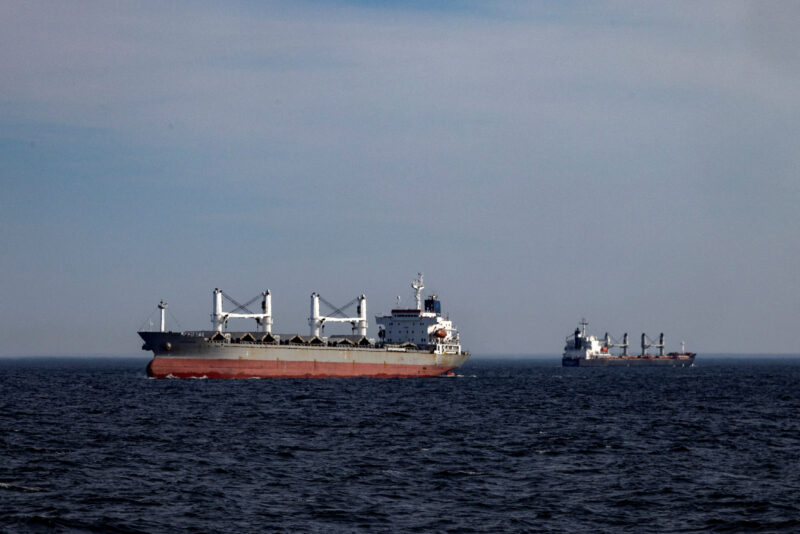
- Black Sea air and maritime attacks are very likely to continue disrupting Ukrainian and Russian grain flows, with effects extending beyond the immediate strike zone. Reports identify attacks on Odesa logistics hubs, Reni port and a dry cargo ship carrying military cargo, alongside a backlog of roughly 80 vessels at Ukrainian Danube ports. Combined Russian and Ukrainian wheat exports are estimated at roughly half of the previous year's July to September level, while the attribution for closure of the Black Sea route remains disputed. (Confidence: medium · ASSESSED)
- I&W: Confirm: vessel tracking records a larger backlog at Ukrainian Danube ports, or additional attacks close Odesa, Reni or other grain-handling facilities. (0-14 days)
- I&W: Break: Black Sea grain traffic resumes at major Ukrainian ports and the vessel backlog falls below its 22 September level without new port or vessel attacks. (1-3 months)
Outlook & scenarios
Sustained reciprocal strike cycle (65%)
Likely. Russia continues daytime and overnight strikes against Ukrainian energy, logistics and industrial targets, while Ukraine conducts additional deep strikes against Russian refineries and other energy infrastructure. Civilian harm, power outages and shipping disruption remain persistent features of the next 14 days.
Limited energy-target pause (25%)
Unlikely. Trump, Zelenskyy and the Kremlin establish matching terms for a narrow energy ceasefire. The pause reduces attacks on refineries, substations and power facilities while strikes continue against other military and logistics targets.
Expanded mass-strike phase (40%)
Roughly even chance. Russia conducts a new major attack using large numbers of jet-powered drones, ballistic missiles and other strike systems against several Ukrainian regions, prompting another Ukrainian deep-strike response against Russian energy sites.
NATO spillover (10%)
Very unlikely but high impact. A Russian drone or missile attack reaches NATO territory, or an incident involving suspected Russian sabotage causes casualties or major disruption in a European state. This would sharply widen the political and security consequences of the campaign.
Recommendations
- Maintain a 24-hour strike tracker that separates reported launches, interceptions, impacts, secondary explosions and confirmed damage. Record whether each event occurs during daytime or overnight operations.
- Prioritise verification of damage and operational disruption at the Poltava Naftogaz facility, Fire Point sites in Kyiv Oblast and Pavlohrad, the Kremenchuk refinery, Interpipe Steel, the Odesa and Reni logistics hubs, and the Kuybyshev, Ufa and Moscow refineries.
- Treat the energy ceasefire as unconfirmed until Russia and Ukraine issue matching terms and the absence of strikes on energy facilities is observable for at least 72 hours.
- Update infrastructure and civilian-impact reporting separately from military target reporting. Track outages, railway interruptions, refinery production stoppages, residential damage and casualty figures by oblast.
- Monitor vessel-tracking data around Odesa and the Danube ports, including the roughly 80-vessel backlog, alongside attacks on grain terminals, silos and cargo ships.
- Maintain a separate warning stream for possible spillover into NATO territory, including drone or missile incursions, fires at defence facilities and incidents involving logistics assets supporting Ukraine.
Confidence & uncertainty
Overall confidence is high because the core assessment is supported by multiple independent wire-service, major-media and local reports, including Ukrainian official statements, Russian official statements and reporting from locations affected by the strikes. The principal uncertainties concern the operational damage at Russian refineries, the effect of strikes on named Ukrainian facilities, conflicting casualty figures in Kharkiv Oblast and whether the proposed energy ceasefire has any enforceable terms.
Intelligence gaps
- [EEI 1.1 · PARTIAL] Number of airstrikes and aircraft/UCAV sorties per 24-hour period, broken down by administrative region and timestamped geolocation of each strike/strike cluster. Recommended collection: air defense radar/ADS-B
- [EEI 1.3 · UNCOVERED] Airspace access and sortie origin information: airbases, staging areas, tanker/ISR support flights, and routing corridors used in the last 7 days. Recommended collection: airspace/ADS-B; satellite/imagery
- [EEI 2.1 · PARTIAL] Confirmed civilian fatalities and injuries attributed to airstrikes by location and date, including hospital admission logs and mortuary reports. Recommended collection: civilian authorities/human intelligence
- [EEI 2.2 · UNCOVERED] Functional status reports and capacity of hospitals and emergency services in strike-affected areas (beds available, emergency department functionality, evacuation of patients). Recommended collection: humanitarian organizations/civilian authorities
- [EEI 2.4 · UNCOVERED] Population displacement metrics: numbers and routes of internally displaced persons, shelter occupancy rates, and evidence of mass evacuations or blocked humanitarian access corridors. Recommended collection: humanitarian organizations; social media
- [EEI 3.1 · PARTIAL] Statements, orders, or internal communications (official or leaked) indicating stated campaign objectives, target prioritization, or changes in rules of engagement. Recommended collection: signals/COMINT; open-source media
- [EEI 3.2 · UNCOVERED] Evidence of munitions and parts resupply rates: documented deliveries to forward depots/airbases, rail/road convoys with munitions manifest, or satellite imagery showing stockpile levels over time. Recommended collection: logistics tracking; satellite/imagery
- [EEI 3.3 · PARTIAL] Indicators of escalatory posture or force employment changes: deployment or activation of long-range strike assets, increased sorties of strategic platforms, or movement/deployment of additional surface-to-air systems. Recommended collection: satellite/imagery; air defense radar
- [EEI 3.4 · UNCOVERED] Foreign involvement or external support evidence: observed deliveries of strike munitions, presence of foreign contractor personnel at bases, or procurement transactions tied to the campaign. Recommended collection: customs/open-source intelligence; satellite/imagery
Cited sources
[1] globalbankingandfinance.com · Zelenskiy Warns of New Russian Mass Attack on Ukraine | Finance News (B) · Tue Sep 22 2026 23:36:40 GMT+0000 (Coordinated Universal Time) · sha256:7131af00ebf6 [2] Rambler News (news.rambler.ru), republishing Svobodnaya Pressa (Свободная пресса) · «Это уже не проблема, это катастрофа»: Киев, Одесса и Житомир снова в огне, под вечер вышли на охоту реактивные «Герани», впереди ночь (B) · Tue Sep 22 2026 18:08:28 GMT+0000 (Coordinated Universal Time) · sha256:b54375bad6cf [3] Рыбарь (Rybar) via tvgram.ru · Удары ВС РФ по Украине, мобилизация и Феофан Грек: дайджест Рыбаря (E) · Tue Sep 22 2026 20:40:00 GMT+0000 (Coordinated Universal Time) · sha256:310b9e5e7998 [4] CBC News · Trump and Zelenskyy discuss potential for energy truce in face of new wave of strikes on infrastructure (A) · Tue Sep 22 2026 14:44:12 GMT+0000 (Coordinated Universal Time) · sha256:781a43d5e036 [5] 24 Канал (24tv.ua) · Обзор событий войны и карта боевых действий сегодня, 22 сентября – освобождение Шандрыголового, удары России (B) · Tue Sep 22 2026 15:00:00 GMT+0000 (Coordinated Universal Time) · sha256:5ed64ebb928a [6] pda.orsk.ru · ВС РФ поразили ВСУ в районе семи поселков в котле в Харьковской области, а украинский завод «Интерпайп сталь» остановил производство после удара ВС РФ (D) · sha256:18f45e84e25d [7] Bloomberg (republished by gCaptain) · The Other Hormuz: Black Sea Blockade Threatens a Food Supply Shock (A) · Tue Sep 22 2026 16:55:14 GMT+0000 (Coordinated Universal Time) · sha256:608cd4c7db3b [8] Reuters (republished by gCaptain) · Russia's Arctic Port Murmansk to Use Fertilizer Equipment to Start Shipping Grain (A) · Tue Sep 22 2026 17:43:35 GMT+0000 (Coordinated Universal Time) · sha256:2b09b1b038ad
Source content hashes were computed at collection time; the cited text is preserved unmodified for the life of this product.
Red cell review: CONCUR WITH COMMENT
TLP:CLEAR