TLP:CLEAR · Disclosure is not limited.
US-Iran Exchanges Keep Hormuz Tensions Acute
Time window: Last 1 day · Audience: General analyst · Type: Situation report · DTG: 2026-08-23 16:37Z · Overall confidence: HIGH
BLUF
US-Iran military and economic pressure is very likely to remain acute through 6 September 2026. Commercial traffic through the Strait of Hormuz is likely to remain severely constrained rather than fully halted, while Iranian warnings and reported attacks on UAE-linked vessels raise the risk of wider Gulf spillover.
Executive summary
The United States is maintaining sanctions, blockade enforcement and economic pressure against Iran, while Iranian officials are threatening US economic interests and neighbouring states that support Washington. JMIC continues to rate the Strait of Hormuz threat level as SEVERE, and Kpler and commercial vessel-tracking data show sharply reduced traffic, although US claims of oil flows above 8 million barrels per day and more than 15 million barrels moved on Tuesday conflict with those indicators. France, the United Kingdom, Italy, Ukraine, Saudi Arabia and Pakistan are also involved through military deployments, specialist support or scheduled diplomatic engagement. Economic and humanitarian effects remain serious, but the timing and quality of several supporting claims limit confidence in their current scale.
Change from previous assessment
Since the 22 August brief, the assessment of Hormuz traffic has been raised from low to medium confidence because JMIC's SEVERE rating, Kpler's count of 95 crossings and lower commercial tracking data provide additional corroboration, although US oil-flow claims remain unresolved. The wider spillover judgement is narrowed to documented pressure on UAE-linked vessels, Jordanian US facilities and Saudi export routes rather than an unconfirmed resurgence in Gulf of Aden piracy. A new judgement has been added on sustained international military and diplomatic involvement by France, the United Kingdom, Italy, Ukraine, Saudi Arabia and Pakistan. The prior assessment of acute US-Iran pressure is retained, while the economic judgement is lowered to low confidence because much of the supporting humanitarian and economic data is dated or temporally inconsistent.
Key judgments
- US-Iran military and economic pressure is very likely to remain acute through 6 September 2026. Washington is implementing sanctions, a naval blockade and wider economic pressure, while Iran has warned neighbouring states and prepared to strike US oil and other companies in the Middle East. The assessment is medium confidence because the reporting combines multiple major-media accounts with inconsistent dates and several statements of intent rather than independently verified operations. (Confidence: medium · ASSESSED)
- I&W: Confirm: on 24 August, Scott Bessent announces new economic measures targeting Iran and Iranian officials repeat threats against Gulf interests or US companies. (0-14 days)
- I&W: Break: Washington publicly suspends the naval blockade or materially eases the sanctions campaign, while Tehran announces an end to retaliatory threats and attacks. (0-14 days)
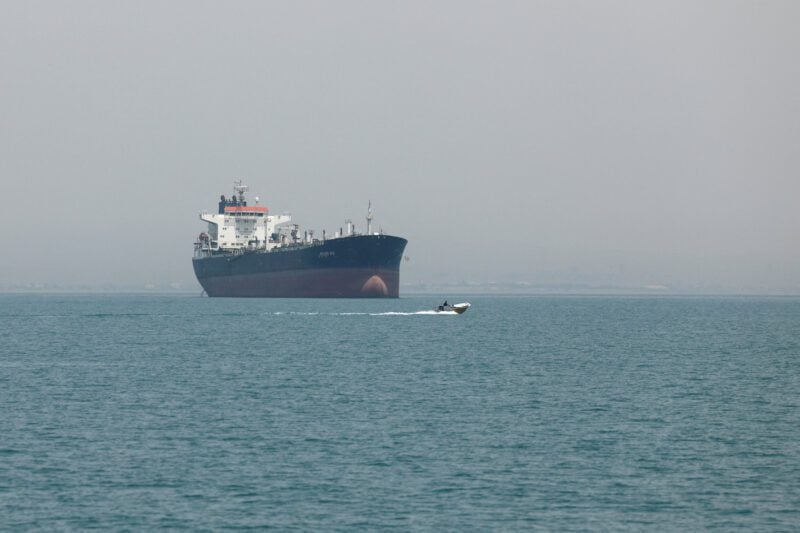
- Commercial vessel traffic through the Strait of Hormuz is likely to remain severely constrained rather than fully halted through 6 September 2026. JMIC rates the threat level as SEVERE, Kpler reported 95 confirmed crossings after a 19.5 percent weekly fall, and commercial tracking shows much lower ordinary traffic. Claims from Chris Wright of flows above 8 million barrels per day and more than 15 million barrels moved on Tuesday conflict with those indicators, keeping confidence at medium. (Confidence: medium · ASSESSED)
- I&W: Confirm: Kpler reports 95 or fewer confirmed weekly crossings and JMIC retains its SEVERE rating. (0-14 days)
- I&W: Break: commercial tracking records a sustained rise above 95 confirmed crossings per week and JMIC lowers the Hormuz threat rating from SEVERE. (0-14 days)
- Iran is likely to widen pressure against Gulf-linked energy interests and states cooperating with US economic measures during the next 14 days. The UAE has accused Iran of attacking ADNOC-linked vessels, reporting attributes nearly 20 missile and drone attacks to Iran against UAE oil-company vessels, and Iranian officials have threatened neighbouring states, their interests and oil export routes. Confidence is medium because the attacks and warnings are reported by major media, but attribution and chronology remain partly contested. (Confidence: medium · ASSESSED)
- I&W: Confirm: a new attack is reported against an ADNOC-linked vessel, a US company in the Middle East, a Jordanian US facility or an oil export route from the Persian Gulf. (0-14 days)
- I&W: Break: Iran publicly withdraws its threats against neighbouring states and no new attack is reported after further regional economic measures. (0-14 days)
- Economic and humanitarian stress in Iran and among Gulf shipping communities is likely to persist during the next 14 days, but the scale of current deterioration is uncertain. Reporting says Iranian oil exports have virtually stopped, inflation and currency pressures are deepening, more than 20,000 seafarers are affected and the crisis has raised fears after strikes on desalination plants. Confidence is low because several supporting indicators are dated to January or March 2026 and do not establish present conditions. (Confidence: low · ASSESSED)
- I&W: Confirm: Iranian oil exports remain virtually stopped and the IMO continues to report more than 20,000 seafarers affected by regional instability. (0-14 days)
- I&W: Break: Iranian exports resume at a clearly material level and the IMO revises the number of affected seafarers below 20,000. (0-14 days)
- International military and diplomatic involvement in the confrontation is very likely to continue through 6 September 2026. France has deployed the Charles de Gaulle to Cyprus, the United Kingdom has reinforced Persian Gulf bases, Italy has deployed naval vessels and air-defence systems, Ukraine has sent drone specialists to US bases, and Saudi and Pakistani leaders have scheduled engagement on Iran. The reporting is consistent across the named actors, supporting high confidence, but it does not establish a common command arrangement or coordinated diplomatic strategy. (Confidence: high · ASSESSED)
- I&W: Confirm: Asim Munir visits Tehran on 24 August while France, the United Kingdom or Italy announces additional deployments or expanded protection missions. (0-14 days)
- I&W: Break: the Charles de Gaulle, United Kingdom forces or Italian naval and air-defence assets are withdrawn without replacement and no further senior diplomatic engagement is announced. (0-14 days)
Outlook & scenarios
Managed pressure with constrained Hormuz traffic (55%)
The United States maintains sanctions and blockade pressure without immediately reopening large-scale military operations. Iran keeps commercial traffic through Hormuz reduced while permitting selected Iraqi oil tankers to transit. European and Gulf deployments protect bases and shipping, while Saudi crude continues to move through northern Red Sea routes.
Wider Gulf spillover (25%)
Iran acts on its warnings by targeting US economic interests, ADNOC-linked vessels, Jordanian facilities or Gulf oil export routes. The United States and European states increase maritime and air-defence activity, and Saudi diversion routes face additional pressure.
Conditional diplomatic de-escalation (15%)
Masoud Pezeshkian's call for an end to the war, Asim Munir's planned visit to Tehran and Saudi diplomatic engagement in France produce talks. Iran links full reopening of Hormuz to the lifting of the US blockade, easing of oil sanctions, release of frozen assets and an end to military threats. Shipping improves in stages rather than returning immediately to normal.
Wildcard: full Gulf oil-route interdiction (8%)
Iran moves from restricting Hormuz traffic to attempting to block all routes used to export oil from the Persian Gulf. Attacks on Gulf energy interests spread beyond the Strait, producing a high-impact disruption to regional exports and forcing further military mobilisation.
Recommendations
- Maintain a daily Hormuz traffic dashboard that reconciles JMIC's threat rating, Kpler's confirmed crossing count, commercial vessel-tracking data and the US administration's reported oil-flow figures. Escalate analytic review when the sources diverge by more than one reporting cycle.
- Prepare a same-day assessment of Scott Bessent's expected 24 August announcement. Map each measure against Iranian warnings concerning oil-smuggling networks, cash transfers, exchange houses, ship registries and front companies.
- Track named escalation points separately: ADNOC-linked vessels, US oil companies in the Middle East, US facilities in Jordan, Saudi export routes, the Bab el-Mandeb, and the Yanbu to Ain Sukhna tanker route.
- Follow Asim Munir's 24 August visit to Tehran, Mohammed bin Salman's France visit and Masoud Pezeshkian's negotiating position. Record whether any statement addresses the specific Iranian conditions for reopening Hormuz.
- Keep a humanitarian watchlist for seafarer impacts, desalination-plant damage, food-import disruption and Iranian inflation and currency pressure. Treat January and March indicators as historical baselines until refreshed reporting is available.
- Assess the operational effect of the USS Abraham Lincoln's more than 240 days at sea and reported crew welfare incidents. Flag any evidence of reduced sortie generation, crew relief or a change in the carrier's Gulf deployment.
Confidence & uncertainty
Overall confidence is high because the core situation is supported by multiple high-confidence event groupings and corroborating reporting from JMIC, Kpler, commercial vessel tracking, official statements and major media. The strongest evidence concerns the severe Hormuz threat rating, reduced commercial traffic, Iranian warnings and the presence of external military and diplomatic actors. The principal uncertainties are the contradiction between reported commercial traffic data and US oil-flow claims, inconsistent event dates, and the limited current evidence for the scale of humanitarian and economic effects.
Intelligence gaps
- [EEI 1.1 · UNCOVERED] Concentrations or unusual movements of IRGC-Navy fast attack craft, small boat swarms, or escort vessels within 200 km of US/allied ships, including approach distances and formation changes. Recommended collection: maritime/AIS
- [EEI 1.2 · UNCOVERED] Detected pre-launch activity at coastal missile or rocket batteries (vehicle dispersal, fuel/warhead handling, radars powering up, transport erector launchers moving to firing positions). Recommended collection: imagery/signals
- [EEI 1.3 · PARTIAL] Increased launch/arming/positioning of armed UAVs (MALE/loitering munitions) or tactical aircraft at Iranian coastal bases with sortie generation rates and munitions loadouts. Recommended collection: air/ADS-B/imagery
- [EEI 1.4 · UNCOVERED] Command-and-control indications of attack orders or elevated rules-of-engagement from IRGC/General Staff (intercepted communications, internal order messages, force-wide alert messages). Recommended collection: signals/human
- [EEI 2.2 · UNCOVERED] Issuance of formal orders, mobilization directives, travel restrictions, or official internal communications within IRGC/Armed Forces indicating escalation posture or stand-down. Recommended collection: human/diplomatic
- [EEI 2.3 · UNCOVERED] Directives, logistics movements, or communications from Iranian commanders to regional proxy militias (Houthis, Iraqi Shia militias, Lebanese groups) that change their threat posture or task them with specific operations. Recommended collection: signals/human
- [EEI 2.4 · PARTIAL] Changes in Iran's diplomatic exchanges with key states (offers of negotiation, warnings, or coordination with Russia/China) or requests for deconfliction with maritime/naval actors. Recommended collection: diplomatic
- [EEI 3.1 · PARTIAL] Incidents involving commercial vessels within the Strait of Hormuz or Persian Gulf: attacks, boarding attempts, near-misses, AIS spoofing or deliberate AIS outages, including vessel IDs and locations. Recommended collection: maritime/AIS
- [EEI 3.2 · UNCOVERED] Discovery or reporting of naval mines, unexploded ordnance, or damage to fixed maritime infrastructure (oil platforms, terminals, pipelines) with geolocated imagery or on-scene assessments. Recommended collection: imagery/open-source
- [EEI 3.3 · PARTIAL] Commercial indicators of disruption: sudden increases in war-risk insurance premiums for Gulf transits, vessel re-routing decisions, port throughput reductions, or charter cancellations for Gulf shipments. Recommended collection: financial/commercial
- [EEI 3.4 · UNCOVERED] Movements or posture changes of regional state navies/air forces (Saudi, UAE, Kuwait, Bahrain, UK) such as task group departures, airbase dispersals, or announced maritime patrols near choke points. Recommended collection: open-source/imagery
Cited sources
[1] japantimes.co.jp · Trump’s economic isolation plan risks Iran strikes across Gulf (A) · sha256:74c0e675c764 [2] firstpost.com · Trump’s economic squeeze on Iran could widen the war across the Gulf (B) · sha256:ff49b5efcc97 [3] Российская газета · Иран пригрозил соседям последствиями за поддержку экономической войны США (B) · sha256:5b941f541814 [4] gcaptain.com · Trump Administration Claims Massive Oil Flows Through Hormuz But Industry Data Raises Questions (B) · sha256:8f4f24a9f59d [5] polites.news · Иран пригрозил соседям ударом за поддержку экономического давления США (B) · sha256:8b197156f74b [6] ABC News Australia · Iranian strikes on US facilities heightened tensions in Jordan — ABC News Australia (A) · sha256:9a5ca99a3f18 [7] Informed Comment · Iran counters Trump “D-Day” by Menacing Arab Oil Monarchies (D) · sha256:2d16a7c5a60c [8] Wikipedia · Economic impact of the 2026 Iran war (B) · sha256:db39effd7ba9 [9] Wikipedia · 2026 Iran war regional mobilizations (B) · sha256:7a95d8fb6270 [10] rferl.org · Iran Hangs Another January Protester As Surge In Executions Continue (A) · sha256:26cf6ddcaf8e
Source content hashes were computed at collection time; the cited text is preserved unmodified for the life of this product.
TLP:CLEAR