TLP:CLEAR · Disclosure is not limited.
Venezuela: Dialogue Advances, Implementation Uncertain
Time window: Last 7 days · Audience: General analyst · Type: Situation report · DTG: 2026-08-19 16:08Z · Overall confidence: MEDIUM
BLUF
Likely US-backed talks have produced limited cooperation between Delcy Rodríguez's government and the opposition, including a reported release of 131 political prisoners, an agreement to replace Supreme Court judges and negotiations over 31 tonnes of gold held by the Bank of England. The next 1-3 months will test whether these commitments become auditable measures while inflation, earthquake reconstruction and uncertain sanctions arrangements continue to constrain the process.
Executive summary
Venezuela's political crisis remains in a negotiated phase. The government confirmed on 15 August that 131 political prisoners had been released, while Delcy Rodríguez's government and opposition representatives reportedly agreed to pursue the recovery of 31 tonnes of gold, establish transparency and auditing mechanisms, replace Supreme Court judges and prioritise reconstruction. Washington remains deeply involved through its three-stage transition plan, support for the talks and selective sanctions relief for Venezuelan oil trade. Economic and humanitarian pressures remain acute, with earthquake losses estimated at 6 per cent of GDP, reported monthly price growth of 19.9 per cent in July and more than 500,000 barrels per day of Venezuelan oil moving to US Gulf Coast refineries. Several earthquake casualty figures and dates, as well as the current scope of US sanctions relief, remain unresolved.
Change from previous assessment
The core assessment is unchanged: Venezuela remains in a negotiated but incomplete phase rather than a settled transition. This update sharpens the operational test by incorporating the reported six-hour Caracas session on 12 August, the government's confirmation of 131 prisoner releases on 15 August and current reports of more than 500,000 barrels per day moving to US Gulf Coast refineries. Confidence remains medium because the new reporting confirms political commitments more clearly than implementation, while sanctions status and earthquake data remain contested.
Key judgments
- Likely US-backed dialogue has produced limited, concrete cooperation between Delcy Rodríguez's government and Venezuelan opposition representatives. Reported measures include the release of 131 political prisoners on 15 August, an agreement to replace all judges on the Supreme Court of Justice, negotiations in Caracas on 12 August to recover 31 tonnes of gold held by the Bank of England, and proposed transparency and auditing mechanisms for recovered assets. The gold and judicial measures rely mainly on reported statements rather than independent evidence of implementation, so confidence is medium. (Confidence: medium · ASSESSED)
- I&W: Confirm: Caracas publishes a joint implementation document naming the asset custodian, auditing body and first reconstruction disbursement for the Bank of England gold. (0-14 days)
- I&W: Break: Delcy Rodríguez's government or opposition representatives publicly retract the prisoner-release, judicial-replacement or gold-recovery commitments. (0-14 days)
- Very likely Washington will remain the principal external sponsor of Venezuela's transition and will continue using political engagement alongside selective economic pressure. The State Department has welcomed the talks, Marco Rubio outlined a three-stage plan covering stabilisation, economic recovery, reconciliation and democratic transition, and the Senate has stated that US policy supports a peaceful transition through free and fair elections. Major-media reporting also describes US oil-trade licences and a gradual lifting of sanctions on Venezuelan interim authorities. Confidence is high for continued US diplomatic centrality, but the exact scope of sanctions relief remains unsettled. (Confidence: high · ASSESSED)
- I&W: Confirm: The State Department or Marco Rubio announces another negotiation round or publishes transition benchmarks for Caracas. (0-14 days)
- I&W: Break: Washington publicly ends the oil-trade licences and withdraws support for the dialogue with Delcy Rodríguez's government. (1-3 months)
- Likely the next 1-3 months will favour reconstruction and institutional changes over a full electoral transition. The US plan places democratic transition after stabilisation, economic recovery and political reconciliation, while current reported actions focus on judicial replacement, earthquake reconstruction and asset recovery. Marco Rubio stated on 2 June that conditions still needed to be established for elections. This is an assessed inference, not a directly reported electoral timetable, and confidence is medium. (Confidence: medium · ASSESSED)
- I&W: Confirm: Jorge Rodríguez or the National Assembly publishes an implementation schedule for judicial replacement and earthquake reconstruction without an accompanying election timetable. (0-14 days)
- I&W: Break: Venezuelan authorities and opposition representatives jointly publish an election timetable and defined electoral preparations. (1-3 months)
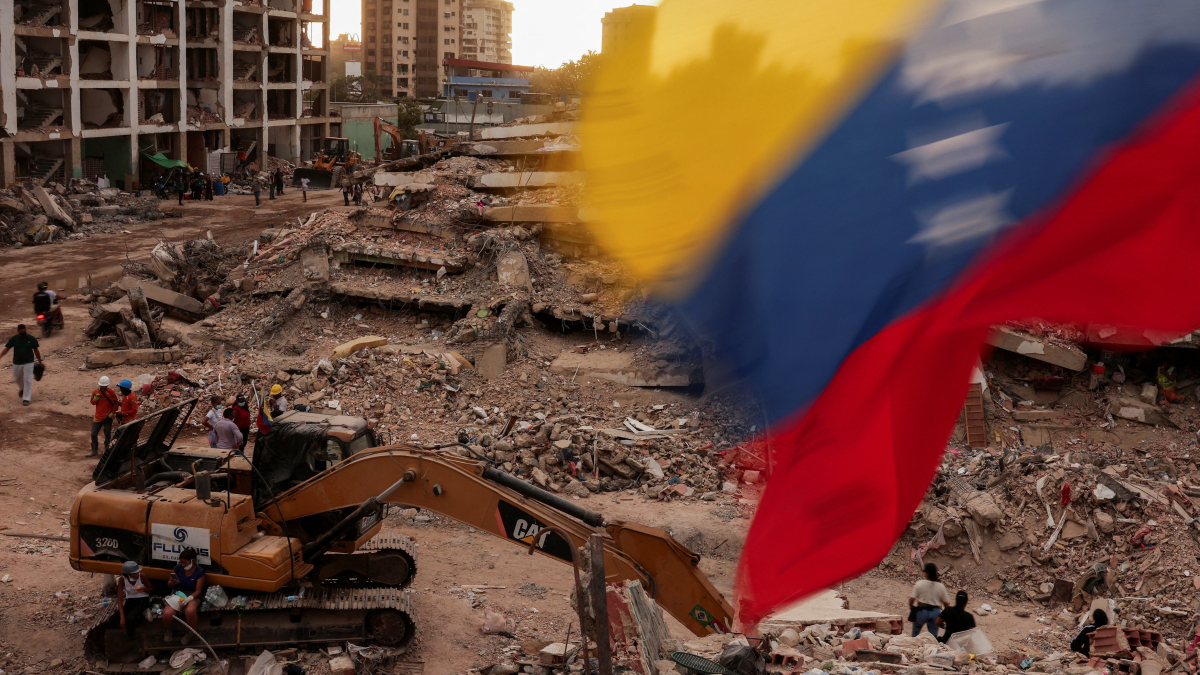
- Very likely economic and humanitarian pressures will continue to shape Venezuela's political bargaining, especially over gold access, oil revenues and sanctions relief. The 24 June earthquakes were reported to have killed more than 6,100 people and caused losses estimated at 6 per cent of GDP; prices then rose by 19.9 per cent in July. Venezuela is reported to be sending more than 500,000 barrels per day to US Gulf Coast refineries, while PDVSA expects crude output to reach 1.245 million barrels per day by the end of August. Confidence is medium because reporting conflicts over the earthquakes' date and death toll, and describes Venezuelan oil exports both as more than 500,000 barrels per day and as about half of output. (Confidence: medium · ASSESSED)
- I&W: Confirm: A further Venezuelan monthly price report remains at or above 19.9 per cent, or PDVSA reports output below its 1.245 million barrels per day end-August target. (0-30 days)
- I&W: Break: The Bank of England releases the 31 tonnes of gold and Venezuela documents initial reconstruction disbursements alongside sustained oil flows. (1-3 months)
Outlook & scenarios
Managed incremental bargaining (55%)
Likely over the next 1-3 months. Delcy Rodríguez's government and opposition representatives operationalise the reported prisoner releases, judicial changes and gold-recovery plan. Washington maintains diplomatic sponsorship and selective oil-trade licences. Reconstruction spending becomes the main practical test of the dialogue.
Stalled partial settlement (30%)
Unlikely, but plausible over the next 1-3 months. The parties preserve talks but fail to establish the audit, custody and disbursement arrangements needed to recover the Bank of England gold. Judicial changes remain declaratory, while economic pressure limits incentives for further concessions.
Sanctions reversal and asset impasse (15%)
Very unlikely, high impact. Washington narrows or revokes the oil-trade licences while the Bank of England continues to withhold the gold. Caracas loses economic room for reconstruction, and the dialogue shifts from implementation to disputes over sanctions, asset control and responsibility for the humanitarian burden.
Recommendations
- For the next 14 days, maintain a verification matrix for the reported 131 prisoner releases, judicial replacement agreement and 31-tonne gold plan. Record named beneficiaries, formal decrees, court actions, asset custodians, audit arrangements and evidence of disbursement separately from official announcements.
- Track US sanctions notices and oil-trade licences as distinct policy instruments. Do not treat reports of selective oil relief as evidence that broader financial sanctions have been removed.
- Prioritise collection on electoral milestones in Caracas, including any published timetable, electoral authority measures and links between judicial reform and election preparations. Treat the absence of a timetable as an unresolved gap rather than evidence that elections have been cancelled.
- Use the Bank of England's position, any Venezuelan opposition filing and any joint reconstruction spending record as the principal tripwires for assessing whether the gold agreement has moved beyond political statements.
- Treat NASA's 109 VIIRS thermal anomalies recorded in Venezuela on 18-19 August as an alert for follow-up only. Seek geolocation and independent imagery before attributing any anomaly to strikes, shelling, industrial fires or wildfires, because the data record heat but not cause.
- Keep earthquake casualty figures and dates marked as unresolved in analytic products until reconciled. Avoid presenting a single death toll or event date as settled fact.
Confidence & uncertainty
Overall confidence is medium. Current reporting on the talks combines official US and Venezuelan statements with major-media accounts, while NASA provides high-reliability monitoring data for the thermal anomalies. Confidence is lower on implementation because the prisoner release and institutional agreements are not independently documented in the available claims. The main uncertainties are conflicting earthquake dates and casualty figures, inconsistent descriptions of US sanctions relief, and differing measures of Venezuelan oil exports.
Intelligence gaps
- [EEI 1.2 · UNCOVERED] Public resignations, defections, detentions, or disciplinary actions naming specific senior military, intelligence, or police officers (name, rank, unit, date, supporting evidence). Recommended collection: open-source/social media
- [EEI 1.3 · UNCOVERED] Published orders, decrees, or personnel lists showing promotions, reassignments, or purges within the National Bolivarian Armed Forces, National Guard, or presidential protection units (document or official gazette reference). Recommended collection: open-source/diplomatic
- [EEI 1.4 · PARTIAL] Arrests, detentions, or restrictions on movement of named opposition leaders or political figures with detention location, custody authority, and detention conditions reported. Recommended collection: human/local media
- [EEI 2.1 · PARTIAL] Verified protest activity by location and estimated turnout (street-level counts, police reports, hospital/ambulance logs, timestamped geolocated photos or videos) on specified dates. Recommended collection: social media/open-source
- [EEI 2.2 · UNCOVERED] Documented lists or communications naming regional protest coordinators, strike organizers, or logistics nodes (transport bookings, fuel/food supply movements) tied to opposition plans. Recommended collection: social media/human
- [EEI 2.3 · UNCOVERED] Financial movements to opposition-controlled organizations or individuals above defined thresholds (bank transfers, wire records, large cash seizures, crypto wallet transfers with timestamps and amounts). Recommended collection: financial/forensic
- [EEI 2.4 · PARTIAL] Public formation or activation of alternative governance bodies by the opposition (declared councils/ministries, named members, declared headquarters or offices) with supporting documentation or announcements. Recommended collection: open-source/diplomatic
- [EEI 3.1 · PARTIAL] Crude oil and refined product export volumes from Venezuelan ports by vessel (AIS-identified tankers), including flagged destinations and any ship-to-ship transfer events, by week. Recommended collection: maritime/AIS
- [EEI 3.2 · UNCOVERED] Notices of correspondent banking relationship changes for PDVSA, the Central Bank of Venezuela, or other state entities (account freezes, closures, new bank signings) with bank names and dates. Recommended collection: economic/finance
- [EEI 3.3 · UNCOVERED] Detected arrivals/deployments of foreign military personnel, equipment, or advisory teams (air/sea container manifests, port calls with cargo descriptions, geolocated imagery of military assets) originating from Russia, Cuba, Iran, or other external supporters. Recommended collection: imagery
- [EEI 3.4 · UNCOVERED] Export records or interdictions showing volumes and destinations of gold, diamonds, or other high-value commodities linked to state entities or proxies (customs manifests, seized shipments, buyer identities). Recommended collection: economic/finance
Cited sources
[1] Congressional Research Service · Venezuela's Post-Maduro Political Transition and U.S. Policy (A) · sha256:95067ddc7334 [2] MercoPress · Venezuela's Reopening and Latin America's Payment Shift (B) · sha256:e8f6caa72233 [3] chosun.com · Venezuela's Interim Government, Opposition Reclaim Frozen Gold (A) · sha256:54efaf901202 [4] anewz.tv · Venezuela seeks Bank of England gold for earthquake recovery (B) · sha256:5c561a92d8c4 [5] Wikipedia · 2026 United States intervention in Venezuela (B) · sha256:8f74f5d5139e [6] Wikipedia · United States sanctions during the Venezuelan crisis (B) · sha256:2b016bcfb4c7 [7] aljazeera.com · US refineries taking in half of Venezuela’s oil output, official says (B) · sha256:df24647ec776
Source content hashes were computed at collection time; the cited text is preserved unmodified for the life of this product.
Red cell review: CONCUR WITH COMMENT
TLP:CLEAR