TLP:CLEAR · Disclosure is not limited.
West Africa: JNIM Pressure on Mali and Burkina Faso
Time window: Last 7 days · Audience: General analyst · Type: Situation report · DTG: 2026-08-20 00:10Z · Overall confidence: MEDIUM
BLUF
JNIM and the Azawad Liberation Front have demonstrated the ability to coordinate attacks across Mali, seize or contest military sites, and force withdrawals by Malian troops and Russia's Africa Corps. Continued JNIM and FLA pressure is likely, but the evidence supplied for 13-20 August 2026 does not independently establish a new attack surge: NASA's 45 thermal detections from 16 to 19 August record heat, not cause.
Executive summary
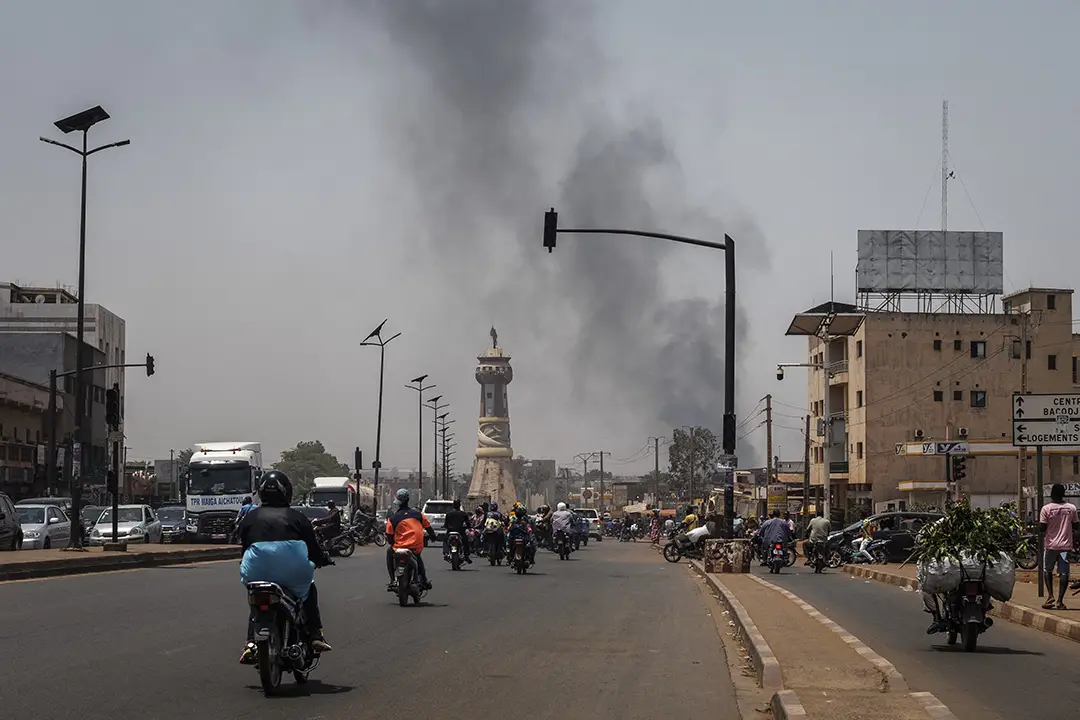
The main security development remains the 25 April 2026 offensive in Mali, when JNIM and the FLA coordinated attacks against Malian and Russian positions, captured or contested military sites, and contributed to withdrawals from northern locations. Reporting also indicates sustained JNIM activity in Burkina Faso and expansion beyond Mali towards Benin and north-western Nigeria. Humanitarian access remains constrained, while armed drones and attacks on schools increase risks to aid workers and communities. The assessment is limited by inconsistent dates and attributions in the reporting set, including the reported death of Mali's defence minister Sadio Camara, and by the absence of a dated, independently corroborated attack in the 13-20 August reporting window.
Key judgments
- JNIM and the Azawad Liberation Front have demonstrated a broad, coordinated campaign against Malian security positions, and continued attacks in Mali are likely over the next one to three months. The strongest evidence is concentrated on the 25 April 2026 offensive, including attacks on strategic sites in central and southern Mali, a military base in northern Mali, and reported gunfire in Gao, Sévaré, Kidal and Mopti. The assessment is weakened by inconsistent reporting on the roles of JNIM and the FLA and by the absence of a dated, independently corroborated attack in the current reporting window. (Confidence: medium · ASSESSED)
- I&W: Confirm, within 0-14 days: independently corroborated reporting or imagery shows JNIM or the FLA attacking or holding a new military site in Kidal, Aguelhok, Tessalit, Gao, Sévaré, Mopti, or central or southern Mali. (0-14 days)
- I&W: Break, within 0-14 days: Malian forces and Russia's Africa Corps re-establish and maintain control at Kidal, Aguelhok and Tessalit without a comparable JNIM or FLA operation. (0-14 days)
- Malian troops and Russia's Africa Corps are likely to remain unable to restore secure control across northern Mali in the near term, despite continued coordination between Mali and Russia. Reported defeats by JNIM and withdrawals from Kidal, Aguelhok and Tessalit indicate that the partnership has not yet reversed territorial and operational losses. Confidence is medium because the reporting is direct but largely concerns the April offensive rather than developments in the current week. (Confidence: medium · ASSESSED)
- I&W: Confirm, within 0-30 days: Malian or Russia's Africa Corps units withdraw from another northern or central base, or JNIM or the FLA establishes a sustained presence at one. (0-30 days)
- I&W: Break, within 1-3 months: Malian and Russian forces recapture and hold Kidal, Aguelhok and Tessalit while restoring regular military access between those locations. (1-3 months)
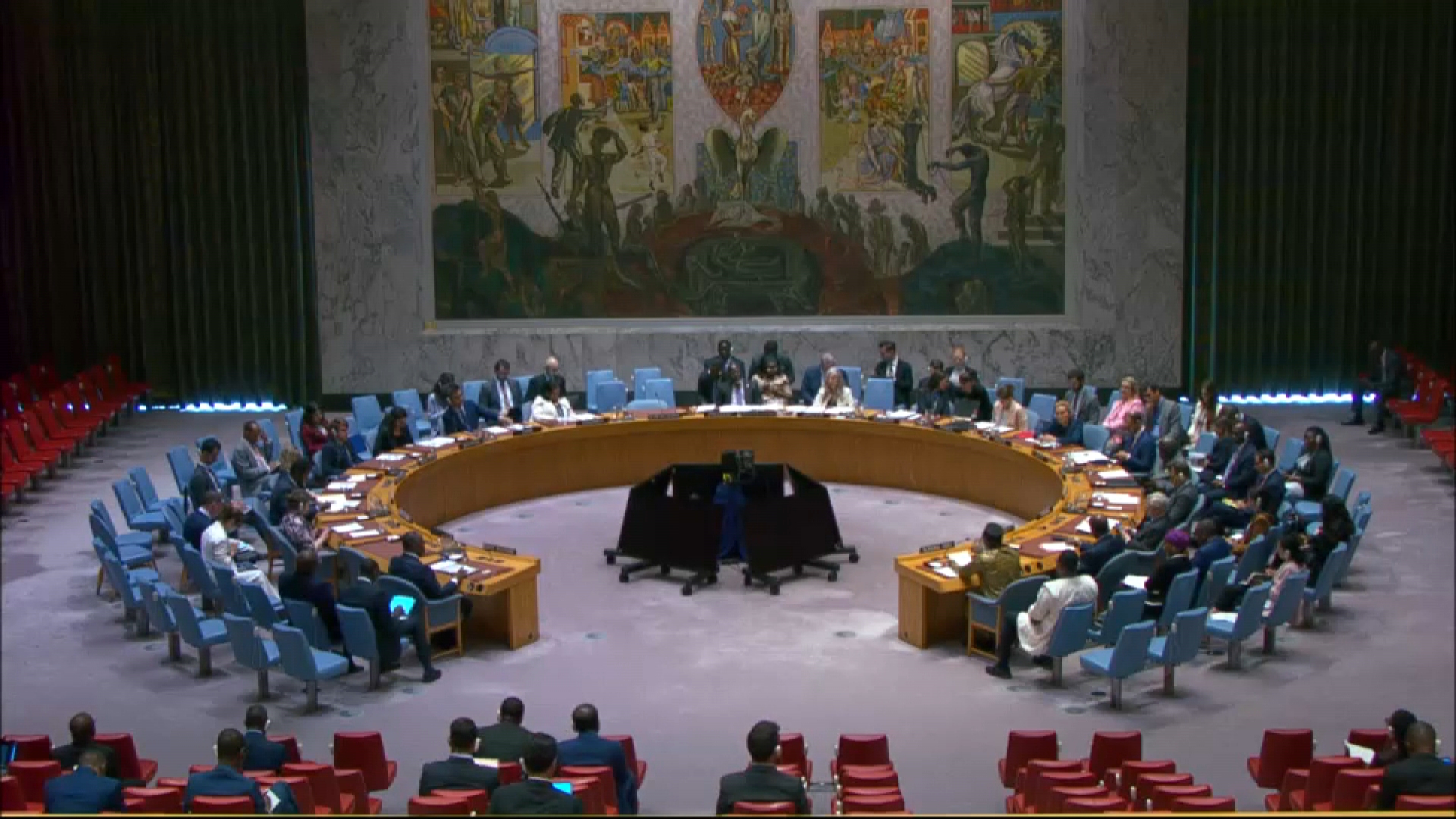
- JNIM's operational capacity is likely to have benefited from the reported 50-million-dollar ransom, while the use of drones, communications technology and cryptocurrencies is likely to improve the ability of non-state armed groups to sustain attacks. Confidence in the ransom assessment is low because the payer, timing and allocation are inconsistently reported, and the UN sanctions committee report was presented behind closed doors. The financial link therefore rests on thin, largely single-source reporting despite the reported UN attribution. (Confidence: low · ASSESSED)
- I&W: Confirm, within 0-60 days: a publicly attributable UN or independent financial investigation corroborates the 50-million-dollar payment, identifies the payer and traces funds to JNIM's April offensive or Sahel-based fighters. (0-60 days)
- I&W: Break, within 0-60 days: credible reporting establishes that the payment was not made by the United Arab Emirates, did not reach JNIM, or was unrelated to the April offensive. (0-60 days)
- Humanitarian access in the central Sahel is likely to remain severely constrained, while JNIM's reported spread into Benin and north-western Nigeria is likely to sustain pressure on coastal-state security and Ghana-Burkina Faso trade routes. Attacks on schools, armed drones and reported insecurity along trader routes will continue to expose civilians, aid workers and transporters. The practical effect of the Ghana-Burkina Faso defence agreement is uncertain because traders have questioned implementation and reported that they have not been briefed on the arrangements. (Confidence: medium · ASSESSED)
- I&W: Confirm, within 0-30 days: aid organisations report new access restrictions, an attack on a school or aid team in Mali or Burkina Faso, or verified JNIM activity in Benin or north-western Nigeria. (0-30 days)
- I&W: Break, within 1-3 months: Ghana and Burkina Faso deploy the agreed escorts on named trade routes, traders receive operating guidance, and no new verified JNIM activity or aid-access restriction is reported in the affected areas. (1-3 months)
- NASA's 45 VIIRS thermal detections in West Africa from 16 to 19 August 2026, including three high-confidence detections, are unlikely to establish a new jihadist attack surge because thermal signatures record heat rather than cause. The detections are a useful cue for collection, but they do not identify JNIM, the FLA or Islamic State's Sahel Province as responsible. (Confidence: high · ASSESSED)
- I&W: Confirm, within 0-14 days: no independent reporting links the three high-confidence detections to JNIM, the FLA or Islamic State's Sahel Province attacks. (0-14 days)
- I&W: Break, within 0-14 days: geolocated detections match independently corroborated strikes or shelling at named sites in Mali or Burkina Faso. (0-14 days)
Outlook & scenarios
Persistent localised insurgent expansion (55%)
JNIM and the FLA maintain pressure on military positions and strategic sites in Mali, while Malian forces and Russia's Africa Corps retain selected urban positions but do not reverse losses in northern Mali. JNIM activity in Burkina Faso continues at a high level.
Limited Mali-Russia containment (25%)
Mali and Russia convert their coordination into a limited counter-offensive, while Mali's Alliance of Sahel States partners begin deploying forces under the regional defence agreement. This reduces JNIM and FLA freedom of movement around northern bases without restoring durable state control across Mali.
Coastal spillover and humanitarian squeeze (15%)
JNIM expands activity from Mali into Benin and north-western Nigeria. The Ghana-Burkina Faso security arrangement remains poorly implemented, trade routes stay exposed, and humanitarian access in the central Sahel deteriorates.
Wildcard: rapid strategic rupture in Mali (5%)
JNIM and the FLA seize additional strategic sites, deepen the economic blockade affecting Bamako, and trigger a wider crisis in water, electricity and political control. This low-probability outcome would exceed the current assessment that JNIM taking control of Mali remains a distant prospect.
Recommendations
- Prioritise daily collection on Kidal, Aguelhok, Tessalit, Kati, Gao, Sévaré and Mopti. Cross-check official statements, commercial imagery and local reporting before treating any reported loss or recapture as confirmed.
- Maintain separate attribution lines for JNIM, the FLA and Islamic State's Sahel Province. Do not treat simultaneous attacks as evidence of operational cooperation without independent evidence of planning or command links.
- Track the 50-million-dollar ransom reporting as an unresolved financial intelligence lead. Seek corroboration of the payer, payment date, recipient, fund flows and any connection to the April 2026 offensive before using it to revise estimates of JNIM resources.
- Use NASA VIIRS detections from 16 to 19 August as collection cues rather than attack counts. Require geolocation and independent reporting before attributing a detection to JNIM, the FLA or Islamic State's Sahel Province.
- Monitor implementation of the Ghana-Burkina Faso defence agreement on named trade routes. Record whether escorts are deployed, whether traders receive operating guidance and whether reported attacks or vehicle losses decline.
- Reconcile the competing JNIM strength estimates of around 6,000 and 7,000-8,000 members. Until resolved, present the force estimate as uncertain and avoid using it as a precise measure of operational capacity.
- Review humanitarian indicators weekly, focusing on access restrictions, attacks on schools, armed-drone incidents affecting aid workers and new JNIM activity in Benin and north-western Nigeria.
Confidence & uncertainty
Overall confidence is medium. The assessment draws on high-reliability UN and NASA reporting, alongside multiple major-media accounts of the Mali offensive and regional security trends. The main uncertainties are the lack of a dated, independently corroborated attack in the current reporting window, inconsistent dates and attributions surrounding Sadio Camara's reported death and the FLA-JNIM roles, competing estimates of JNIM strength, and the single-source nature of key details about the reported 50-million-dollar ransom. NASA's current thermal data confirms heat anomalies but not their cause.
Cited sources
[1] Wikipedia · 2026 Mali offensives (B) · sha256:6dcaf0b6ff15 [2] Harvard Political Review · The Malian Rebel Spring Offensive and the New Order in the Sahel - Harvard Political Review (B) · sha256:14d9dcf71863 [3] The Globe and Mail · Islamist group used $50-million ransom to escalate its attacks in Mali, UN says (A) · sha256:deda7f75565b [4] africa.businessinsider.com · Mali initiates high-stakes Putin phone call as Russia reaffirms security partnership amid Sahel militant pressure (B) · sha256:2b0db23fd691 [5] adf-magazine.com · Terrorist Rule in Mali Would Upend Region (B) · sha256:f14da53baf47 [6] jpost.com · A $50 million hostage ransom funded al-Qaeda terrorism in West Africa, UN says (B) · sha256:118b88c52c05 [7] longwarjournal.org · American missionary abducted in Niger freed after nearly 10 months of captivity (B) · sha256:8a9cb1872982 [8] United Nations · UN / WEST AFRICA THE SAHEL (A) · sha256:5b32bc02133e [9] United Nations · Latest News (A) · sha256:a25db56c2619 [10] africa.businessinsider.com · Ghana’s new security deal with Burkina Faso faces a test on dangerous trade routes (B) · sha256:55ff63d9945d [11] NASA · NASA FIRMS thermal detections — West Africa (5d) (A) · sha256:19b7f9a9440d
Source content hashes were computed at collection time; the cited text is preserved unmodified for the life of this product.
TLP:CLEAR