TLP:CLEAR · Disclosure is not limited.
West Africa Security Update: Nigeria Alert, Mali Setback and Togo Emergency
Time window: Last 1 day · Audience: General analyst · Type: Situation report · DTG: 2026-09-15 00:34Z · Overall confidence: HIGH
BLUF
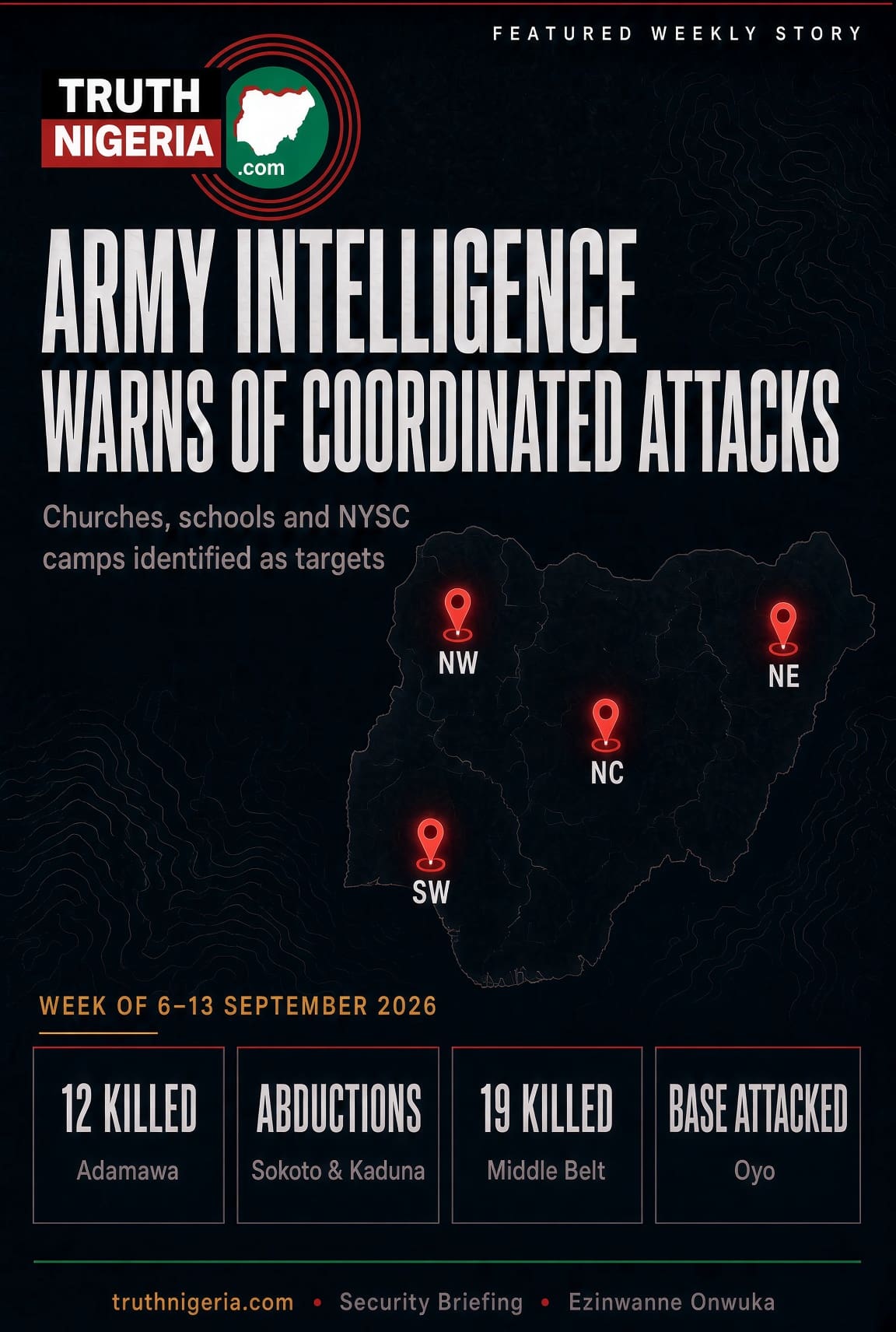
Nigeria, Mali and Togo have all reported or enacted new security measures amid separate episodes of militant and terrorist violence. The strongest immediate concern is Nigeria, where police and army warnings identify schools, worship centres, NYSC camps and other public sites as potential targets, while the evidence does not yet establish a single campaign linking the three theatres.
Executive summary
The security picture has worsened across several West African theatres, but the reporting supports concurrent national crises rather than a confirmed region-wide operation. Nigeria has issued police and army warnings about suspected ISWAP reconnaissance, armed movements and attacks across multiple states. Mali's army suffered a severe reported setback at Dioura, followed by air-ground operations, although casualty estimates range from at least 50 to at least 80 soldiers. Togo has placed the Savanes region under a state of emergency and issued travel warnings for Kpendjal and Kpendjal Ouest. The main uncertainties concern Nigerian attack attribution, the Dioura death toll and whether any operational link exists among JNIM, suspected ISWAP members and attackers in northern Togo.
Change from previous assessment
The assessment has broadened since 14 September. The prior brief centred on the reported Operation HADIN KAI strike at Tumbunma Baba in Borno State and found no substantiated region-wide pattern. This brief adds reported Nigerian warnings and attacks across multiple states, a major reported attack and counter-operation at Dioura in Mali, and Togo's state of emergency and travel warnings. Confidence is higher that West Africa faces several concurrent security pressures, but remains lower for casualty totals, attribution and cross-border coordination. The prior brief's Patria line is retired because the current evidence set does not address it.
Key judgments
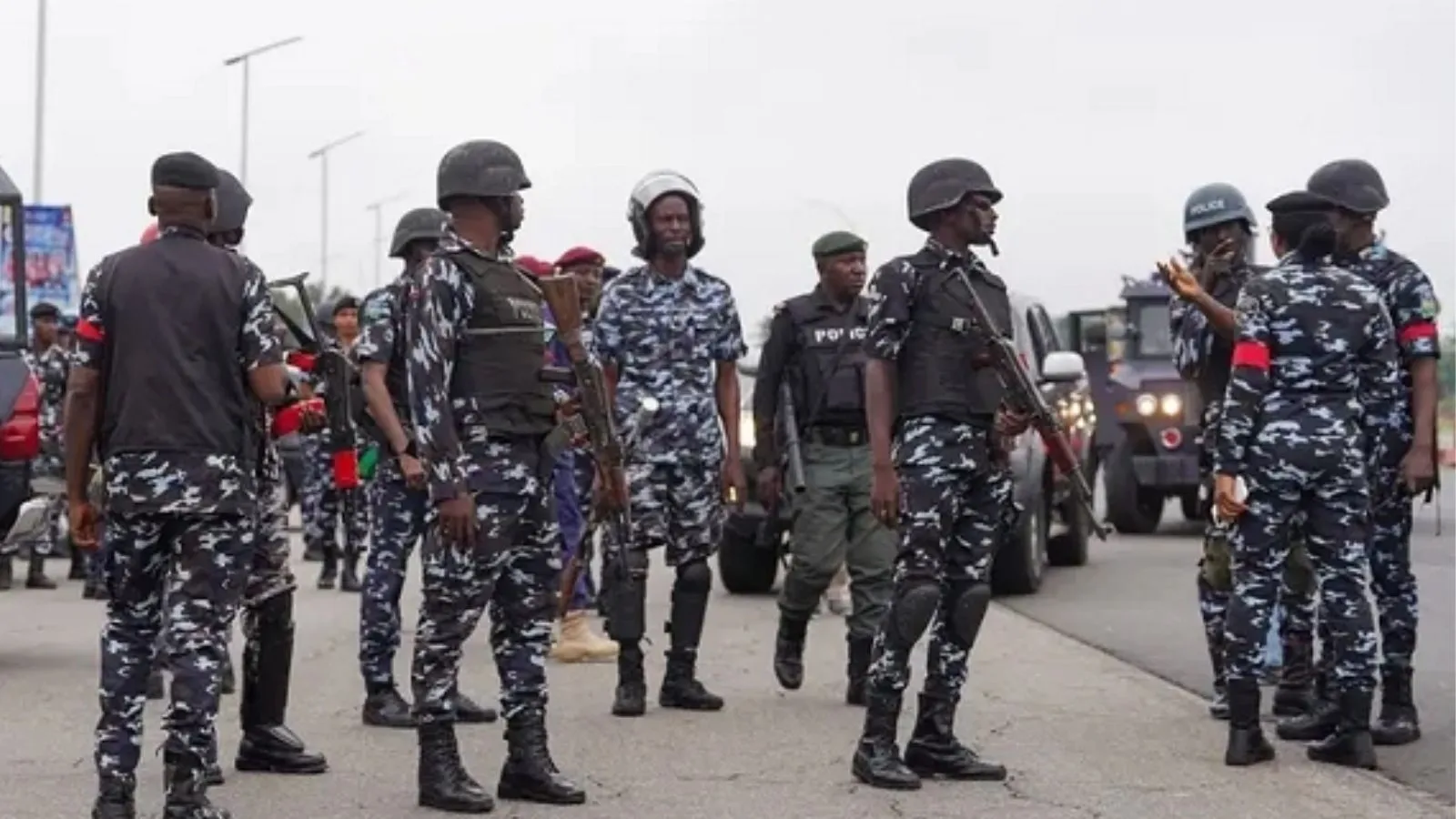
- Nigerian authorities very likely assess an elevated near-term threat to schools, worship centres, NYSC camps and other vulnerable sites. The Nigerian Police Force's 13 September wireless warning, the Nigerian Army's 9 September alert, reported reconnaissance by suspected ISWAP members and local collaborators, and the tracked movement from Katsina through Kaduna towards Plateau State support that assessment. This remains a reported warning rather than independent confirmation of attack preparations. Confidence is medium because the alert date differs between reports, the police have not issued a separate public statement, and much of the supporting detail comes through media reporting. (Confidence: medium · REPORTED)
- I&W: Confirm if the Nigerian Police Force or Nigerian Army names a target, date or operational area, or reports an interdiction tied to movement from Katsina through Kaduna towards Plateau State. (0-14 days)
- I&W: Break if official Nigerian reporting withdraws the warning or states that no corroborated intelligence supports the reported threat to public facilities. (0-14 days)
- Nigeria likely faces a geographically dispersed security crisis rather than violence confined to one locality. Reports describe at least 35 people killed and more than 70 abducted across Adamawa, Sokoto, Kaduna, Benue and Niger States, alongside separate incidents in Oyo, Kaduna, Adamawa and Sokoto involving suspected terrorists, bandits, a Fulani ethnic militia and unidentified attackers. The actor mix and inconsistent reporting prevent attribution to one organisation. Confidence is medium because the incident tally and most individual cases rely on local-media reporting, including a disputed account of a suspected Nigerian Air Force strike in Niger State. (Confidence: medium · ASSESSED)
- I&W: Confirm if new attacks are recorded in at least two of Adamawa, Sokoto, Kaduna, Benue, Niger and Oyo States, with official security responses identifying separate armed actors or methods. (0-30 days)
- I&W: Break if official Nigerian investigations state that the reported incidents were duplicate accounts, materially misattributed or unrelated to armed violence. (0-30 days)
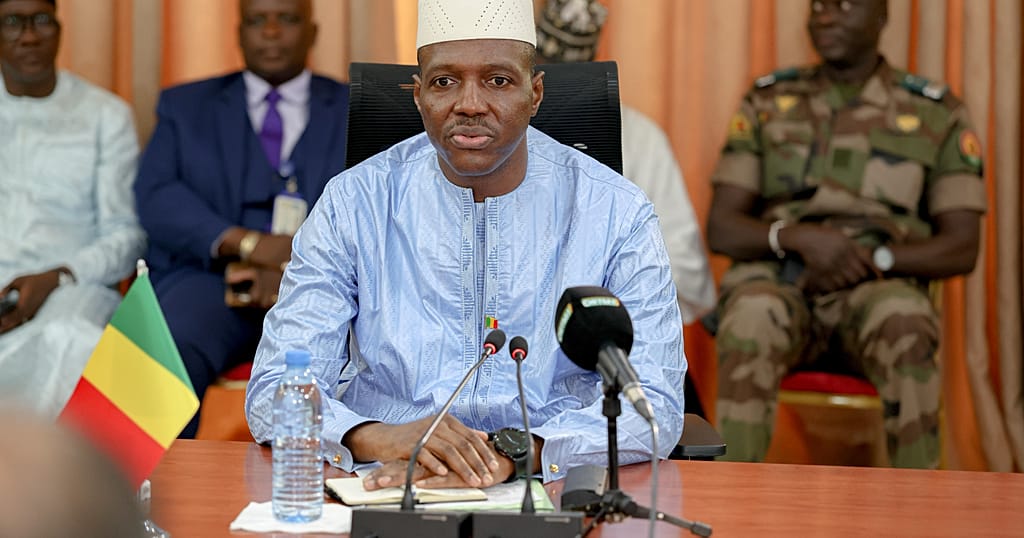
- Mali's army very likely suffered a severe operational setback at Dioura in the Mopti region, followed by a counter-operation. Reporting places the 10 September attack at at least 50 soldiers and five Russian Africa Corps paramilitaries killed, with several dozen soldiers taken prisoner, while JNIM claimed control of the barracks and Mali's army reported air-ground operations on 13 September. The death toll remains unresolved, with other accounts citing 60 to 80 or at least 80 soldiers. Confidence is medium because the scale of the loss is supported by multiple reports, but casualty figures, the extent of JNIM control and the claim of responsibility remain contested. (Confidence: medium · ASSESSED)
- I&W: Confirm if Malian authorities or independent reporting verifies that the Dioura barracks was overrun or lost, confirms prisoners, or raises the confirmed death toll above 50. (0-14 days)
- I&W: Break if Mali's army provides a substantiated status report showing that it retained the barracks and that the reported mass casualties and prisoner losses were materially overstated. (0-14 days)
- Togo likely will sustain restrictive security measures in the Savanes region as authorities respond to persistent violence along the Burkina Faso border. The government has declared a state of emergency, while travel guidance specifically discourages travel to Kpendjal and Kpendjal Ouest and onward travel to Burkina Faso. The reported pattern includes repeated attacks on Togolese security forces, civilian casualties since 2022 and kidnappings since 2023. Confidence is medium because the current reporting on the emergency and travel restrictions comes through a company statement rather than a directly cited government notice. (Confidence: medium · ASSESSED)
- I&W: Confirm if Togo extends the state of emergency, adds movement restrictions in Kpendjal or Kpendjal Ouest, or repeats the warning against onward travel to Burkina Faso. (0-14 days)
- I&W: Break if the Togo government formally lifts the emergency and withdraws the specific travel warnings without reporting a replacement security measure. (1-3 months)
- It is unlikely that the current reporting establishes operational coordination among JNIM in Mali, suspected ISWAP members in Nigeria and the attackers reported in northern Togo. The accounts identify different actors, locations and attack patterns, and provide no common plan, command link or shared target. Confidence is low because the absence of a reported link is not proof that no link exists, and the relevant reporting is incomplete. (Confidence: low · ASSESSED)
- I&W: Confirm if credible reporting identifies a common command structure, shared planning or coordinated timing linking JNIM, suspected ISWAP members and attackers in northern Togo. (1-3 months)
- I&W: Break if official investigations attribute the Nigerian, Malian and Togolese incidents to separate actors with no operational relationship. (1-3 months)
Outlook & scenarios
National containment and localised countermeasures (50%)
Nigerian police and army measures remain focused on schools, worship centres, NYSC camps, borders and the Katsina-Kaduna-Plateau corridor. Togo maintains its Savanes emergency measures, while Mali continues air-ground operations around Dioura. Violence remains localised and no coordinated attack on a Nigerian public facility is confirmed.
Sustained multi-theatre attrition (35%)
Further attacks occur in at least two Nigerian states, northern Togo experiences another security incident, and Mali faces additional pressure around Mopti or other contested positions. Authorities respond with tighter access controls, patrols and movement restrictions, while casualty and attribution reporting remains contested.
High-impact attack on a Nigerian public facility (12%)
Suspected ISWAP members and local collaborators carry out a coordinated attack against a school, worship centre, NYSC camp or other public facility in Nigeria. The event triggers a wider police and army security response. This is a low-probability, high-impact wildcard, and it does not require proven operational coordination with JNIM or attackers in Togo.
Recommendations
- For the next 14 days, prioritise collection on the Nigerian warning: obtain the underlying 9 September Nigerian Army alert and 13 September police communication, verify the alert date, and track activity along the Katsina-Kaduna-Plateau route.
- Maintain a separate incident ledger for Adamawa, Sokoto, Kaduna, Benue, Niger and Oyo States. Record actor attribution, casualty figures and abductions separately rather than aggregating all cases as jihadist attacks.
- Use 50 soldiers as the conservative Dioura casualty baseline until Malian authorities or independent reporting resolve the 50-to-80 range. Track the status of the barracks, reported prisoners and the results of Mali's air-ground operations.
- Monitor implementation of Togo's state of emergency in Kpendjal and Kpendjal Ouest, including any new movement restrictions or changes to the warning against onward travel to Burkina Faso.
- Do not infer a regional command structure from simultaneous violence. Require evidence of shared planning, communications or coordinated timing before linking JNIM, suspected ISWAP members and attackers in northern Togo.
- Keep Burkina Faso's ADCT development reporting separate from the security trendline. Verify the 12 September itinerary before using it for geographic exposure mapping, because the supplied accounts place the visit in different regions.
Confidence & uncertainty
Overall confidence is high because seven usable sources include official government reporting and major-media accounts that corroborate the existence of Nigerian security warnings, the Dioura attack and subsequent Malian operations, and Togo's emergency measures. Official and major-media sourcing supports the core developments, while local-media and company-statement reporting supplies much of the peripheral detail. The main uncertainties concern the precise Nigerian attack intent, the date of the police alert, the Dioura death toll and the attribution or operational linkage of attacks.
Intelligence gaps
- [EEI 1.4 · PARTIAL] Humanitarian indicators of imminent threat to civilians: sudden internal displacement flows or mass movements within 72 hours, shelter/IDP site openings, and major road closures affecting civilian evacuation routes. Recommended collection: humanitarian/NGO
- [EEI 2.1 · UNCOVERED] Reports or imagery confirming weapons and materiel holdings: number and types of heavy weapons observed or seized (mortars, artillery, technicals, IED caches, MANPADS), locations of caches, and recent rearmament deliveries. Recommended collection: imagery/HUMINT
- [EEI 2.2 · UNCOVERED] Active recruitment and propaganda indicators: new recruitment messages/accounts, numbers of claimed/new recruits by region, youth/ethnic group targeting, and physical recruitment events or forced conscriptions. Recommended collection: social_media/HUMINT
- [EEI 2.3 · UNCOVERED] Cross-border operational indicators: seizures or sightings of convoys crossing borders, capture/abandonment of border posts, patterns of fighters moving between neighboring countries, and use of transnational smuggling routes. Recommended collection: border_patrol/satellite
- [EEI 2.4 · UNCOVERED] Financing and logistics flows that sustain operations: recent seizures of cash/drugs/minerals, transactions or remittances linked to identified networks, and commercial transport companies or ports repeatedly used for shipments to insurgent-held areas. Recommended collection: financial/customs
- [EEI 3.1 · PARTIAL] Force posture and sustainment: foreign and host-nation troop deployments (unit types, strength estimates, bases used), changes in airbase activity (sortie rates, aircraft types, times), and frequency of logistics convoys or resupply flights. Recommended collection: diplomatic/military_reporting/satellite
- [EEI 3.3 · UNCOVERED] Critical sustainment vulnerabilities: reported ammunition/fuel shortages, road/bridge interdictions affecting supply lines, strikes on logistics hubs, and closure rates of key supply routes. Recommended collection: logistics/imagery
- [EEI 3.4 · PARTIAL] Political and legal decisions influencing operations: government decrees (states of emergency, mobilization orders), approved cross-border operations or foreign troop agreements, and public statements altering rules of engagement. Recommended collection: diplomatic/government
Cited sources
[1] TruthNigeria · Terrorist Attacks Surge Across Nigeria as Army Issues Red Alert for Coordinated Strikes - Truth Nigeria (D) · Mon Sep 14 2026 16:09:35 GMT+0000 (Coordinated Universal Time) · sha256:668e7e7bb5a2 [2] Pulse Nigeria (pulse.ng) · Police issue nationwide alert over possible attacks on schools, churches and NYSC camps (B) · Mon Sep 14 2026 12:48:18 GMT+0000 (Coordinated Universal Time) · sha256:72601748cdf3 [3] Intel Region · Nigerian police issue nationwide alert over planned terrorist attacks on schools, churches and NYSC camps | Intel Region (E) · Mon Sep 14 2026 15:49:18 GMT+0000 (Coordinated Universal Time) · sha256:ed89aedc527d [4] Africanews · At least 50 soldiers killed in jihadist attack on Malian army base (A) · Mon Sep 14 2026 15:24:34 GMT+0000 (Coordinated Universal Time) · sha256:712a409bbfca [5] buch-dein-visum.de · Togo: Safety Advice Updated (B) · Mon Sep 14 2026 16:01:23 GMT+0000 (Coordinated Universal Time) · sha256:ff863b33f402
Source content hashes were computed at collection time; the cited text is preserved unmodified for the life of this product.
TLP:CLEAR