TLP:CLEAR · Disclosure is not limited.
Iran-US Standoff: Hormuz Risk and Nuclear Talks Remain Unresolved
Time window: Last 1 day · Audience: General analyst · Type: Situation report · DTG: 2026-11-21 12:25Z · Overall confidence: HIGH
BLUF
Shipping near Khasab remains exposed to attack, while US-Iran talks are stalled over Iran’s enriched uranium stockpile and the Strait of Hormuz. A further US strike on Iran by 5 December is a roughly even chance; the attacker in the latest reported tanker incident and the IRGC’s claimed drone shoot-downs remain unverified.
Executive summary
Reporting on 20 and 21 November centres on maritime incidents near Khasab, the Strait of Hormuz and stalled US-Iran negotiations. UKMTO reported that an outbound tanker was hit by an unknown projectile near Khasab; other reporting differs on the incident’s date and distance from shore. UKMTO also advises caution, while weekly Strait traffic remains well below pre-conflict levels. Washington and Tehran continue exchanging messages through mediators, but disagree over the fate of Iran’s enriched uranium. Separately, the IAEA safeguards picture remains unresolved, with reported gaps in access and knowledge of Iran’s nuclear material. The IRGC claimed it downed US MQ-9 and MQ-1 drones, but the claims are not independently confirmed in the available reporting.
Change from previous assessment
The prior brief reported an unverified IRGC claim that a US MQ-9 had been downed; this update adds a separate IRGC claim involving an MQ-1 over Qeshm Island, also unverified. The current reporting gives more detail on tanker attacks near Khasab, including a conflict over the latest incident’s date and distance, and adds a clearer account of the uranium dispute blocking US-Iran talks. The safeguards gap remains a concern, now framed with specific reported issues at Isfahan and over the high-enriched uranium stockpile. On strike risk, the prior brief assessed a further US strike by 5 December as a roughly even chance. This assessment holds at roughly even chance because Trump’s stated delay conflicts with reporting of UK preparations and lobbying. Prior forecasts of a US strike by 20 November and US acknowledgement of a Qeshm strike by that date both resolved yes. Those outcomes do not establish that another strike will follow.
Key judgments
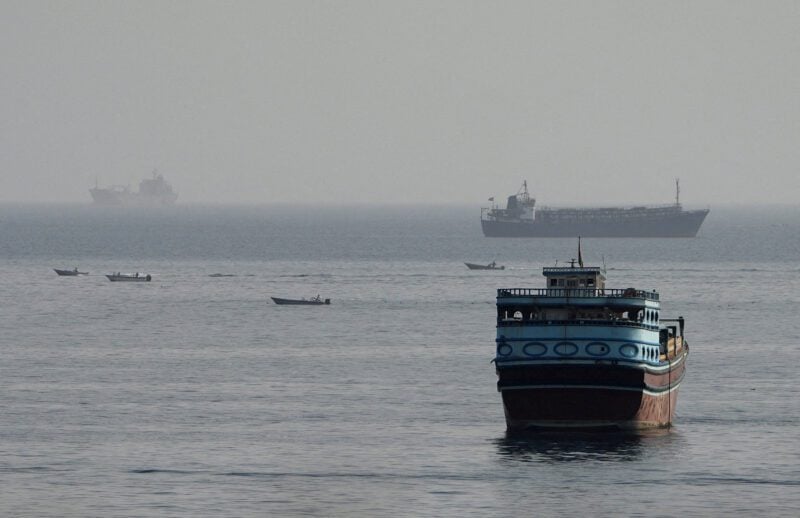
- Commercial shipping in the Strait of Hormuz and near Khasab is likely to remain hazardous over the next 14 days, but a full closure of the Strait is not established. UKMTO reported an outbound tanker hit by an unknown projectile 11 nautical miles north of Khasab; trade reporting places a tanker strike and fire on 20 November, about eight nautical miles north of Khasab. The accounts may concern the same incident, but the date and distance differ. Reporting also describes four tankers struck within 13 nautical miles of Khasab over three days, including TARA GAS, which was hit twice. UKMTO’s reported transit figures remain about 65 per cent below pre-conflict levels. Iran’s statements on reopening the Strait and breaking the US blockade give conflicting indications of its operating status. (Confidence: medium · ASSESSED)
- I&W: Two or more additional UKMTO incident alerts for vessels near Khasab or in the Strait of Hormuz would confirm continued elevated danger. (0-14 days)
- I&W: A weekly UKMTO transit count returning to within 20 per cent of pre-conflict levels, with no new incident alert near Khasab, would weaken this judgment. (0-1 month)
- US-Iran negotiations are likely to remain deadlocked over enriched uranium through 21 December, despite continued message exchanges through mediators. A high-placed source cited in reporting described the indirect talks as stalled; the US demands a plan to remove Iran’s enriched uranium and guarantees against renewed enrichment, while Abbas Araghchi has said Iran will not transfer its 60 per cent enriched uranium abroad. Donald Trump said Iran wants a deal but not one acceptable to him, while Araghchi said Tehran seeks an agreement that prevents another war. The parties’ public positions leave little evidence of an agreed basis for a near-term settlement. (Confidence: medium · ASSESSED)
- I&W: A publicly announced negotiating round that produces written terms on the enriched uranium stockpile would break the deadlock assessment. (0-1 month)
- I&W: Further public statements maintaining the US demand to remove enriched uranium and Iran’s refusal to transfer it would confirm continued deadlock. (0-1 month)
- The IAEA’s verification gap in Iran is very likely to persist over the next three months. The reported gap includes loss of continuity of knowledge over Iran’s previously verified high-enriched uranium stockpile, lack of access to the Isfahan enrichment plant and inability to conclude that declared nuclear material has not been diverted. These concerns appear in an official joint statement drawing on the IAEA’s safeguards reporting. The forecast of persistence is an assessment, not a direct report of what Iran will do. (Confidence: medium · ASSESSED)
- I&W: IAEA confirmation of access to the Isfahan enrichment plant and a fresh accounting of the previously verified high-enriched uranium stockpile would break this judgment. (1-3 months)
- I&W: A subsequent IAEA report that again records no requested access or inventory information would confirm it. (1-3 months)
- A further US strike on Iran by 5 December is a roughly even chance. Trump said he would defer a decision on next steps until the new year, which weighs against an imminent strike. UK reporting says senior officials have been preparing for renewed US action and that the UK and Gulf allies are lobbying Washington to prevent new strikes. These competing signals, and the limited detail available on the UK assessments, support a medium-confidence estimate rather than a stronger call. (Confidence: medium · ASSESSED)
- I&W: A White House announcement of renewed military action or a verified US strike on Iranian territory would confirm the assessment. (0-14 days)
- I&W: No US strike by 5 December, alongside a renewed public statement that Trump will defer a decision until the new year, would weaken the assessment. (0-14 days)
- The IRGC’s claims that it downed a US MQ-9 over the Strait of Hormuz and a US MQ-1 over Qeshm Island remain unverified, and neither loss is independently established in the available reporting. The reports relay IRGC statements; the evidence provided does not confirm the losses or the claimed use of a new air-defence system. Confidence is low because the claims lack independent corroboration. (Confidence: low · ASSESSED)
- I&W: US acknowledgement of a drone loss or independently verified wreckage attributable to either platform would confirm a loss. (0-14 days)
- I&W: A US statement that both aircraft returned safely, supported by flight or operational records, would break the claim that either was downed. (0-14 days)
Outlook & scenarios
Armed stalemate and persistent shipping risk (45%)
Trump’s stated delay in deciding on next steps holds through the new year. US-Iran messages continue through mediators, but uranium terms remain unresolved. Tanker incidents and depressed Strait of Hormuz traffic sustain risk to commercial shipping without an agreed, verified closure.
Renewed limited strikes (30%)
The US resumes strikes against Iran before 5 December, with Israel involved in the wider military campaign. Iran responds with military action and pressure on regional shipping. The UK and Gulf allies continue pressing Washington to avoid further strikes.
Conditional diplomatic pause and Strait reopening (20%)
Washington and Tehran reach terms for a limited pause, with Iran reopening the Strait of Hormuz after US commitments. The uranium dispute remains unresolved, so a Strait arrangement does not itself establish a comprehensive nuclear agreement.
Full-scale war and regional spillover (5%)
The US and Israel launch a full-scale campaign against Iran. Iran retaliates in the Gulf, while the Strait of Hormuz remains under pressure. This low-probability, high-impact scenario carries the greatest risk of prolonged disruption to energy flows and wider regional security.
Recommendations
- Use UKMTO alerts as the baseline for maritime incident reporting. Keep the 20 and 21 November tanker accounts separate until the date, distance and incident identity are reconciled.
- Do not attribute the tanker strike to the IRGC Navy or report the MQ-9 and MQ-1 losses as confirmed without independent corroboration.
- Track UKMTO weekly transit counts and incident notices near Khasab alongside Iranian statements on reopening the Strait. Report the difference between conditional offers and claims that the blockade is ineffective.
- Monitor IAEA reporting for access to Isfahan and updated accounting of Iran’s high-enriched uranium stockpile. Treat a diplomatic statement as distinct from verified safeguards access.
- Maintain a separate watch for a US decision on renewed strikes before 5 December. Weigh Trump’s stated delay against the reported UK assessment and lobbying activity rather than treating either signal as decisive.
Confidence & uncertainty
Overall confidence is high in the underlying reported events because the material includes UKMTO reporting, an official joint statement on IAEA safeguards, and reporting from major media and maritime trade sources. Confidence is lower for forecasts and disputed claims: the tanker accounts differ on date and distance, the attacker is unidentified, Iran’s statements on the Strait conflict, and the IRGC drone claims lack independent confirmation. The high headline level reflects corroboration of the broader situation, not equal confidence in every judgment.
Alternative analysis (red cell)
The negotiations may be better characterized as strained and intermittently stalled rather than durably deadlocked. The single-source deadlock report (f665e27e-a580-4d2a-a335-4ec1a3dd2e22) is offset by continuing mediator exchanges (b536cd15-a084-4275-8cce-2f9ec3864895) and Iranian statements that a fair solution remains possible (07ae7877-f36f-47cd-aabf-38ac68783505). On the available evidence, a near-term settlement remains unlikely, but persistence of deadlock through 21 December is not clearly the most defensible reading.
Intelligence gaps
- [EEI 1.1 · UNCOVERED] Observed repositioning, sustained increases, or new forward basing of Iranian conventional or IRGC forces (armored units, missile batteries, aircraft, naval vessels) toward borders or regional launch points. Recommended collection: IMINT/satellite
- [EEI 1.2 · PARTIAL] Hezbollah or other Iran-aligned proxy forces conducting mass mobilization, visible rocket/artillery emplacements, cross-border firing incidents, or preparations for cross-border operations from Lebanon, Syria, Iraq or Yemen. Recommended collection: HUMINT/ground ISR
- [EEI 1.4 · UNCOVERED] Interdicted or observed shipments (air, sea, land manifests, seizures, satellite imagery of transfers) of advanced weapons or missile components from Iran toward proxy groups or forward staging points. Recommended collection: maritime/AIS
- [EEI 2.1 · UNCOVERED] Satellite or on-the-ground imagery showing fires, damage, or operational shutdown at major oil export facilities, refineries, storage terminals, or key pipeline infrastructure in the Gulf and Red Sea. Recommended collection: IMINT/satellite
- [EEI 2.4 · UNCOVERED] Rapid increases in war-risk insurance premiums for Middle East routes, shipping company advisories to avoid region, or major charter cancellations tied to the conflict. Recommended collection: financial/open-source
- [EEI 3.1 · UNCOVERED] Movement/arrival of major foreign military assets into the region: US carrier strike groups, amphibious ready groups, strategic bomber flights, Russian/Chinese naval taskings, or allied expeditionary units (visible in AIS, NOTAMs, satellite imagery, official releases). Recommended collection: IMINT/satellite
- [EEI 3.2 · UNCOVERED] Official expedited arms transfers, basing/overflight agreements, or declarations of operational support (formal government announcements, defense ministry releases, logistics flight manifests). Recommended collection: open-source/diplomatic
- [EEI 3.3 · UNCOVERED] Embassy evacuations, large-scale personnel movements, issuance of government travel bans/advisories, or multinational security alerts affecting foreign nationals and diplomatic posture in the region. Recommended collection: diplomatic/open-source
Red cell review: PARTIAL DISSENT
TLP:CLEAR