TLP:CLEAR · Disclosure is not limited.
US-Iran Military Exchanges and Persian Gulf Shipping Risks
Time window: Last 1 day · Audience: General analyst · Type: Situation report · DTG: 2026-11-21 12:23Z · Overall confidence: HIGH
BLUF
Further attacks on commercial shipping near the Strait of Hormuz are likely over the next 14 days, with traffic already about 65% below pre-conflict levels. The US has widened blockade enforcement to cover ships receiving Iranian cargo at sea; reports of IRGC drone shoot-downs remain disputed, and US-Iran talks are deadlocked over enriched uranium.
Executive summary
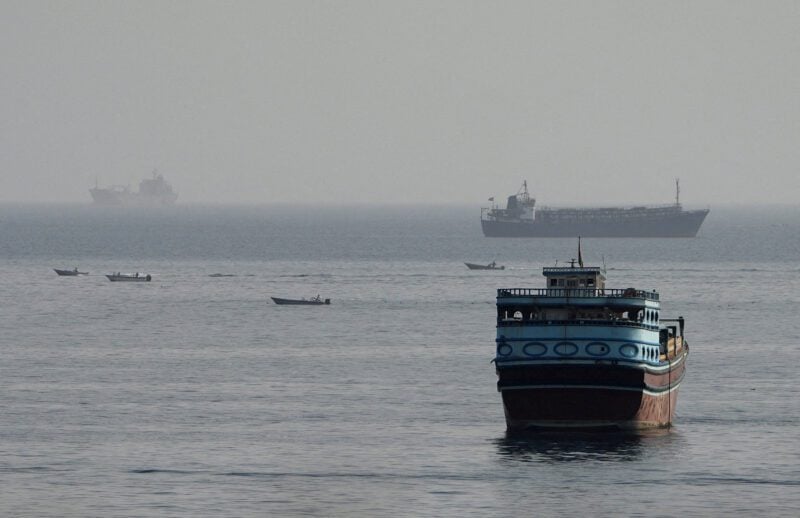
Recent reporting describes repeated attacks on tankers near Khasab, Oman, including strikes on TARA GAS and NAVIG8 MESSI on 16 and 17 November. A further tanker strike near Khasab was reported on 20 November, but accounts differ on the date and distance from shore; the attacker remains unidentified. UKMTO reported 263 Strait of Hormuz transits in the preceding seven days, about 65% below pre-conflict levels, and JMIC assessed the threat to commercial shipping as severe. CENTCOM has warned it may stop, board, divert or capture ships receiving Iranian cargo through ship-to-ship transfers. On 21 November, the IRGC claimed to have downed US drones over the Strait, but reporting conflicts on the number and model. Indirect US-Iran negotiations are reported to be deadlocked over Iran's enriched uranium stockpile.
Change from previous assessment
Since the 20 November brief, reporting has added tanker attacks near Khasab, a ship-to-ship transfer of Iranian crude from Olym to Hao Fan, CENTCOM's expanded enforcement warning for vessels receiving Iranian cargo, and conflicting IRGC claims about US drone shoot-downs. A new report describes US-Iran talks as deadlocked over enriched uranium. The assessment of near-term shipping risk is reinforced, but attacker attribution and drone details remain unresolved. Prior outcomes show that the earlier 0.50 forecast of US airstrikes, the 0.80 forecast of a Qeshm Island strike and the 0.65 forecast of a direct Iranian attack on US personnel were correct. The 0.65 forecast that Iran would admit IAEA inspectors was wrong; the 0.30 forecast of a binding agreement reopening the Strait of Hormuz was correctly below even odds. Initial confidence in this brief is medium for specific escalation pathways, given conflicting incident details and single-source elements.
Key judgments
- Further deliberate attacks on commercial shipping near the Strait of Hormuz are likely over the next 14 days, while vessel traffic remains heavily reduced rather than stopped. UKMTO reported six verified attacks through 18 November and 263 transits in the preceding seven days, about 65% below pre-conflict levels. Reporting also describes four tankers hit within 13 nautical miles of Khasab over three days, including TARA GAS, which was struck twice. Reports of a further strike near Khasab disagree on its date and exact location, and the attacker has not been identified. (Confidence: medium · ASSESSED)
- I&W: Confirm: UKMTO records another verified attack on a commercial vessel in the Strait of Hormuz or near Khasab. (0-14 days)
- I&W: Break: UKMTO records no further verified attacks and reports Strait of Hormuz transit volumes rising towards pre-conflict levels. (0-14 days)
- There is a roughly even chance of a direct US enforcement encounter involving a ship-to-ship transfer of Iranian crude within 30 days. On 17 November, the tankers Olym and Hao Fan transferred Iranian crude in the Persian Gulf; the cargo was reported at about 200,000 barrels. CENTCOM has warned that ships receiving Iranian cargo at sea can be stopped, boarded, diverted or captured, and that non-compliance can bring enforcement action, including force. The cargo's commercial viability as an export remains disputed, and Hossein Mohebi, the IRGC spokesman, has threatened a harder Iranian response if US forces attack Iranian vessels. (Confidence: medium · ASSESSED)
- I&W: Confirm: CENTCOM reports stopping, boarding, diverting or capturing a named vessel carrying Iranian cargo transferred at sea. (0-30 days)
- I&W: Break: CENTCOM suspends or narrows its ship-to-ship transfer enforcement notice, or the Olym-Hao Fan cargo completes an export voyage without interception. (0-30 days)
- Reports that the IRGC downed US drones over the Strait of Hormuz on 21 November do not establish how many drones were lost or what type they were. Available accounts conflict: one reports two drones, while others describe an MQ-9 or MQ-1 and give different cumulative totals. The claims are attributed to Iranian forces, and the supplied reporting does not include US confirmation. (Confidence: low · REPORTED)
- I&W: Confirm: CENTCOM or the US military acknowledges a drone loss over the Strait of Hormuz and identifies its model. (0-14 days)
- I&W: Break: the IRGC withdraws or materially revises its claim, or a US statement explicitly denies a drone loss in the reported incident. (0-14 days)
- US-Iran negotiations are likely to remain deadlocked over enriched uranium for the next month. A report citing a high-placed source says indirect talks have stalled because Washington seeks a plan to liquidate Iran's enriched uranium stockpile and written guarantees against renewed enrichment, while Iran refuses to transfer its stockpile abroad. Abbas Araghchi also ruled out transferring Iran's 60% enriched uranium abroad. The deadlock report relies on a single-source account, but the stated negotiating positions are also reflected in separate reporting. (Confidence: medium · ASSESSED)
- I&W: Confirm: US or Iranian officials restate that no agreement is possible without opposing terms on uranium stockpiles or future enrichment. (0-30 days)
- I&W: Break: the US and Iran announce an agreed uranium arrangement or a new negotiating round with a mutually accepted agenda. (0-30 days)
Outlook & scenarios
Continued maritime pressure without a major expansion of combat (55%)
The US maintains its blockade and enforces its expanded rules against ship-to-ship transfers. Iran continues to contest the blockade, while commercial traffic remains far below pre-conflict levels and further vessel attacks occur. The parties avoid a sustained expansion of direct strikes.
Negotiations resume with limited concessions (25%)
Qatar or other mediators arrange renewed indirect talks. The US and Iran pursue a limited arrangement on shipping or uranium without resolving their disagreement over transferring enriched uranium abroad, the blockade or sanctions.
A blockade encounter prompts a wider exchange (15%)
US forces stop, board or capture a vessel linked to Iranian oil transfers. Iran responds against US forces or shipping, moving the confrontation beyond the current maritime enforcement pattern. The conflicting drone reports remain unresolved or are followed by further military claims.
Regional energy infrastructure is targeted (5%)
Low-probability, high-impact wildcard: a US enforcement action against an Iranian vessel is followed by an attack on regional energy infrastructure. Fars commentary has threatened such retaliation, but the supplied reporting provides no evidence of operational preparation.
Recommendations
- Maintain a single incident log for the Strait of Hormuz and waters near Khasab. Reconcile UKMTO timestamps, vessel identities, coordinates and attack counts before treating reports as separate incidents.
- Keep attacker attribution separate from incident confirmation. Do not attribute tanker strikes near Khasab to the IRGC without corroboration beyond social-media claims.
- Track CENTCOM notices and confirmed enforcement actions against named vessels receiving Iranian cargo at sea. Flag any use of force or Iranian response as a potential change in escalation risk.
- Seek US confirmation and independent corroboration of the IRGC drone claims before using the reported number or aircraft model in operational assessments.
- Monitor public statements and mediator announcements for movement on uranium stockpiles, future enrichment, sanctions, the blockade and Strait of Hormuz access. These are the reported points dividing Washington and Tehran.
Confidence & uncertainty
Overall confidence is high for the existence of severe maritime disruption and expanded US blockade enforcement. UKMTO's transit and verified-attack reporting is consistent with vessel-specific maritime reporting, while CENTCOM's enforcement notices provide direct confirmation of the US position. Confidence is lower on the attacker in the tanker incidents and on the number and type of drones reportedly downed. The account of a negotiating deadlock relies partly on a report citing a high-placed source.
Intelligence gaps
- [EEI 1.1 · UNCOVERED] Concentrations or unusual movements of IRGC-Navy fast attack craft, small boat swarms, or escort vessels within 200 km of US/allied ships, including approach distances and formation changes. Recommended collection: maritime/AIS
- [EEI 1.2 · UNCOVERED] Detected pre-launch activity at coastal missile or rocket batteries (vehicle dispersal, fuel/warhead handling, radars powering up, transport erector launchers moving to firing positions). Recommended collection: imagery/signals
- [EEI 1.3 · UNCOVERED] Increased launch/arming/positioning of armed UAVs (MALE/loitering munitions) or tactical aircraft at Iranian coastal bases with sortie generation rates and munitions loadouts. Recommended collection: air/ADS-B/imagery
- [EEI 1.4 · UNCOVERED] Command-and-control indications of attack orders or elevated rules-of-engagement from IRGC/General Staff (intercepted communications, internal order messages, force-wide alert messages). Recommended collection: signals/human
- [EEI 2.2 · UNCOVERED] Issuance of formal orders, mobilization directives, travel restrictions, or official internal communications within IRGC/Armed Forces indicating escalation posture or stand-down. Recommended collection: human/diplomatic
- [EEI 2.3 · UNCOVERED] Directives, logistics movements, or communications from Iranian commanders to regional proxy militias (Houthis, Iraqi Shia militias, Lebanese groups) that change their threat posture or task them with specific operations. Recommended collection: signals/human
- [EEI 3.2 · UNCOVERED] Discovery or reporting of naval mines, unexploded ordnance, or damage to fixed maritime infrastructure (oil platforms, terminals, pipelines) with geolocated imagery or on-scene assessments. Recommended collection: imagery/open-source
- [EEI 3.3 · PARTIAL] Commercial indicators of disruption: sudden increases in war-risk insurance premiums for Gulf transits, vessel re-routing decisions, port throughput reductions, or charter cancellations for Gulf shipments. Recommended collection: financial/commercial
- [EEI 3.4 · UNCOVERED] Movements or posture changes of regional state navies/air forces (Saudi, UAE, Kuwait, Bahrain, UK) such as task group departures, airbase dispersals, or announced maritime patrols near choke points. Recommended collection: open-source/imagery
Red cell review: CONCUR WITH COMMENT
TLP:CLEAR