TLP:CLEAR · Disclosure is not limited.
Sudan Conflict Situation Report: Drone Harm and Kordofan Displacement
Time window: Last 7 days · Audience: General analyst · Type: Situation report · DTG: 2026-11-23 22:05Z · Overall confidence: HIGH
BLUF
Very likely, armed drones will remain a leading source of civilian harm in Sudan, while humanitarian needs remain acute. OCHA confirmed that a drone strike damaged a UN facility in Khartoum while staff were inside, but responsibility for the 22 November strikes and allegations of launches from Ethiopia remain unverified.
Executive summary
Between 16 and 23 November, reporting confirmed the impact of drone strikes in greater Khartoum and added UN Human Rights Office figures on civilian deaths across Sudan. The UN reported that close to three-quarters of civilians killed in 2026 were killed in drone strikes. OCHA reported 30.4 million people in need of humanitarian assistance; IOM figures put displacement at 8.6 million inside Sudan and 4.6 million abroad. In Kordofan, IOM recorded 383,252 people displaced over the year to 25 October, while a single social-media report said SPML/RSF forces took Qurdud Nyama on 23 November. Sudan and Ethiopia have closed each other's consulates amid mutual accusations, but the alleged Ethiopian origin of drones used in Khartoum remains unverified. Sudanese political and civil groups are scheduled to meet in Nyon from 25 to 28 November.
Change from previous assessment
The assessment of the 22 November Khartoum strikes is unchanged, with OCHA's confirmation that staff were inside the damaged UN facility strengthening confidence in the reported impact. This brief adds the UN Human Rights Office's 2026 civilian-death and drone-strike figures, a new IOM figure for displacement from Kordofan, the reported SPML/RSF capture of Qurdud Nyama, and the scheduled Nyon meeting. Confidence in the Ethiopian-launch allegation remains low because it rests on an army-source claim and conflicts with reporting that neither the SAF nor RSF officially commented on the attack's origins. The prior Blue Nile control judgement is not updated because this week's reporting does not establish current control there.
Key judgments
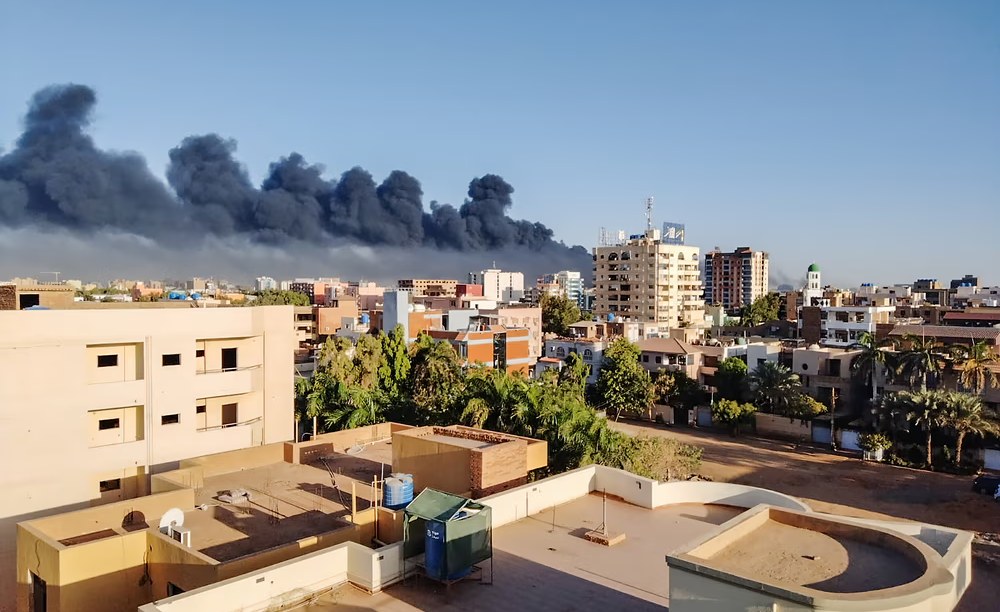
- Very likely, drone strikes in and around Khartoum on 22 November killed at least four people and damaged a UN building while staff were inside. Reports describe three family members killed and nine people wounded in Omdurman, and a ten-year-old child killed in a separate attack south of Khartoum. OCHA confirmed damage to the UN facility, but the available reporting does not establish who carried out the strikes. (Confidence: medium · REPORTED)
- I&W: Confirmation: OCHA or another UN agency releases incident details or imagery confirming damage to the facility and staff presence during the strike. (0-14 days)
- I&W: Break: OCHA or the UN corrects its account, stating that the building was not hit on 22 November or that staff were not inside. (0-14 days)
- Very likely, armed drones will remain a leading cause of civilian deaths in Sudan over the next month. The UN Human Rights Office reported that close to three-quarters of civilians killed in 2026 were killed in drone strikes, and documented strikes on markets, civilian vehicles, fuel sites and health facilities. Li Fung said both the SAF and RSF increasingly use drones. These figures do not identify responsibility for the overall civilian toll. (Confidence: medium · ASSESSED)
- I&W: Confirmation: a new UN Human Rights Office update attributes more than half of verified civilian deaths in its reporting period to drone strikes. (0-30 days)
- I&W: Break: a new UN Human Rights Office update attributes fewer than half of verified civilian deaths to drone strikes and reports a sustained decline in attacks on civilian sites. (0-30 days)
- Very likely, humanitarian needs will remain acute in Sudan over the next 1-3 months. OCHA reported 30.4 million people in need of assistance, and IOM reported 8.6 million internally displaced and 4.6 million who had fled abroad. A separate report put the number forced from their homes at more than 12 million, so the total varies by estimate and reporting basis. One in three hospitals was reported non-operational. (Confidence: medium · ASSESSED)
- I&W: Confirmation: a new OCHA assessment continues to report more than 30 million people in need or documents further reductions in humanitarian access or health services. (0-3 months)
- I&W: Break: OCHA issues a revised estimate below 20 million people in need and reports broad restoration of access to health services. (0-3 months)
- Likely, Kordofan will remain a source of displacement over the next 1-3 months, although the latest territorial claim is not independently verified. IOM recorded 383,252 people displaced from Kordofan between 25 October 2025 and 25 October 2026. A single social-media report said SPML/RSF forces took Qurdud Nyama, on the North and South Kordofan border, on 23 November. That report alone does not establish durable control. (Confidence: low · ASSESSED)
- I&W: Confirmation: IOM records new displacement from Kordofan, or independent geolocated reporting confirms SPML/RSF control of Qurdud Nyama. (0-30 days)
- I&W: Break: independent geolocated reporting shows SAF or allied forces control Qurdud Nyama and IOM reports no new displacement from Kordofan. (0-30 days)
- Unlikely, Sudan and Ethiopia will enter direct military confrontation in the next 1-3 months, despite a diplomatic rupture. Sudan and Ethiopia closed each other's consulates and expelled staff amid accusations of backing armed groups. A Sudanese army source alleged that the Khartoum drones were launched from Bahir Dar, but another report said neither the SAF nor RSF had officially commented on the attack or its origins. The launch allegation remains unverified, lowering confidence in this assessment. (Confidence: low · ASSESSED)
- I&W: Confirmation: no exchange of fire or independently verified cross-border strike is reported between Sudanese and Ethiopian forces. (1-3 months)
- I&W: Break: independent evidence confirms a drone launch from Bahir Dar, or reporting establishes a direct exchange of fire between Sudanese and Ethiopian forces. (0-3 months)
- Unlikely, the Nyon process meeting scheduled for 25-28 November will produce an immediate ceasefire agreement. The meeting is described as involving Sudanese political and civil groups, while neither the SAF nor RSF took part in the October Geneva consultative meeting. Abdel Fattah al-Burhan had rejected US and Quad ceasefire proposals on 8 November. The meeting's eventual attendance and outcomes remain unknown. (Confidence: low · ASSESSED)
- I&W: Confirmation: the meeting ends without an agreement or public ceasefire commitment from both the SAF and RSF. (25-28 November)
- I&W: Break: the SAF and RSF both attend or publicly endorse a ceasefire agreement arising from the Nyon meeting. (25-28 November)
Outlook & scenarios
Continued fighting and drone-driven civilian harm (65%)
The SAF and RSF continue fighting, with armed drones remaining a major threat to civilians and civilian infrastructure. Kordofan remains a displacement focus, while the reported capture of Qurdud Nyama remains contested or unverified.
Political engagement without an immediate ceasefire (27%)
The 25-28 November Nyon meeting produces further contact among Sudanese political and civil groups but no immediate ceasefire agreement involving the SAF and RSF. Humanitarian needs and drone-related risks persist.
Cross-border escalation involving Ethiopia (8%)
This low-probability, high-impact scenario follows independent confirmation of the alleged Bahir Dar launch or a direct exchange between Sudanese and Ethiopian forces. The existing consulate closures and mutual accusations provide a tense backdrop, but the drone-origin allegation remains unverified.
Recommendations
- In reporting on the 22 November Khartoum strikes, distinguish confirmed damage and casualties from attribution. Treat claims of RSF responsibility and launches from Ethiopia as unverified unless independently corroborated.
- Maintain a weekly civilian-harm tracker with the reported date, location, target type, deaths, injuries and attribution status for drone incidents. Keep the UN's January-October civilian-death figures separate from its January-June strike counts.
- Compare new IOM displacement updates with the existing Kordofan figure and seek independent geolocated confirmation before describing Qurdud Nyama as under durable SPML/RSF control.
- Review the Nyon meeting's attendance and final statements after 28 November. Count progress towards a ceasefire only if both the SAF and RSF publicly commit to one.
- Use the dates and definitions attached to OCHA and IOM figures in future products. Do not combine the different displacement estimates without explaining their differing bases.
Confidence & uncertainty
Overall confidence is high for the core developments because OCHA confirmed that a UN facility in Khartoum was hit while staff were inside, UN Human Rights Office reporting provides a broad account of civilian deaths and drone strikes, and OCHA and IOM provide current humanitarian and displacement estimates. Confidence is lower on responsibility for the Khartoum strikes, the alleged Ethiopian launch, and control claims in Kordofan. Displacement totals also vary by estimate and reporting basis.
Intelligence gaps
- [EEI 1.1 · PARTIAL] Observed concentrations and movement of armed units (size estimates, unit identifiers if visible) within X km of named towns/roads/airfields (e.g., El Fasher, Geneina, Nyala, Khartoum neighborhoods) including timestamps and direction of movement. Recommended collection: imagery/satellite
- [EEI 1.3 · PARTIAL] Reports or intercepts of orders, operational directives or public statements from RSF/SAF commanders indicating planned offensives, ceasefire acceptance/rejection, defensive postures or orders to withdraw from named locations. Recommended collection: signals/communications intercepts
- [EEI 1.4 · PARTIAL] Status of critical infrastructure and lines of communication: control or denial of named bridges, main highways (identify route numbers), airfields, fuel depots and telecommunication hubs and any reported sabotage/blockage incidents. Recommended collection: human intelligence/field reporting
- [EEI 2.1 · PARTIAL] Counts and locations of newly displaced persons arriving at formal sites, informal camps, border crossings or collective centers (daily/weekly arrivals, site coordinates), including demographics (women, children, elderly) where available. Recommended collection: humanitarian/UN OCHA reports
- [EEI 2.2 · UNCOVERED] Access impediments to humanitarian assistance: reported attacks on, blockages of, or denial of passage for named humanitarian convoys (dates, GPS locations, responsible actor if known) and closure status of specific routes. Recommended collection: human intelligence/field reporting
- [EEI 2.3 · PARTIAL] Functional status of medical infrastructure in named locations: number of operational hospitals/clinics, reported shortages of key medicines/blood, and hospital casualty/occupancy figures for the last 72 hours. Recommended collection: medical/health cluster reporting
- [EEI 3.1 · PARTIAL] Detection of flights, ships or overland convoys delivering military materiel or foreign personnel to named airfields, ports or border crossings (flight/IMO numbers, manifests if available, timestamps, route origin/destination). Recommended collection: air-traffic / maritime / border customs
- [EEI 3.2 · UNCOVERED] Imagery or on-the-ground confirmation of foreign military personnel or private military contractor bases/forward operating elements at specified coordinates or compounds, including vehicle/weapon types observed. Recommended collection: imagery/satellite
- [EEI 3.3 · PARTIAL] Financial and sanctions-relevant indicators: atypical large transfers, use of designated front companies, or shipments routed through third states linked to procurement of weapons or fuel for RSF or SAF (transaction dates, parties, amounts where obtainable). Recommended collection: financial intelligence
Red cell review: CONCUR WITH COMMENT
TLP:CLEAR